
Guide
Home Solar Panel Systems for Mobile & Manufactured Homes: 2026 Costs, Sizing & Tax Credit Update
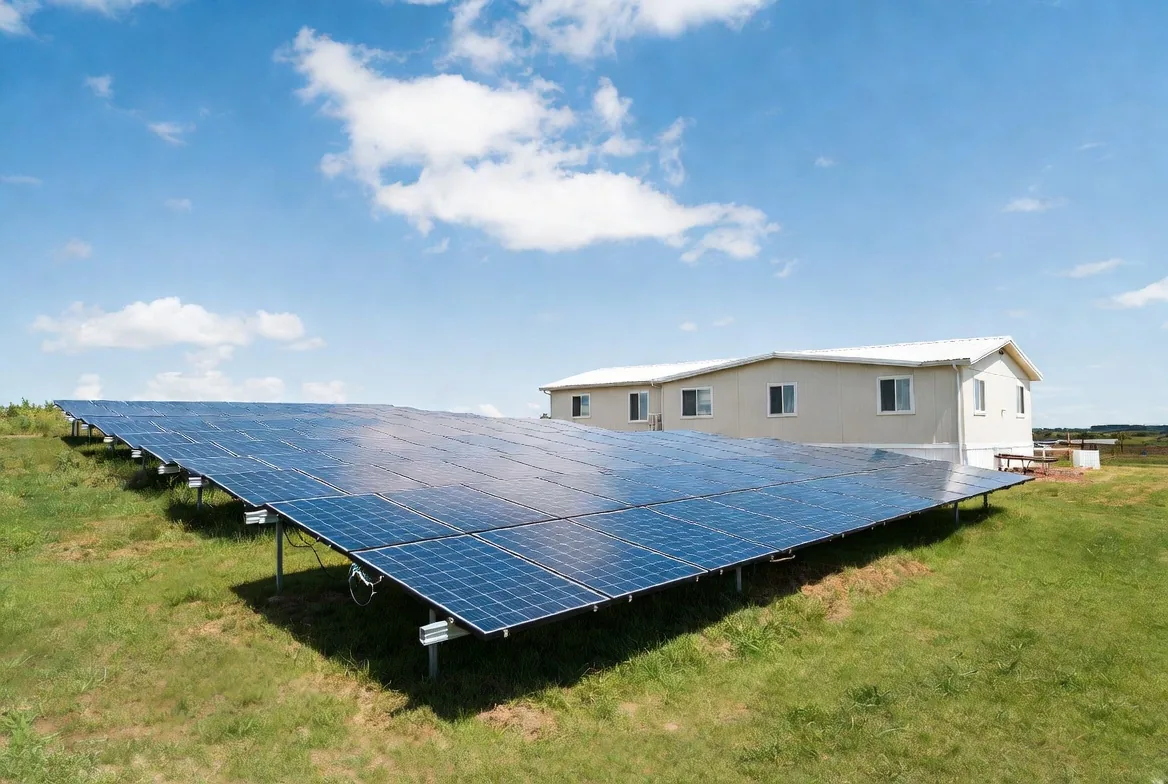
What a "home solar panel" system actually includes
When most people search for a home solar panel system, they picture the panels on the roof. In reality you're buying a small power plant made of several parts working together:
- Panels (modules) — typically 350-450 watts each. Monocrystalline panels dominate the market, with premium models reaching 20-23% efficiency, standard monocrystalline around 18-20%, and older polycrystalline panels closer to 15-17%.
- Inverter — converts the DC power panels produce into the AC power your home uses. String inverters are cheaper but let one shaded or dirty panel drag down the whole array; microinverters (like Enphase IQ8) cost more but perform better on smaller, partially shaded roofs — common on mobile homes tucked near trees or neighboring units.
- Racking or mounting — roof rails, or a ground-mount steel/aluminum frame.
- Optional battery storage — lithium-ion units such as the Tesla Powerwall (about 13.5 kWh) add resilience during outages but add significant cost.
- Balance of system — wiring, disconnects, rapid-shutdown equipment, and permitting.
System size is usually described in kilowatts (kW) of capacity. As a rough rule of thumb, each kW of panels produces about 1,300 kWh a year in an average US location:
| System size | Annual production | What it typically covers | |---|---|---| | 3 kW | ~3,900 kWh/yr | Lights and small appliances in an efficient home | | 5 kW | ~6,500 kWh/yr | Most of a small or manufactured home's usage | | 8 kW | ~10,400 kWh/yr | Near-full offset for an average US household | | 10 kW | ~13,000 kWh/yr | Full offset plus headroom for an EV or electric heat |
The average US household uses roughly 10,500 kWh per year, so most manufactured homes — which tend to be smaller and more efficient — land comfortably in the 3-8 kW range.
Why mobile and manufactured homes need a different approach
Manufactured homes built after June 15, 1976 fall under the federal HUD Code (24 CFR Part 3280) rather than local residential building codes. That distinction matters for solar in a few concrete ways:
Roof load is the first constraint. HUD-code roofs are engineered to lighter minimum loads than site-built homes, generally in the range of 20-40 psf depending on the home's designated wind and snow zone. Panels plus racking typically add 2.5-4 psf of dead load — not huge, but enough to eat into the safety margin on an older or lighter-framed roof. Most reputable installers will ask for a licensed structural engineer's (PE) letter before mounting anything on a manufactured home's roof.
Ground-mount is usually the better call. For many mobile home owners, a ground-mounted array sidesteps the roof-load question entirely, avoids new penetrations that can lead to leaks, and lets you set the optimal tilt and orientation instead of working around a low-pitch or flat roof. The tradeoffs are yard space, trenching costs for wiring, and setback rules from your lot line or community.
Foundations and anchoring matter. Homes on pier-and-anchor foundations with tie-down straps — rather than a continuous poured foundation — need extra attention to wind uplift, particularly in higher wind zones. This affects both roof-mount feasibility and ground-mount footing design.
Titling can complicate financing. Homes titled as personal property (chattel) rather than real estate often face different loan terms and interconnection paperwork than site-built homes, which is worth sorting out with your utility and lender before you get quotes.
What a system actually costs in 2026
Gross installed cost has hovered near $3.00 per watt nationally for the past few years, with lower-cost markets (Arizona, Florida, Texas) closer to $2.40-$2.80/W and higher-cost regions (California, the Northeast, Hawaii) running $3.00-$4.00/W.
| System size | Gross cost (~$3.00/W) | |---|---| | 3 kW | ~$9,000 | | 5 kW | ~$15,000 | | 8 kW | ~$24,000 | | 10 kW | ~$30,000 |
A battery adds roughly $12,000-$16,000 on top of panel costs. For manufactured homes specifically, expect the effective cost per watt to run a bit higher than these national averages, since fixed costs like permitting, the structural engineer's letter, and ground-mount engineering get spread across a smaller system.
The federal tax credit changed for 2026
This is the single biggest shift homeowners need to know about going into 2026: the 30% Residential Clean Energy Credit (Section 25D) is gone. The One Big Beautiful Bill Act, signed July 4, 2025, moved up the credit's expiration from 2035 to the end of 2025. To claim the 30% credit, a system had to be installed and paid for by December 31, 2025 — a signed contract or deposit in 2025 doesn't qualify on its own.
For a cash or loan purchase in 2026, that means no federal credit reduces your cost. State incentives, utility rebates, and net metering policies are now the main levers for value — check DSIRE for what's available where you live. One workaround worth asking about: solar leases and power purchase agreements (PPAs) are typically owned by the leasing company, which can still claim the separate commercial Section 48E credit, so a lease quote may pencil out better than a cash purchase in 2026's new landscape.
Payback period and ROI in the new landscape
With the 30% credit in place through 2025, typical payback periods ran roughly 6-10 years, with the best-sited systems in strong solar markets paying back in 5-7. Without that credit, expect payback to stretch to roughly 10-13+ years for a straightforward cash purchase, and potentially 12-15+ years for a manufactured home with the added costs of ground-mount engineering and a smaller system size.
That's not necessarily a dealbreaker — panels are warrantied for 25-30 years and degrade only about 0.5% per year, so a system still pencils out over its lifetime in most markets. But if your state has strong net metering or your utility rates are already high (above roughly $0.25/kWh), payback moves back toward the 8-10 year range and the economics look considerably better.
A practical checklist before you buy
- Get a structural engineer's letter before considering any roof-mount install on a HUD-code home.
- Compare a ground-mount quote to a roof-mount quote — for many manufactured homes, ground-mount wins on both safety and long-run output.
- Get a lease/PPA quote alongside a cash quote. With the federal credit gone for direct purchases, a lease may now be more competitive than it was in 2025.
- Check your state's net metering rules on DSIRE before sizing the system — in states with less favorable export rates, sizing for self-consumption (and possibly adding a battery) beats maximizing total capacity.
- Sort out titling and financing early if your home is titled as chattel property, since loan terms can differ meaningfully from a real-estate-secured loan.
Sources
- IRS: Residential Clean Energy Credit
- DOE: Homeowner's Guide to the Federal Tax Credit for Solar Photovoltaics
- NREL: U.S. Solar Photovoltaic System and Energy Storage Cost Benchmarks
- HUD: Manufactured Housing and Standards (24 CFR Part 3280)
- DSIRE: Database of State Incentives for Renewables & Efficiency