
Guide
How Much Does It Cost to Install Solar Panels on a Mobile or Manufactured Home in 2026?
The quick answer
Installing solar panels on a mobile or manufactured home in 2026 typically costs $2.58 to $3.50 per watt before any incentives, or roughly $11,000 for a 4 kW system up to $27,000+ for a 10 kW system — and most manufactured homes only need 4-8 kW to offset their usage. Ground-mounting, which many manufactured homes require because of roof limits, adds $0.30-$1.00 per watt on top of that. DIY kits can cut the total by 40-55%, but the federal tax credit that used to soften these numbers changed at the end of 2025, which matters a lot for anyone budgeting a purchase this year.
What actually drives the price
Solar pricing is usually quoted per watt ($/W). On competitive online marketplaces like EnergySage, turnkey installed systems average $2.58-$2.60/W. Broader national datasets from the Lawrence Berkeley National Laboratory and the Solar Energy Industries Association, which include less price-shopped installs, put the median closer to $3.36-$3.50/W. The Department of Energy's benchmark lands in between, at $2.74-$3.30/W for a standard roof-mounted system.
Only about 12% of that price is the solar panels themselves — premium monocrystalline modules wholesale for $0.30-$0.50/W. Inverters add another 10-14%, and racking is a small 3%. The bigger costs are "soft costs": installer overhead and profit (22-30%), customer acquisition and sales (12-18%), permitting and utility interconnection (8%), and field labor (7-15%). That split explains why prices haven't fallen as fast as panel manufacturing costs have.
Cost by system size
- 4 kW — $2.70-$2.89/W, $10,800-$11,560 total. Fits a small single-wide using ~400 kWh/month.
- 6 kW — $2.66-$2.70/W, $15,960-$16,200 total. Typical double-wide using ~600-700 kWh/month.
- 8 kW — $2.61-$2.70/W, $20,880-$21,600 total. Larger or energy-intensive double-wide.
- 10 kW — $2.55-$2.70/W, $25,300-$27,000 total. High-usage homes or EV charging.
Because manufactured homes tend to have a smaller footprint but sometimes higher heat loss per square foot depending on age, most owners land in the 4-8 kW range rather than the ~12 kW a typical site-built home needs for full offset.
Why manufactured homes cost more to install than they look
This is the part general solar calculators miss. Manufactured homes are built to the federal HUD Code (24 CFR § 3280.305) rather than the International Residential Code that governs site-built houses, and HUD's minimum roof live-load ratings — 20 psf in southern climate zones, 30 psf in the middle zone, 40 psf up north — don't include a margin for bolted-on equipment. A standard rigid-panel array adds 2.5-4.0 psf of dead load, which is often enough to trigger a required structural engineer evaluation ($300-$800) and, if the roof doesn't pass, truss reinforcement ($1,500-$4,000).
Older single-wide homes compound this: shallow 2:12-3:12 roof pitches, bowstring or flat metal roofing that can't take standard lag-bolt mounts, and frequently a 60-100 amp main electrical panel that needs upgrading to 150-200 amps ($1,500-$3,500) before it can handle a grid-tied inverter. Double-wides built after 2000 tend to have steeper pitches and 200-amp service already, which removes a lot of that friction.
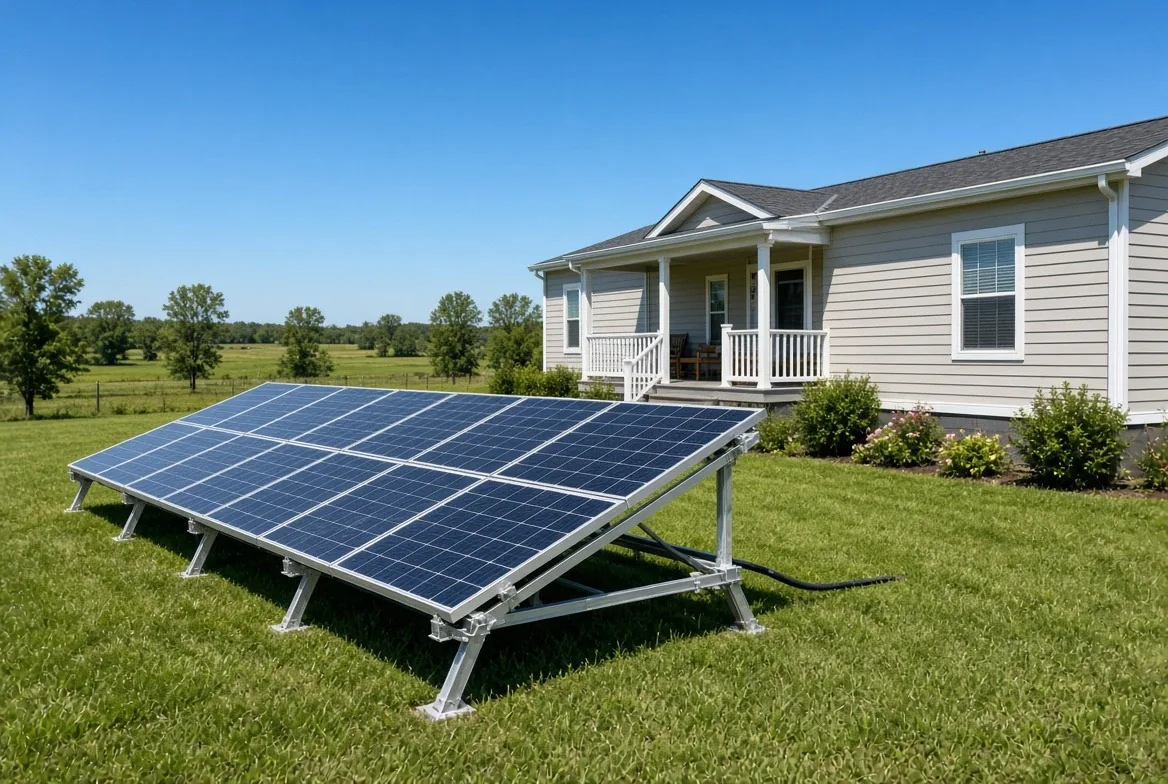
When the roof doesn't pencil out, the fallback is a ground-mounted array — which also runs 10-15% more efficient since it stays cooler than a rooftop system. That switch adds roughly $0.30-$0.50 per watt for racking, concrete footings, and trenching, and any conduit run into the house has to penetrate the skirting with weatherproof, frost-heave-tolerant fittings. If you're in a manufactured home community on leased land, add one more hurdle: ground mounts and even net-metering agreements usually require written park-owner approval, and master-metered communities may not allow individual interconnection at all.
DIY kits vs. professional installation
Self-installed kits are the biggest lever homeowners have on total cost. Equipment-only kits run $1.00-$1.50/W, and after adding permit fees ($200-$500), balance-of-system hardware ($500-$1,000), and a required licensed-electrician sign-off for the utility interconnection ($500-$1,200), the realistic total lands at $1.20-$1.70/W — a 40-55% reduction versus a $2.58-$3.50/W professional install. A 6 kW hybrid-inverter kit, for example, typically runs $6,000-$7,500 in materials against $15,960-$16,200 installed. The tradeoff is that you're still responsible for structural compliance and permitting, and HUD roof-load rules don't relax just because you're doing the labor yourself.
The federal tax credit changed for 2026
This is the single biggest shift in the math this year. The 30% federal Residential Clean Energy Credit (IRS Section 25D) was ended early under the One Big Beautiful Bill Act, effective December 31, 2025. Systems placed in service from January 1, 2026 onward get a 0% federal credit for cash or loan purchases — a $20,000 system that would have netted out to about $14,000 in 2025 now simply costs $20,000. Third-party-owned systems (leases and PPAs) still route around this through a separate commercial tax mechanism (Section 48E), which is one reason those structures are gaining share even though you never own the equipment.
How much it varies by state
Sunbelt states with competitive installer markets and simple roof geometry — Arizona, Texas, Florida — post the lowest per-watt prices, around $2.10-$2.25/W. States like New York and Massachusetts run $2.70-$3.45/W due to higher labor costs and more complex permitting, though higher electricity rates there can still shorten payback.
Financing: loans, leases, and PPAs
A cash purchase needs $25,000-$31,000 upfront for a typical site-built-sized system (less for the 4-8 kW a manufactured home usually needs) but now carries zero federal offset. Unsecured solar loans need little or no money down, but dealer fees of 15-35% are often baked into the loan principal, and at 7.5-9.5% APR over 20-25 years, total repayment can reach $43,900-$54,200 on a $25,000 system. It's also worth knowing that roughly 42% of manufactured-home financing is structured as a chattel (personal property) loan rather than a real-property mortgage, which carries higher rates (8-12%+) and higher denial rates — that can spill over into how a lender treats an attached solar loan. Leases and PPAs need $0 down and shift maintenance risk to the provider, with PPA electricity typically priced 10-30% below the local utility rate, but you won't own the system or qualify for any ownership-based savings.
Bottom line
For most manufactured and mobile homes, a realistic 2026 budget is $11,000-$22,000 professionally installed for a right-sized 4-8 kW system, or $5,000-$12,000 self-installed — plus $1,500-$4,000 more if your roof needs reinforcement, or $0.30-$0.50/W more if you end up ground-mounting instead. Get a structural evaluation before you get a quote; it changes which of these numbers actually applies to your home.
Sources: EnergySage, U.S. Department of Energy, HUD Manufactured Home Construction and Safety Standards, IRS Residential Clean Energy Credit, and our own mobile-home solar cost data.