
Guide
Solar Panels and Home: A Mobile & Manufactured Homeowner's Guide to Roof Load, Cost & Payback (2026)
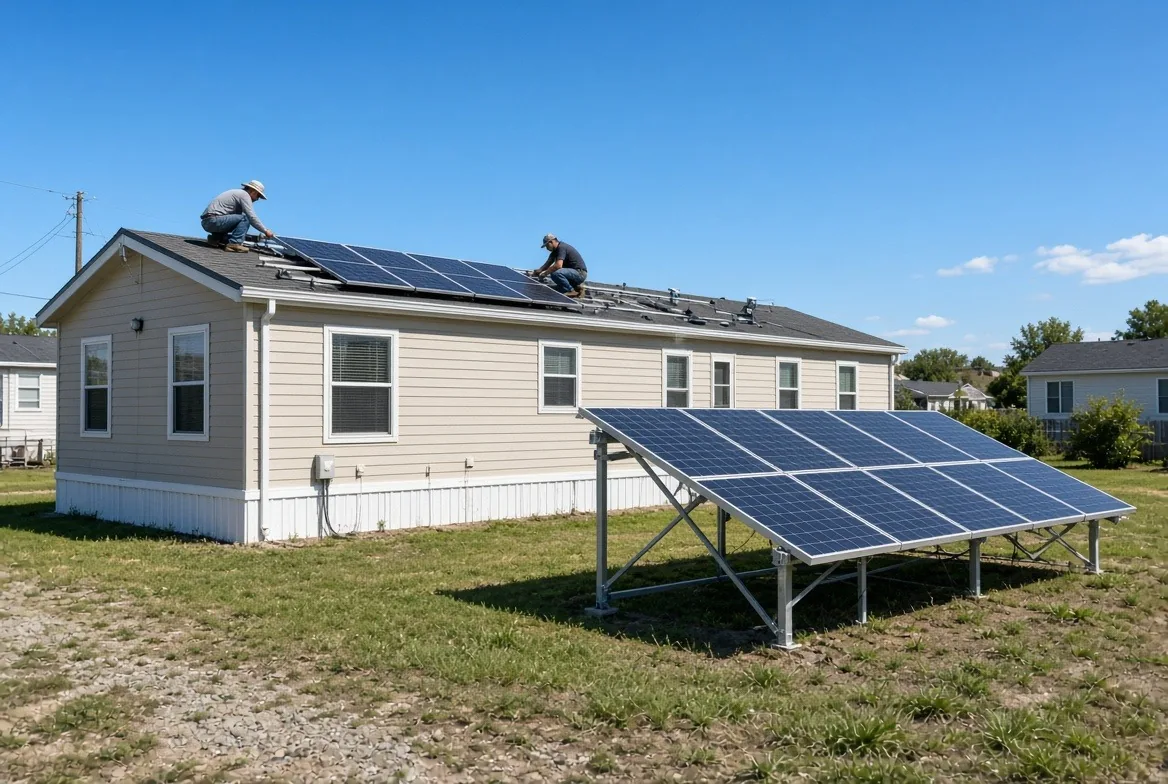
Why "solar panels and home" looks different for manufactured housing
Most solar guides are written for site-built houses on permanent foundations. Mobile and manufactured homes are a different animal: lighter roof trusses, skirted crawlspaces instead of basements, and — depending on your state — a title that classifies the home as real property or as personal property (chattel). All three of those differences change what "adding solar panels to your home" actually involves, from the structural math to the financing paperwork.
This guide covers what to check before you sign a contract, how big a system a typical manufactured home actually needs, and what the real numbers look like for cost, savings, and payback in 2026.
Roof load: the first question, before price
Federal manufactured-home rules (the HUD Code, 24 CFR § 3280.305) set minimum roof live-load capacity by climate zone: 20 psf in the South Zone, 30 psf in the Middle Zone, and 40 psf in colder North Zone areas. A standard rigid solar array adds roughly 2.0 to 4.0 psf of permanent dead load, plus concentrated point loads at every mounting bracket. Because manufactured-home trusses are engineered close to their design tolerance — with less spare margin than a site-built roof — that extra weight has to be checked against the home's specific engineering, not assumed.
Two things follow from this:
- If a structural review shows the roof can't take a standard rigid array without reinforcement, lightweight flexible panels are a real option — around 0.35–0.8 psf versus 20–40 lbs for a full rigid panel — at some cost in efficiency and lifespan.
- If the roof genuinely can't take it, a ground-mounted array in the yard sidesteps roof load entirely, at the cost of trenching and conduit work to bring power back to the house.
Wind uplift matters too: HUD standards require manufactured-home roofs to resist uplift pressures from about −30 to −36 psf generally, and as much as −51 to −89 psf near roof edges. Panels mounted too close to the roof perimeter can act like a wing and increase that uplift risk, so installers keep a setback from the edges and use uplift-rated hardware.
Grid-tied, off-grid, or ground-mount?
For homes already on utility power — which describes most homes in manufactured-home communities — a grid-tied system is the default choice, and many jurisdictions offer expedited, over-the-counter permitting for roof-mounted systems up to 8 kW. Larger systems, or anything with battery backup, usually need a full plan review.
Off-grid systems (with battery storage) make sense mainly for homes without utility access. They cost more up front because the batteries do a lot of the heavy lifting that the grid otherwise provides for free.
How big a system does a manufactured home actually need?
Because manufactured homes are smaller than the average site-built house, they typically need a smaller — and cheaper — system to cover their electricity use:
| Home size | Avg. annual usage | Recommended array | Panels (300W) | |---|---|---|---| | 600 sq ft | ~5,460 kWh | 1.8 kW | 6 | | 800 sq ft | ~7,280 kWh | 2.4 kW | 8 | | 1,000 sq ft | ~9,100 kWh | 3.0 kW | 10 | | 1,200 sq ft | ~10,920 kWh | 3.6 kW | 12 |
For comparison, NREL benchmarks a typical site-built home at roughly 7.15 kW (a range of 3.0–11.0 kW) and 24 panels — meaningfully more hardware than most manufactured homes require.
What it actually costs, and how fast it pays back
Nationally, residential solar installs run about $2.50–$3.00 per watt before incentives. The federal Residential Clean Energy Credit (IRC Section 25D) currently covers 30% of that cost for systems you own outright — leases and power-purchase agreements don't qualify, since the credit follows the equipment owner, not the electricity user.
At current federal incentive levels, a small manufactured-home system pays for itself in roughly 4.5–9 years depending on size. That math changes if the 30% credit isn't renewed past its currently legislated window — an unsubsidized system stretches out to a 15–17 year payback, which is worth knowing before you assume today's numbers hold for a system you install years from now.
Location matters more than most buyers expect. A 6 kW system nets out to about $9,800 after credit in Kentucky's lower-cost market, versus roughly $12,000–$15,200 in states like California, Iowa, or Indiana — the spread comes from a mix of local labor costs, permitting fees, and how much your utility charges per kWh (which also determines how fast you earn the system back).
Financing depends on how your home is titled
This is the part general solar guides skip entirely, and it matters a lot for manufactured-home owners:
- Real property (manufactured home on a permanent foundation, titled with the land): standard home-equity loans, HELOCs, or a mortgage refinance can fund the system, same as a site-built home.
- Chattel/personal property (home titled separately from leased land, common in mobile home parks): expect unsecured solar loans, general home-improvement loans, or financing offered directly through the installer, since the home itself can't usually secure a mortgage-style loan.
Either way, buying the system outright (cash or loan) is what preserves eligibility for the 30% federal tax credit — leasing does not.
Does it add resale value?
Research from Zillow and Lawrence Berkeley National Laboratory found homes with owned (not leased) solar systems sell for about 4.1% more than comparable homes without solar — roughly $4 of added value per installed watt. That premium applies to owned systems; a leased system transfers an ongoing payment obligation to the buyer rather than an asset, which tends to complicate a sale rather than help it.
The short version
Before getting quotes, get a straight answer on three things: whether your specific roof trusses can carry a standard array without reinforcement, whether your home is titled as real property or chattel (it determines your financing options), and whether you're buying outright or leasing (it determines whether you keep the 30% tax credit and the resale bump). Get those three answered first, and the rest of the shopping process — system size, installer quotes, exact payback timeline — gets a lot more concrete.
Sources
- 24 CFR § 3280.305 — HUD structural design requirements for manufactured homes
- HUD Manufactured Home Construction and Safety Standards, Part 3280 (GovInfo)
- Homeowner's Guide to Solar — U.S. Department of Energy
- Solar Panels Can Increase Home Values. Are They Worth It? — The Mortgage Reports
- Solar Tax Credit 2025 — WattBuild