
Guide
Solar Panels for Home: 2026 Cost, Sizing & Incentive Guide for Mobile & Manufactured Homeowners
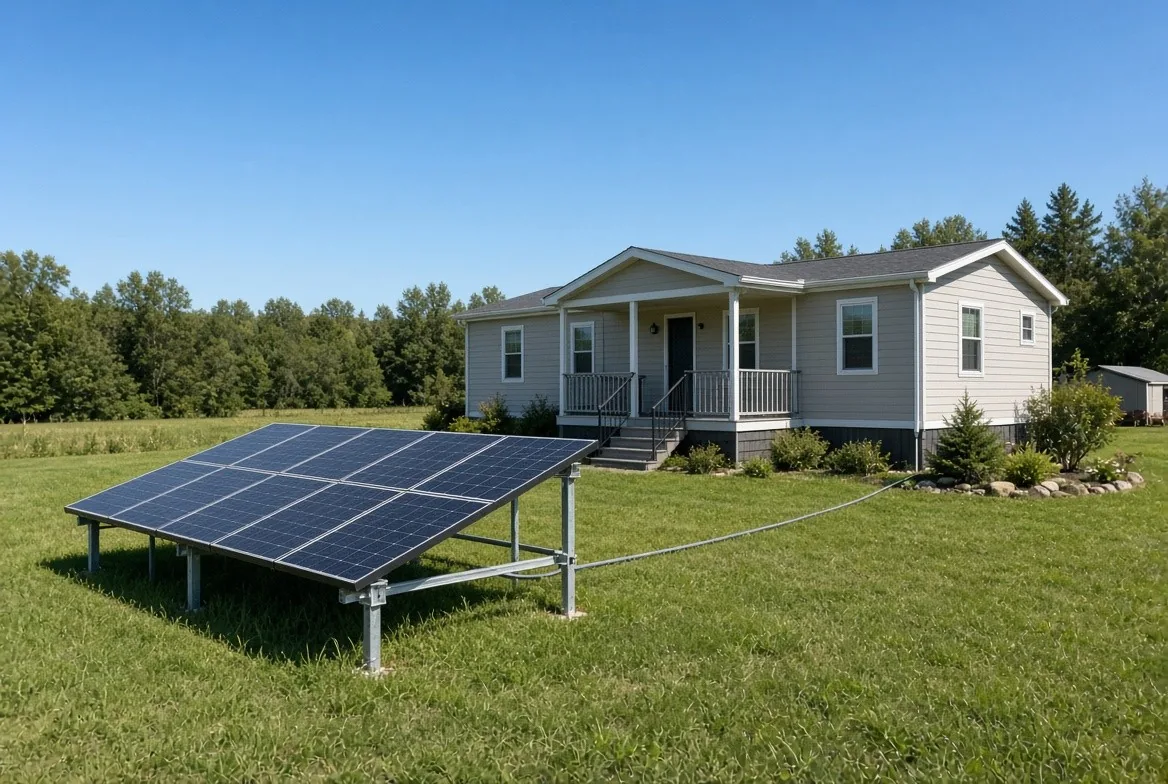
Why "solar panels for home" means something different if you live in a manufactured or mobile home
Most articles about home solar panels are written for people with a conventional, site-built roof and an unlimited construction budget. If you own a mobile or manufactured home, the physics of solar are the same, but the engineering, permitting, and financing rules are not. This guide walks through how home solar actually works, what it costs in 2026 broken down by system size, which incentives still apply now that the federal tax credit has expired, and which mounting option makes sense when your roof wasn't built to carry rooftop equipment.
How home solar panels work
A residential solar system converts sunlight into usable household electricity through a straightforward chain: photovoltaic (PV) modules absorb photons and release electrons, generating direct current (DC) electricity. That DC power runs through wiring to an inverter, which converts it into the 120/240-volt alternating current (AC) your home's outlets and appliances use. Any electricity you don't use immediately either flows back to the grid (crediting your utility bill under net metering) or charges a battery for use after sunset.
That part is identical whether you live in a single-family house or a manufactured home. What's different is everything above the wiring: the roof.
The manufactured-home roof problem
Manufactured homes are built off-site under the HUD Code (24 CFR Part 3280), which set structural rules in 1976. Homes built before that date — true "mobile homes" — have no uniform structural standard at all and typically use lightweight roof framing never intended to carry extra weight.
Even post-1976 homes are rated for one of three HUD roof live-load zones: 20 pounds per square foot (psf) in the South, 30 psf in the Middle zone, and 40 psf in the North (where snow load is factored in). A standard rigid glass solar array — panels, rails, flashing, and racking — adds roughly 3 to 4 psf of permanent dead load. On a South Zone roof rated mainly for a technician to walk on during maintenance, that margin disappears fast. Add HUD wind-zone requirements (up to 47 psf of horizontal drag and 32 psf of uplift in hurricane-prone Wind Zone III) and a rigid rooftop array can turn into a liability during a storm instead of an asset.
Automated permitting tools like NREL's SolarAPP+ explicitly exclude manufactured and mobile homes from expedited review, meaning every install needs a custom structural engineering sign-off. Many older homes also run 60- or 100-amp electrical panels, which may need a $1,500–$3,500 upgrade before the National Electrical Code's interconnection rules allow a solar tie-in at all.
Three ways around the roof limits
- Ground-mounted arrays. If you own your land, a ground mount sidesteps roof load and wind-sail concerns entirely and lets you set the ideal tilt angle. Expect to add $0.30–$0.75 per watt for footings, racking, and trenching to the main panel.
- Accessory-structure arrays. A permanently anchored garage, carport, or shed can host the array instead, keeping the home's original roof untouched.
- Flexible thin-film modules. Lightweight CIGS or flexible monocrystalline panels weigh as little as 0.8 psf — about a 75% weight cut versus rigid glass — and adhere directly to TPO or metal roofing without penetrations. The tradeoff is lower efficiency (around 16% versus 21–23% for rigid modules), so you need more roof area for the same output.
What solar panels for a home actually cost in 2026
Turnkey residential solar in 2026 runs $2.50–$3.50 per watt before any incentives, with per-watt pricing dropping as system size grows because fixed costs (permits, engineering, site visits) spread across more capacity.
| System size | Cost per watt | Pre-incentive cost | Typical fit | |---|---|---|---| | 3.0 kW | $2.95/W | $8,850 | Compact single-wide, gas heat | | 5.0 kW | $2.78/W | $13,900 | Standard single-wide | | 8.0 kW | $2.62/W | $20,880 | Double-wide, all-electric | | 10.0 kW | $2.58/W | $25,800 | Larger double/triple-wide | | 12.0 kW | $2.56/W | $30,720 | Large home, heat pump |
Manufactured-home installs typically run $1,000–$4,000 above these baseline figures once ground-mount racking, longer trenching, or roof reinforcement is factored in. According to the Department of Energy's Solar Photovoltaic System Cost Benchmarks, hardware (modules, inverters, racking, wiring) accounts for roughly 45% of total system cost, with the remainder split between labor, permitting, and installer overhead and margin.
Incentives in 2026 — the federal credit is gone
The 30% federal Residential Clean Energy Credit (Section 25D) expired for systems placed in service after December 31, 2025. That single change has pushed typical simple payback periods from a historical 6–8 years out to roughly 9–12 years nationally. Homeowners now lean more heavily on state and utility programs:
- SRECs in states with solar carve-outs (New Jersey, Massachusetts, Maryland, Washington D.C.) pay $20–$400+ per megawatt-hour generated.
- State tax credits and rebates — New York, for example, still offers a state income tax credit up to $5,000.
- Net metering remains in some form in 38 states plus D.C., though California's shift to NEM 3.0 cut export compensation by roughly 75%, making battery storage far more attractive there.
- Solar for All, funded through the EPA's Greenhouse Gas Reduction Fund, and on-bill tariff programs like Pay As You Save (PAYS) specifically target low- and moderate-income manufactured-home owners with no-upfront-cost paths to solar, according to research from the Clean Energy States Alliance.
Why the math still tends to favor manufactured-home owners
Manufactured homes carry the highest site energy intensity of any U.S. housing category — about 50.5 thousand Btu per square foot per year, roughly 20% above the national residential average, per EIA Residential Energy Consumption Survey data cited by ACEEE. Thinner walls, less insulation, and older HVAC ductwork mean manufactured-home residents often spend up to 70% more per square foot on heating and cooling than site-built homeowners. That higher baseline usage means a right-sized solar array offsets a larger share of a bigger bill — which is exactly why pairing solar with basic weatherization (air sealing, insulation, duct sealing) before sizing the system is worth doing first: a smaller, cheaper array can cover the same percentage of usage once waste is cut.
Payback varies enormously by state
Local electricity rates matter more than installation cost per watt. A few examples from 2026 market data compiled by EnergySage:
| State | Installed cost/W | Payback (years) | 25-year net savings | |---|---|---|---| | Washington, D.C. | $2.95 | 5.2 | up to $112,119 | | Massachusetts | $2.91 | 7.3 | up to $154,691 | | California | $2.48 | 7.3 | up to $129,619 | | Texas | $2.22 | 8.7 | up to $40,939 | | Arizona | $2.21 | 11.6 | up to $35,820 | | North Carolina | $2.14–$2.35 | 15.0 | ~$29,610–$35,066 |
Massachusetts and D.C. post fast paybacks despite higher up-front costs because retail electricity is expensive and D.C.'s SREC market pays well. North Carolina's low installation prices don't help much when electricity itself is cheap.
A practical decision framework
- Check the HUD Data Plate on your home for its roof live-load zone and wind zone before assuming a rooftop install is possible.
- Weatherize first — air sealing and insulation lower the system size you need.
- Pick a mounting method that matches your structure: ground mount or accessory structure if you own land and the roof is marginal; flexible thin-film if the roof has some capacity but not enough for rigid glass; shared-rail rigid arrays only on verified Middle/North Zone roofs.
- Stack incentives — state tax credits, SRECs, Solar for All grants, and on-bill financing now matter more than ever with the federal credit gone.
- Get a real structural sign-off, not just a sales quote — manufactured homes are excluded from automated permitting tools, so this step isn't optional.
Solar can still pencil out well for mobile and manufactured homeowners in 2026 — the underlying economics are often better than for site-built homes, given higher energy burdens — but only if the mounting method and financing plan account for the home's actual structure from the start.