
Guide
400 Watt Solar Panel: 2026 Specs, Real Output and Mobile-Home Sizing
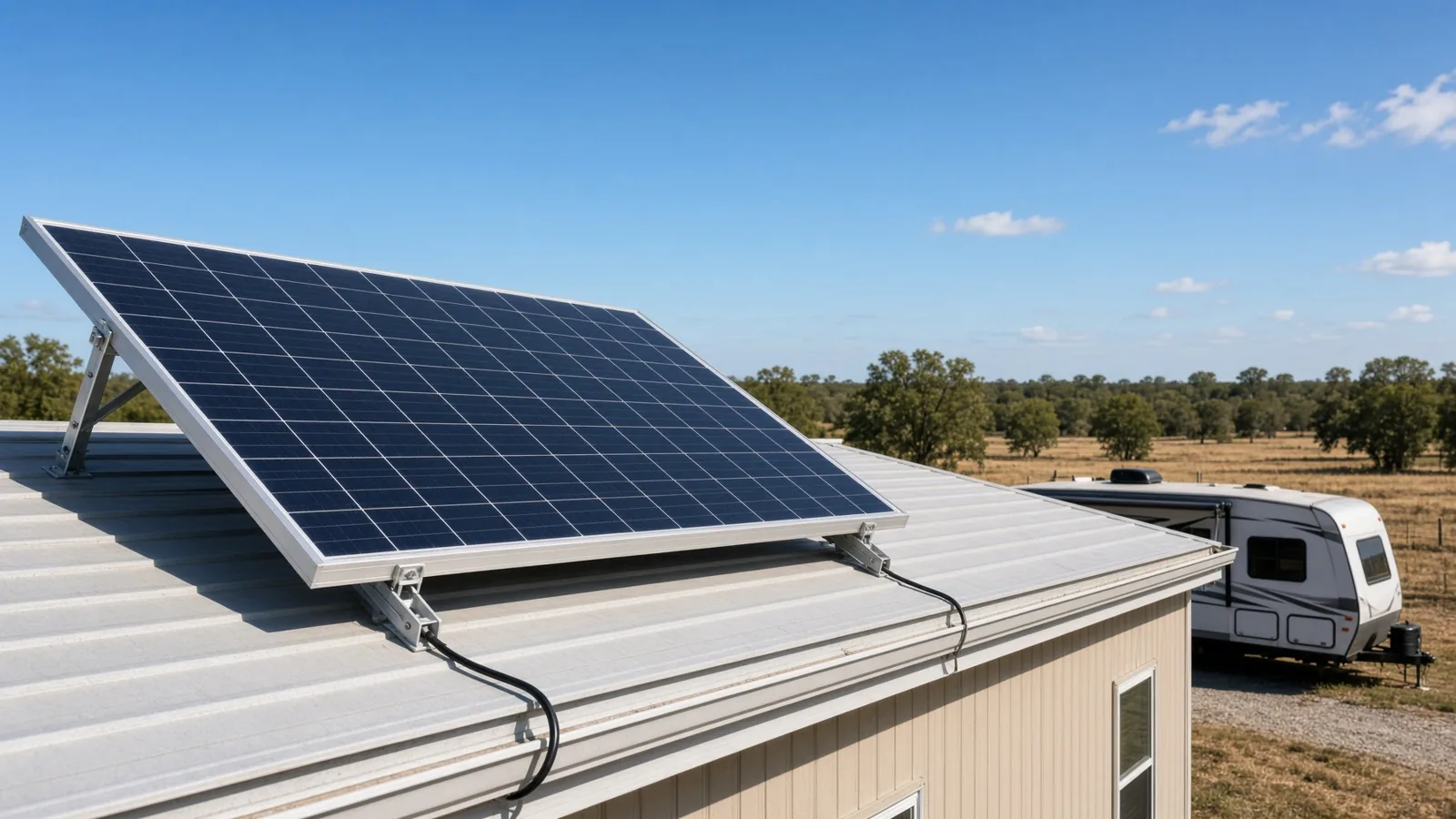
A 400 watt solar panel has become the default building block for mobile and manufactured homes: large enough that two of them carry an RV's daily load, small enough that one person can lift one onto a roof. But the number on the box and the number that reaches your battery are two different figures. In real conditions a single 400 W module delivers about 0.92 to 1.85 kWh a day, not the 3.2 kWh the nameplate implies. That gap decides how many panels you actually buy.
This guide covers what a 400 W panel is in 2026, what it really produces, what it costs in the US, how many a mobile home needs, and the roof-load and wiring limits that decide whether the install is safe.
What a 400 watt solar panel actually is
The 2026 "standard" 400 W rigid panel is a 108 half-cell monocrystalline module. Three formats dominate US listings:
- Rich Solar MEGA 400 (RS-M400) - mono PERC, 108 half-cells, 10BB. 67.8 x 44.7 x 1.2 in (1,722 x 1,135 x 30 mm), 45.2 lb. Voc 37.1 V, Vmp 31.0 V, Isc 13.7 A, Imp 12.9 A, about 20.5% efficiency, 25 A maximum series fuse (richsolar.com).
- ZNShine ZXM7-SH108-400/M - mono PERC, 108 half-cells (6x18). 1,722 x 1,134 x 30 mm, 45.5 lb, Voc 37.10 V, Vmp 30.90 V, Isc 13.70 A, Imp 12.95 A, 20.48% (solarflexion.com).
- Renogy RSP400DCT-108 bifacial - N-type TOPCon, 108 half-cells, bifacial. 1,722 x 1,134 x 35 mm, 45.42 lb, Voc 39.42 V, Vmp 34.0 V, Isc 13.06 A, Imp 11.76 A, 21.5% (renogy.com).
Two warnings. First, some sellers advertise "400 W" for a pair of 200 W panels (Renogy and ACOPOWER both do), which is a different footprint, different Voc and different mounting plan. Second, an older 72-cell 400 W panel is a physically different animal: 1,976 x 1,001 mm, 49.4 lb and 49.6 V Voc instead of 37 V - which changes every string-sizing calculation below.
Note the Voc column while you shop: at 37 V a modern 108-cell 400 W panel plays nicely with budget 100 V and 150 V charge controllers. At 49.6 V it does not.
How much power does one 400 W panel really make?
Nameplate watts assume 1,000 W/m2 of sun and 25 C cell temperature. Neither happens on a roof. The industry-standard derate stack from NREL's PVWatts Version 5 manual is 14% for soiling, shading, mismatch, DC wiring, connections, light-induced degradation, nameplate tolerance and availability. Then add temperature losses - 6.6% typical, but 10-12% on a hot, flush-mounted roof - 2-4% for the MPPT controller, and 0-15% for tilt and azimuth. The combined derate is about 0.77 for a well-tilted array and 0.70 for a flat-mounted one.
That is the honest range. For a tilted array, one panel gives 0.92 kWh/day at 3 peak sun hours, 1.23 at 4, 1.54 at 5 and 1.85 at 6. Monthly, that is roughly 28 to 56 kWh per panel. A flat-mounted panel on an RV or a low-slope manufactured-home roof gives about 9% less - 25 to 51 kWh a month - which is why tilt frames pay for themselves on fixed installations.
What a 400 watt solar panel costs in 2026
Panel prices have split into two markets. Generic single panels are the cheapest watts available; branded panels sold in pallet-sized lots cost more per watt but arrive with better documentation and warranty support.
- ZNShine ZXM7-SH108-400/M single panel: $144.99 ($0.36/W) at US Solar Supplier, $166.99 ($0.42/W) at SolarTown
- Rich Solar MEGA 400, 8-pack: $270.00 per panel ($0.68/W)
- Renogy 400 W N-type bifacial: $330 per panel in a 2-pack ($0.83/W), $303.60 each in a 10-pack ($0.76/W)
Kits cost more because they bundle a controller and cabling:
The cheapest "400 W solar kit" on a big-box shelf is usually 4 x 100 W panels with a 30 A PWM controller for about $361 ($0.90/W). A real 400 W module plus a 40 A MPPT controller beats it on every metric except shipping. Budget roughly $650-$900 for a complete single-panel mobile-home starter: panel, MPPT, mounting hardware and cable.
How many 400 W panels does a mobile home need?
The average US household uses about 865 kWh a month. A manufactured home running 800-1,000 kWh a month needs, at 4.68 kWh per panel per month (5 sun hours, tilted):
- 18-22 panels for 800-1,000 kWh/month
- That is 7.2-8.8 kW, about 380-465 ft2 of module area and 815-995 lb of panel weight
An RV using 1.5 kWh a day needs two panels (800 W) whether they are tilted or flat. An off-grid cabin with a 200 Ah 12 V LiFePO4 bank (2.56 kWh, about 2.3 kWh usable) also needs two panels to refill from empty in one day, and a 60 A MPPT - 800 W at 14 V is about 57 A of charge current, and a common 40 A Rover only accepts 520 W at 12 V.
Mounting on a manufactured home: the load problem
This is where mobile-home installs fail inspection. A 400 W panel weighs 45.2 lb spread over 21.05 ft2, so the panel alone is a 2.15 psf dead load; with racking, plan on 2.5-4 psf. HUD's roof live loads of 20 psf (South), 30 psf (Middle) and 40 psf (North) are snow and foot-traffic allowances under 24 CFR 3280.305 - not a licence to bolt on equipment.
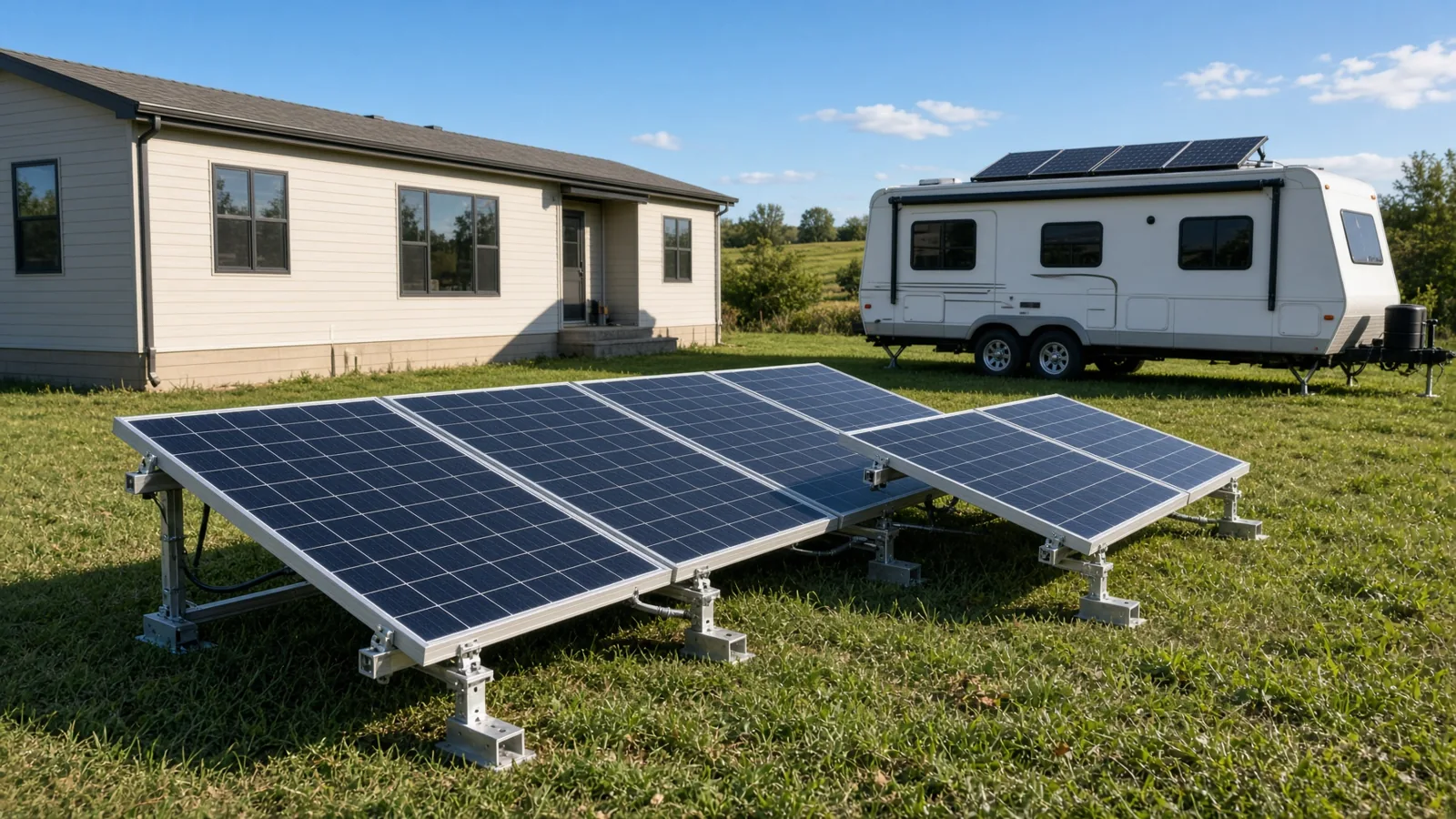
Wind is the bigger number. Wind Zone II roof trusses see -39 psf uplift, so an unshielded 21 ft2 panel can pull roughly 820 lbf against its mounts. Wind Zone III is worse (-47 psf, about 990 lbf). That is why the practical advice for a mobile home is ground mounting first: no truss analysis, no permit-engineering letter, and you get to tilt the array for the full 0.77 derate. Roof mounting makes sense on a post-1994 double-wide with verified truss capacity, a data-plate roof-load check and a stamped engineer's letter - and in California, PV on a manufactured home is treated as an alteration requiring structural engineering.
Wiring, fuses and controller sizing
Cold weather raises voltage and that is what breaks controllers. Applying NEC Table 690.7(A) factors, a 37.1 V Voc panel reaches 42.3 V at -10 C and 43.8 V at -20 C. Three in series is safe on a 100 V MPPT; six in series hits 244.9 V, right at the 245 V start-up limit of a 250 V unit.
For current, NEC 690.8/690.9 wants 1.25 x 1.25 = 1.56 x Isc: 13.7 A x 1.56 = 21.4 A, which lands on a 25 A fuse - the same as the module's own maximum series fuse rating. Use 10 AWG PV wire per string, 8 AWG once you parallel two strings, and add string fuses at three or more paralleled strings.
Bottom line
A 400 W panel is the right size for a mobile-home or RV system in 2026 - as long as you size on 0.77 of nameplate, budget about $0.36-$0.83 per watt for the panel itself, and ground-mount it unless you can prove your roof's truss capacity and uplift resistance in writing. Plan on two panels for an RV or a small cabin, and 18-22 for a home that uses 800-1,000 kWh a month.