
Guide
Portable Solar Panels for Mobile Homes: 2026 Prices, Output and Buying Guide
The short answer
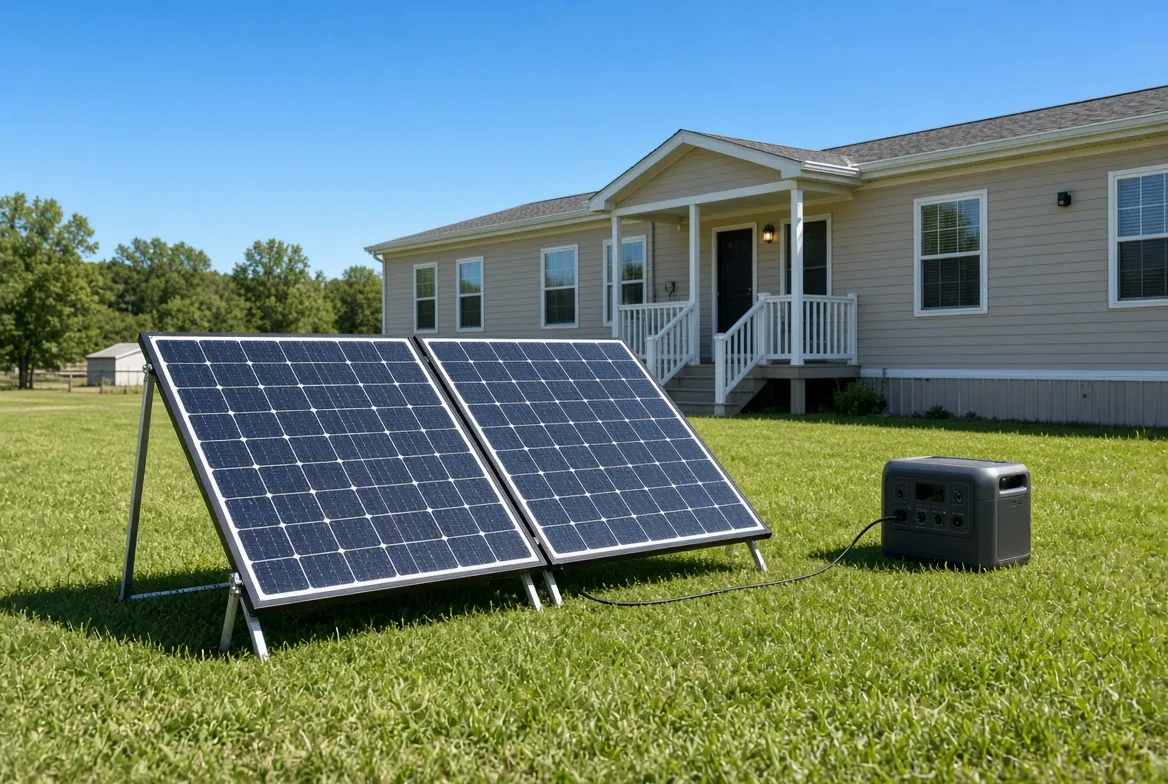
Portable solar panels - the folding, suitcase and briefcase modules that prop up on a kickstand and plug into a battery - are the easiest solar a mobile or manufactured home can own, and the least likely to pay for itself. A 400-800 W portable array makes roughly 1.2-3.2 kWh a day in decent sun. That is about 3.5-9.4% of the roughly 34.1 kWh a day a typical mobile home uses, according to the EIA's 2020 Residential Energy Consumption Survey, which puts average mobile-home electricity use at 12,456 kWh a year.
Put plainly: portable panels will run a fridge, lights, a router, a CPAP and a few small loads through an outage. They will not run heating, cooling or a water heater, and they will not cut your utility bill in any meaningful way.
What counts as a portable panel
"Portable solar panels" covers three quite different products, and they are priced very differently.
- Fabric folding panels (Jackery SolarSaga, Bluetti PV, EcoFlow, Anker SOLIX PS, Goal Zero Nomad): 60-400 W, about $99-$699, or roughly $1.50-$3.00 per watt. They are the lightest option at about 0.07-0.09 lb per watt and fold to around 2 ft by 2 ft.
- Glass and aluminium suitcase or briefcase panels (Renogy, Goal Zero Boulder): 100-200 W, about $165-$415, around $1.45-$2.10 per watt. Heavier and stiffer, and often the only type sold with a long output warranty.
- Solar generator kits that bundle panels with a battery power station: compare these by kWh of battery, not by panel watts. The battery is where the money goes.
All three feed either a portable power station (battery, inverter and charge controller in one box) or a 12 V battery through a charge controller. None of them connects to the grid, and that is exactly what makes them suit a mobile home: nothing is mounted on the structure, nothing is wired into the home's electrical system, and the whole kit moves with you when the home does.
How much power a portable array really makes
The arithmetic is straightforward: array watts x peak sun hours x a real-world derating of 75-80%, divided by 1,000. At five peak sun hours - a fair summer average for much of the southern and central United States - it looks like this:
These are calculations, not measurements. Tilt, heat, soiling, cable losses and shading all move the number, and a northern winter can drop to two or three peak sun hours. The good news for a mobile home is that portability works in your favour here: you can move a folding panel around the yard through the day and tilt it on its kickstand at 40-60 degrees, which is more than most fixed roof arrays can do.
The nameplate is optimistic
Independent testing puts real output below the label. A test of the Jackery SolarSaga 200 by OutdoorGearLab measured 86% of its claimed watts, against 88% and 91% for two competing 200 W panels. Reviewers have also noted that EcoFlow's own material implies its 400 W panel tops out nearer 350 W. Plan on 80-90% of the rated watts at best, and only around solar noon.
What portable solar panels cost in 2026
These are street prices, not list prices. List numbers run 40-50% higher and are rarely what anyone actually pays.
- Renogy 200 W 12 V monocrystalline suitcase: from $289.99 - the cheapest per watt of the group, and it carries a 25-year, 80% output warranty. It also weighs 28-38 lb.
- Anker SOLIX PS400: $599.99-$699.99 for 400 W, about 35 lb.
- Bluetti PV350: $649 for 350 W at 30.6 lb.
- EcoFlow 400 W and Jackery SolarSaga 200 W sit in the same band, roughly $379-$649 depending on the sale of the week.
Then add the part people forget: the power station. Budget $400-$2,000 or more for 1-2 kWh of storage with at least 500 W of solar input. A folding panel on its own is a battery charger with nothing to charge.
For comparison, EnergySage's 2026 cost data puts installed rooftop solar at about $2.60 per watt before incentives, and those rigid modules carry a 25-year output warranty. Portable panels look cheap per watt only until you add the station - which is why they are a backup purchase, not a bill-reduction one.
Portable vs rooftop or ground mount on a mobile home
- Cost per watt: $1.45-$3.00 for the folding panel alone, plus $400-$2,000+ for the station, versus about $2.60 per watt installed for a full rooftop system including inverters, wiring and labour.
- Area: roughly 25-27 sq ft per 400 W of unfolded folding panel, so 50-55 sq ft for an 800 W array. Spread out on the lawn, that is fine. On the roof of a single-wide, it is not.
- Weight and structure: a portable array puts nothing on the roof. A mounted array adds a dead load that manufactured-home roofs were not designed for - 24 CFR 3280.305(c)(3) sets roof live loads at 40/30/20 psf by wind zone and makes no provision for extra mounted equipment, which is why an engineering review (commonly $150-$500) comes first.
- Wind and theft: a kickstand array can tip or blow away in a gust, and it is a portable, valuable object sitting in an open yard. Bring it in when you are away.
- Lifespan and warranty: 1-5 years of product warranty on most folding panels, against 25 years of output warranty on rigid modules. Crystalline silicon modules degrade a median of about 0.5% a year, per NREL's module degradation study; fabric and ETFE portable laminates, folded and sunned repeatedly, will not match that.
Sizing and wiring pitfalls
Match voltage, not just watts
Every power station has an input window, and the panel's open-circuit voltage (Voc) must stay inside it - including on a cold morning, when Voc rises. Jackery publishes a voltage coefficient of -0.268% per degree C; at -10 C that adds about 9.4%. An Anker SOLIX PS400 at 57.6 V Voc climbs to about 63 V, past the 60 V limit many stations advertise. One PS400 per port is already marginal in deep cold; never put two in series on a 60 V station.
Series vs parallel
- Series adds voltage and keeps current the same. Two 200 W panels with 26 V Voc give about 52 V - workable on a 60 V input, but with thin margin in cold weather.
- Parallel adds current at the same voltage. Two Jackery 200 W panels give about 22.4 A, which the station simply clips to its 10.5-15 A limit.
For 12 V-class panels (about 18-25 V Voc) a series pair is usually ideal. For the 46-58 V panels, use one per port or wire them in parallel.
Use MPPT, and skip the suitcase controller
MPPT charge controllers harvest roughly 15-30% more energy than PWM, and more than 30% in cold weather, according to reviewer testing. Portable power stations already have MPPT built in. The trap is a glass suitcase panel with its own 20 A PWM controller: do not feed that controller's output into your station. Use the raw panel leads and keep the PWM for a bare 12 V battery.
Connectors
- MC4 is the industry standard - Bluetti, EcoFlow, Anker and Renogy all use it. It locks and needs a tool to release. Prefer it, because it keeps you free to change station brands.
- Proprietary plugs (Jackery's DC8020, Goal Zero's HPP) lock you into one brand or into an adapter chain.
- Anderson Powerpole and XT60/XT60i appear on station inputs and accessory leads; they are compact but not weather-sealed.
Never unplug a panel under load
PV connectors carry an explicit "do not disconnect under load" warning, and arcing at the connector is a real way to destroy a panel or a station. Stop charging on the station, flip the panel face down or cover it, and then disconnect.
Permits and park rules
A panel that plugs into a stand-alone power station and is not wired into the home is generally treated as an appliance rather than a PV installation, so it normally needs no permit or inspection. The moment anything is tied into the home's wiring - an inlet, a transfer switch, a breaker - permits, NEC rules and an inspection apply. Check with your local building department first, and read your lease or park rules, because many manufactured-home communities restrict gear left outside.
Warranty, durability and what to expect
Warranty terms are short and inconsistent across this category: one to two years on most folding panels, three years plus two on a registered Jackery SolarSaga, and 25 years of 80% output coverage on the Renogy suitcase. Several dealers list different terms for the same panel, so confirm on the manufacturer's own warranty page before buying.
Bifacial versions of the 400 W panels advertise a roughly 10-year lifespan. Ingress ratings run IP65 to IP68 depending on model, which covers rain but not immersion or a season of UV. Store the panels dry, folded and inside, and they will last far longer than one left out on the lawn.
The bottom line
Decide the job before you buy. If you want power through an outage - a fridge, lights, the internet, a medical device - then a 1-2 kWh LiFePO4 power station with 500 W or more of solar input plus 400-600 W of MC4 folding panels is a sensible kit at roughly $1,000-$1,800 on sale. If you want a smaller electricity bill, portable panels are the wrong product: get quotes for a permitted ground mount or an engineered rooftop system instead, and run the numbers on that first.
Either way, buy MC4 panels so you are not locked to one brand, do the cold-morning voltage maths before you connect anything, and treat the whole array as equipment you own rather than a fixture you have installed.
Sources
- EIA 2020 Residential Energy Consumption Survey - mobile-home electricity use of 12,456 kWh a year, about 34.1 kWh a day.
- EnergySage, solar panel cost data - installed systems at about $2.60 per watt before incentives.
- EnergySage, types of solar panels - monocrystalline 20-23%, polycrystalline 15-17%, thin-film 11-16%.
- NREL, module degradation (Jordan and Kurtz) - median degradation of 0.5% a year, mean 0.8%.
- OutdoorGearLab, Jackery SolarSaga 200 review - measured 86% of claimed watts.
- Anker SOLIX 400 W portable solar panel - 57.6 V Voc, rated for stations up to 60 V input.
- Bluetti PV350 and Renogy 200 W suitcase - current US prices and weights.
Prices in this article are retailer sale prices observed in late 2026 and change weekly. The kWh figures are calculations from the stated formula and assumptions, not measurements.