
Guide
Flexible Solar Panels for RV Roofs
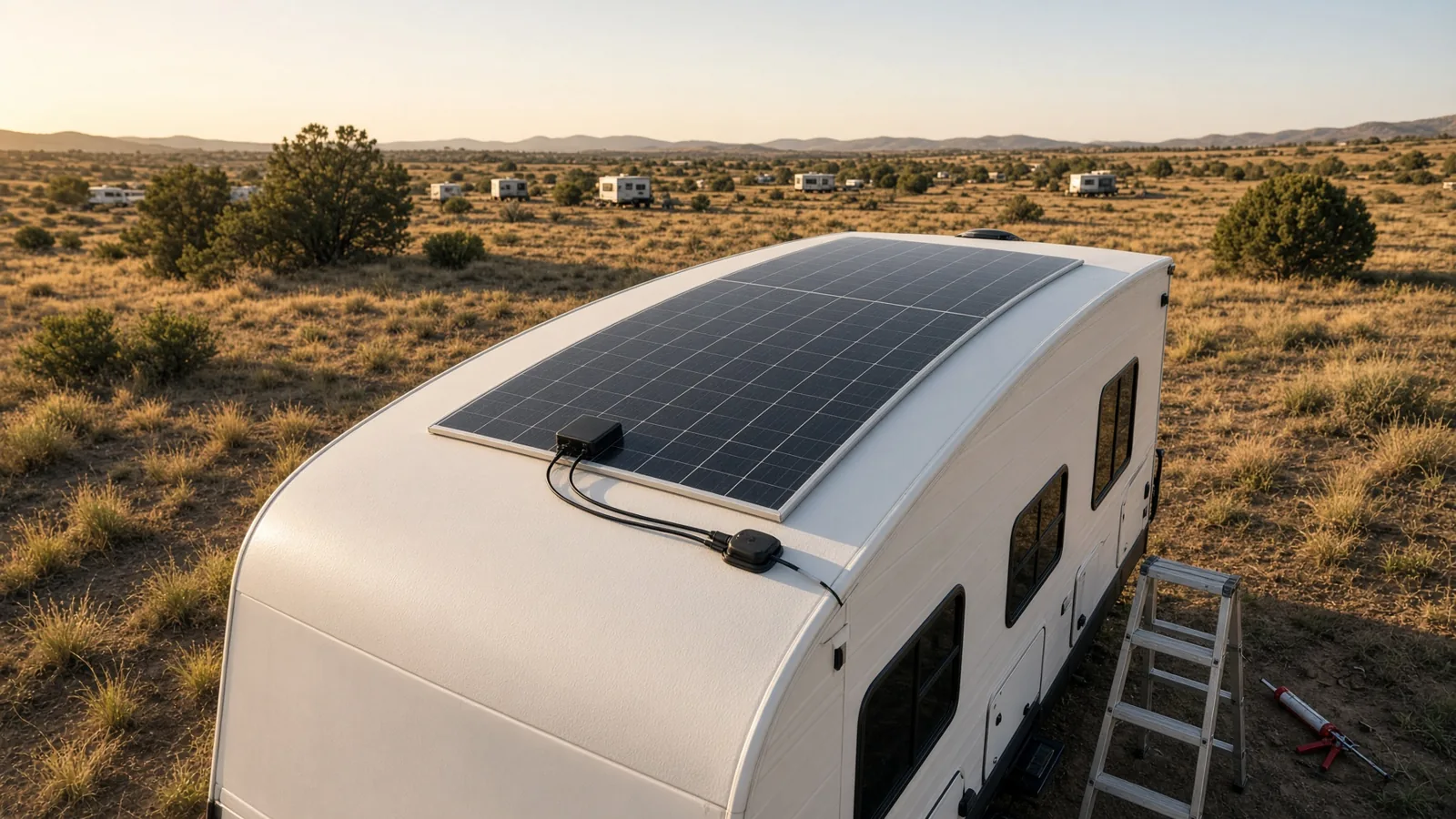
Flexible solar panels are thin, bendable modules that bond or bolt to a curved roof, and on an RV or manufactured home they cost about $1.25 to $1.56 per watt for mono versions and $1.70 to $2.15 for CIGS thin-film. They are 15 to 17 percent efficient at the module level, weigh 18 to 31 watts per pound, and typically carry a five-year product warranty. The catch is heat: bonded flat with no air gap under them, field measurements show roughly 17 to 19 percent of summer output disappearing.
Why flexible panels suit RV and mobile-home roofs
A travel trailer, van or single-wide rarely offers a flat, unshaded rectangle of roof. The surface curves toward the edges, the air conditioner and vents eat square footage, and every pound you add up high raises the center of gravity and the load on a roof structure that was never designed for a rack of glass modules.
A rigid 100 W panel weighs about 13 pounds and covers 34 by 23 inches before you add rails, feet and the fasteners that have to find a rafter. A flexible 100 W panel weighs 5.3 pounds, sits a tenth of an inch thick, and can follow a roof radius instead of fighting it. That weight difference — roughly 0.8 pounds per square foot versus 2.3 — is the whole reason this product category exists.
The trade is real, though. You are buying conformability and low weight with panel efficiency, service life and heat tolerance. Knowing where each of those three gives out is what separates a system that lasts a decade from one that delaminates in three summers.
The pros and the real cons
On the plus side, in numbers:
- Weight: 18 to 31 W per pound for flexible mono, about 34 W per pound for CIGS, against 7 to 8 W per pound for rigid glass.
- Thickness: 0.1 inch for laminated mono, as little as 0.06 inch for CIGS, so they tuck under a roof rack or a vent shroud.
- Mounting: adhesive or short screws into the deck, no rails, no tilted frame, nothing to snag on a tree limb.
- Shade tolerance when wired in parallel: a shaded panel drags down its own string, not the whole array.
On the minus side:
- Module efficiency of 14.9 to 17.3 percent means you need more square feet per watt than rigid panels at around 20 percent. Vendors advertising "22 to 25 percent" are quoting cell efficiency, not the finished module.
- Heat. With no air gap the cells run far hotter than a rack-mounted panel, and that costs 10 to 19 percent of output depending on the day.
- Service life. The warranty is typically five years on flexible mono, versus 10 years product and 25 years performance on rigid. There is no independent long-term field data for flexible modules the way there is for glass.
- Nobody should walk on them. The "walkable" label on some CIGS listings is a manufacturer claim, not a tested rating.
What flexible panels cost per watt
US retail, late 2026, across the four formats buyers actually compare:
- Flexible monocrystalline: $1.25 to $1.56 per watt.
- Flexible CIGS thin-film: $1.70 to $2.15 per watt.
- Rigid monocrystalline: $0.77 to $1.35 per watt.
- Folding portable: $1.12 to $1.50 per watt.
Concrete listings show how the spread works out. A Renogy 100 W flexible panel measures 43.0 by 22.9 by 0.1 inches, weighs 5.3 pounds and sells for about $149, which is $1.49 per watt. The 200 W version, 63.2 by 29.4 inches and 10.8 pounds, runs $280 to $312, or $1.40 to $1.56 per watt. A BougeRV Yuma 200 W CIGS panel, 82.8 by 27.1 inches and 5.95 pounds, lists at $409.99 — $2.05 per watt. Compare a Renogy 100 W N-type rigid panel at 13 pounds and $109.99, or $1.10 per watt.
Multi-packs move the price. The same 200 W flexible panel drops to about $1.44 per watt in an eight-pack, and the rigid 100 W falls to $0.77 per watt in a four-pack — a range worth checking before you buy singles.
Efficiency: what 15 to 17 percent actually means
Efficiency is the share of sunlight hitting the panel that becomes DC electricity. At 15 percent, a square meter of module makes about 150 W under standard test conditions; at 20 percent, about 200 W. In roof terms, a 100 W flexible panel takes roughly 6.8 square feet, while a 100 W rigid panel takes about 5.4 square feet.
For a mobile home with a 14-by-70 foot roof, that difference almost never matters — there is more roof than array. It matters on a camper van or a truck camper, where every square foot of usable deck competes with a vent, a skylight or a kayak. That is where CIGS earns its premium: at around 34 W per pound it is the lightest option per watt, which is why it dominates weight-critical builds despite costing about 40 percent more per watt than laminated mono.
One number to keep you honest: a 200 W panel that measures 82.8 by 27.1 inches has a surface area of about 15.6 square feet, so 200 W over 15.6 square feet is 12.8 W per square foot — about 13 percent module efficiency at best, not the 17 percent in the headline spec. Always divide watts by the panel's actual dimensions before comparing.
Weight per pound and what your roof can carry
Roof load is where manufactured housing and RVs diverge sharply.
Under HUD code 24 CFR 3280.305, manufactured-home roofs are engineered for 20, 30 or 40 pounds per square foot of live load depending on region — 20 psf in the South, 30 in the middle band, 40 in the North — with Wind Zone I requiring at least 9 psf net uplift resistance and 15 psf horizontal. A flexible array at 0.8 psf is a rounding error against those figures. A rigid array at 2.3 psf plus racking is still small, but the point loads at the feet are what crack ceiling panels.
RVs have no universal roof rating. The practical limits are the deck material (EPDM, TPO, fiberglass over lauan), the spacing of rafters, and how much weight the coach builder already put up there. A 400 W flexible array adds roughly 21 pounds spread over 27 square feet; the same wattage in rigid glass adds 60 pounds plus a rack.
How much they bend
Bend radius is the number most listings hide, and it is the one that decides whether a panel will sit flat on your roof curve or lift at the corners and collect wind.
- Renogy quotes 240 to 248 degrees of arc for its flexible mono line, 270 degrees for the ShadowFlux version. Worked out against panel length, that is a radius of roughly 9.9 inches on the 100 W and 14.6 inches on the 200 W.
- Sungold publishes a 200 to 400 mm range, or 7.9 to 15.7 inches.
- A 400 W Callsun panel specifies a 500 mm radius, about 19.7 inches.
- BougeRV's CIGS panel is the outlier — a claimed 360-degree roll, with independent reviews describing a maximum bend diameter around 11 inches.
Budget ETFE panels sometimes cap at 30 degrees of bend, which is not enough for a teardrop trailer's front curve. Since IEC 61215-1:2021 added a formal bending test (MQT 22), a spec sheet that names the standard is a better sign than one that says "flexible" and nothing else.
How much power 100 W actually makes
Nameplate watts are a laboratory number. What lands in the battery depends on sun hours, controller type and whether air moves under the panel. Using 14 percent system loss, 0.95 for an MPPT controller, 0.75 for PWM and 0.88 for a bonded install:
- MPPT, ventilated: 0.29 kWh per day at 3.5 peak sun hours, 0.37 at 4.5, 0.45 at 5.5.
- MPPT, bonded flat: 0.25, 0.32 and 0.40 kWh.
- PWM, ventilated: 0.23, 0.29 and 0.35 kWh.
- PWM, bonded flat: 0.20, 0.26 and 0.31 kWh.
Those figures line up with bench measurements of controller efficiency: 86.8 percent measured for MPPT against 71.4 percent for PWM on the same panel, and a matched-panel test that produced 292.2 Wh from MPPT versus 284.4 Wh from PWM over a day, as independent controller tests also report. The practical rule is that a 400 W bonded array with an MPPT controller returns about 1.3 kWh a day in a 4.5 sun-hour climate — enough for a compressor fridge, lights and device charging, not enough for air conditioning. For the broader picture of how irradiance becomes energy, the EIA's solar explainer is a plain-language starting point.
Heat: the bonded-panel penalty
This is the single biggest mistake in DIY flexible installs, and there is hard data on it.
An owner field test on a bonded flexible array recorded panel temperatures around 71 °C, a calculated 19.3 percent output loss and a measured summer loss near 17 percent — about 15 percent worse overall than a rigid panel on the same vehicle. Adding corrugated plastic underlayment did not lower panel temperature at all, because a compressible layer with no through-path for air just insulates.
The physics is in the Sandia module temperature model: a module with an insulated back runs about 57.5 °C above ambient, against about 29 °C for an open-rack mount. That 28 °C difference translates to roughly 10 to 12 percent of power. Temperature coefficients make it concrete — minus 0.42 percent per °C for flexible mono, minus 0.38 for CIGS — so a 30 °C swing costs about 12 percent on the mono panel.
The fix is a small air gap. PVWatts models an open rack at a 45 °C installed nominal operating cell temperature and about 49 °C on four-inch standoffs, which recovers most of the penalty; manufacturers claim a 5 to 10 mm gap is worth 3 to 5 percent. On a curved roof where a full rack is impractical, standoffs at the corners plus a vented mat gets you part of the way. EnergySage's flexible panel overview covers the same trade-off from a residential buyer's angle.
Shade, wiring and why parallel wins on a curved roof
Partial shade hits flexible arrays harder than owners expect, and the wiring pattern decides how hard.
Forum tests with matched panels give a usable spread:
- Two panels in parallel, two cells shaded on one: 26 percent array loss.
- Two in parallel, one panel half shaded: 54 percent loss.
- Three in series, two cells shaded on one panel: 33 to 50 percent loss.
- A larger array with half of one panel shaded: 8 percent loss.
Each bypass diode costs 0.5 to 0.7 V when it conducts, so a string with three activated diodes loses 1.5 to 2.1 V before any cell loss is counted. On a roof with a stink pipe, a whip antenna and an air conditioner, that is why parallel wiring is the default for curved RV roofs: one shaded panel loses its own output instead of dragging the string, and parallel strings also work with a cheap PWM controller. Series-into-MPPT wins on a flat, open roof where the run to the controller is long and voltage drop matters.
Wire gauge at 20 A over 25 feet one way, for a 400 W parallel array: 10 AWG loses about 5 percent, 8 AWG about 3.1 percent, 6 AWG about 2 percent. Run the same array as 2S at 10 A and 10 AWG drops to about 1.25 percent. Size conductors at 156 percent of short-circuit current per NEC 690.8, which is 16.8 A for a Renogy 200 W panel.
Mounting: adhesive, screws and cable entry
Two mounting methods dominate, and both have failure modes.
Adhesive — VHB tape or a membrane-compatible sealant, with Sikaflex 715 the usual pick on TPO — avoids every penetration. It is the right call on a roof you cannot afford to leak, and it is the worst option thermally because the panel is glued flat. The load that matters is aerodynamic lift, not weight, so the adhesive has to be a rated structural product, not construction adhesive.
Screws and grommets must land in rafters or deck structure, never in membrane alone. Seal each fastener with self-leveling lap sealant (Dicor is the common choice) and never use household silicone on EPDM or TPO — it will not bond and it traps water.
Cable entry is where most leaks start. Use a sealed roof gland bedded in lap sealant, UV-rated PV wire, and mark DC polarity per NEC 690.31. On the electrical side, NEC 551 excludes systems at 24 V nominal or below from most of its requirements, NFPA 1192 4.3.2 points to the ANSI/RVIA low-voltage standard, inverters must be RV-listed under 551.33, and an 8 AWG frame bond is required by 551.20(C). Check the current edition before you rely on any of it.
How long flexible panels last
Plan on five years of good service, and treat anything longer as a bonus.
Flexible mono modules typically carry a five-year product warranty, with output around 90 percent at five years. CIGS is the exception — BougeRV warrants 10 years product and 25 years performance — but the field record is short. Rigid panels carry 10 years product and 25 years at 80 percent output.
Degradation benchmarks come mostly from glass. NREL's fleet data puts median degradation at 0.5 percent per year and mean at 0.8 percent, with thin-film subsets running nearer 1 percent. Flexible modules have no comparable dataset; the honest number is "unknown, assume worse."
Known failure modes, from practitioner reports: PET front sheets yellow and go opaque, edge seals let moisture in, cells microcrack at the busbars, interconnect ribbons fatigue where the panel flexes, hotspots form around a failed cell, and junction-box seals fail. In glass-module studies, junction box and cable failures account for about 12 percent of relative failure rate, and delamination produces 0 to 20 percent power loss with a mean near 10 percent. On a flexible panel, delamination is the failure that matters, because the laminate is the structure.
Flexible vs rigid vs folding: the comparison
Carry the same information as a list, because it is what the decision comes down to:
- Cost per watt: rigid $0.77–$1.35, folding $1.12–$1.50, flexible mono $1.25–$1.56, CIGS $1.70–$2.15.
- Module efficiency: flexible mono 14.9–17.3 percent, CIGS around 17 percent cell, rigid about 20 percent, folding 22–23 percent claimed at cell level.
- Watts per pound: CIGS about 34, flexible mono 18–31, folding 11–14, rigid 7–8.
- Service life: rigid 25+ years with a 10-year product warranty; flexible about 5 years typical; CIGS 10 years product on paper.
- Installation effort: flexible bonds or screws down in an afternoon; rigid needs rails, feet, rafter finding and sealing; folding needs nothing but a place to lean it.
- Heat behaviour: rigid on a rack is coolest, folding in a breeze is next, bonded flexible is worst.
- Theft and wind: flexible is the least stealable and the least wind-catching.
If your roof is flat and you can accept the weight, rigid wins on every economic measure. Flexible wins when the roof curves, the weight budget is tight, or the panel has to be invisible from the ground.
Sizing a system for a 30-amp RV or a single-wide
Work backwards from daily energy, not from panel count.
A 30-amp RV service caps charging at about 360 W through a 30 A controller at 12 V, though most owners stay under 400 W of array to leave headroom. At 400 W bonded with MPPT in a 4.5 sun-hour climate that is about 1.3 kWh a day — a 12 V compressor fridge at 40 to 60 Ah daily plus lights and charging. Push to 600 W ventilated and you are near 2.2 kWh a day, which covers the fridge, a laptop and a small inverter load without generator time.
For a single-wide, the arithmetic is starker. A 3 kWh daily load in a 5.5 sun-hour climate needs about 750 W of bonded flexible array, or roughly 660 W if you can ventilate it. That is a $1,000 to $1,600 panel purchase at current flexible prices, before controller, wire and mounting — and it is the point where a small rigid array on a ground mount usually makes more sense financially. Use the panel figures above, not a marketing calculator, and derate for winter: December sun hours in most of the US are 40 to 50 percent below June.
Who should not buy flexible panels
Skip them if any of these is true:
- Your roof is flat, unobstructed and can carry 3 psf. Rigid glass at half the price per watt will outlast three flexible arrays.
- You want a 20-year install. The warranty is five years for a reason.
- You plan to walk on the roof regularly for maintenance.
- You need maximum watts in minimum area — 15 percent efficient modules need a third more roof than 20 percent ones.
- You are buying the cheapest ETFE panel on a marketplace listing with no bend radius, no laminate spec and no temperature coefficient. That is the profile that delaminates first.
The alternative worth pricing before you commit: a folding portable panel you deploy on the ground, wired to the same controller. It is heavier per watt, must be stowed, and can walk away, but it runs cooler, lasts longer and costs less per watt than bonded flexible.
Troubleshooting three failures you will actually hit
Output falls off after the first summer. Check panel temperature first, not the panel. If the module is too hot to hold a hand on at noon, you are losing 10 to 19 percent to heat, and the fix is airflow, not a new panel. Compare morning output to noon output on the same day — a 25 to 30 percent drop points at temperature, a sudden 50 percent drop points at a shaded or failed cell string.
Brown or yellow patches under the front sheet. That is UV degradation of a PET surface or moisture in the edge seal. It is not recoverable. Test the panel's short-circuit current against its spec on a clear day; anything below 80 percent of rated current means replacement.
Water at the cable gland. The most common leak on a flexible install, and the cheapest to prevent. Re-bed the gland in lap sealant, check that the cable has a drip loop, and confirm the sealant is compatible with the membrane — silicone on EPDM or TPO is a guaranteed rework.
FAQ
Are flexible solar panels worth it for an RV?
Yes, when the roof curves or the weight budget is tight. They cost roughly 30 to 60 percent more per watt than rigid panels and last about five years instead of 25, so the justification is physical, not economic.
How many watts of flexible panel do I need?
Start from daily watt-hours, not roof space. Divide your daily load by 0.32 kWh per 100 W for a bonded MPPT system in a 4.5 sun-hour climate; a 1.3 kWh daily load needs about 400 W.
Do flexible solar panels overheat?
They run hotter than rack-mounted panels because there is no air gap behind them. Expect 10 to 12 percent loss from the temperature rise alone and up to 19 percent in a worst-case bonded install, per field tests and the Sandia temperature model.
Can I walk on flexible solar panels?
No. Laminated mono panels are not rated for foot traffic, and the "walkable" claim on some CIGS listings is a manufacturer statement rather than a tested rating. Use a walkway or step around them.
How long do flexible solar panels last?
About five years is the realistic planning figure, matching the typical five-year product warranty. CIGS modules carry 10-year product warranties, but there is no long-term independent field data for flexible modules.
Do flexible panels work with a PWM controller?
Yes, and parallel wiring suits PWM. Expect about 71 to 75 percent controller efficiency from PWM against 87 to 95 percent from MPPT, which is roughly 15 percent less daily energy from the same array.
What is the minimum bend radius?
It varies from about 5.5 inches on CIGS to 19.7 inches on a 400 W laminated panel. Renogy's flexible mono line works out to roughly 9.9 inches on the 100 W and 14.6 inches on the 200 W. Check the spec before buying.
Can flexible panels be mounted with adhesive only?
Yes. VHB tape or a TPO-compatible sealant such as Sikaflex 715 is a valid no-penetration mount, provided it is a rated structural adhesive. The trade-off is the worst thermal case, since the panel sits flat against the membrane.
Do flexible panels need an air gap?
They benefit from one. A ventilated standoff recovers most of the 10 to 12 percent heat penalty the Sandia model predicts, and manufacturers claim 3 to 5 percent from a 5 to 10 mm gap.
Are flexible panels better in shade?
Only when wired in parallel. A half-shaded panel in a parallel pair cost 54 percent of array output in forum testing, while series strings lost 33 to 50 percent from just two shaded cells.
What efficiency should I expect?
14.9 to 17.3 percent at the module level for flexible mono, around 17 percent for CIGS cells, against about 20 percent for rigid mono. Divide rated watts by actual panel area to check any listing's claim.
Can I add flexible panels to a manufactured home roof?
Yes. At about 0.8 pounds per square foot they are negligible against the 20 to 40 psf live-load ratings in HUD 24 CFR 3280.305. Fasten or bond to the deck structure, seal every penetration, and confirm the roof membrane type before choosing an adhesive.