
Guide
How Do Solar Panels Work? Real Output for Mobile Homes
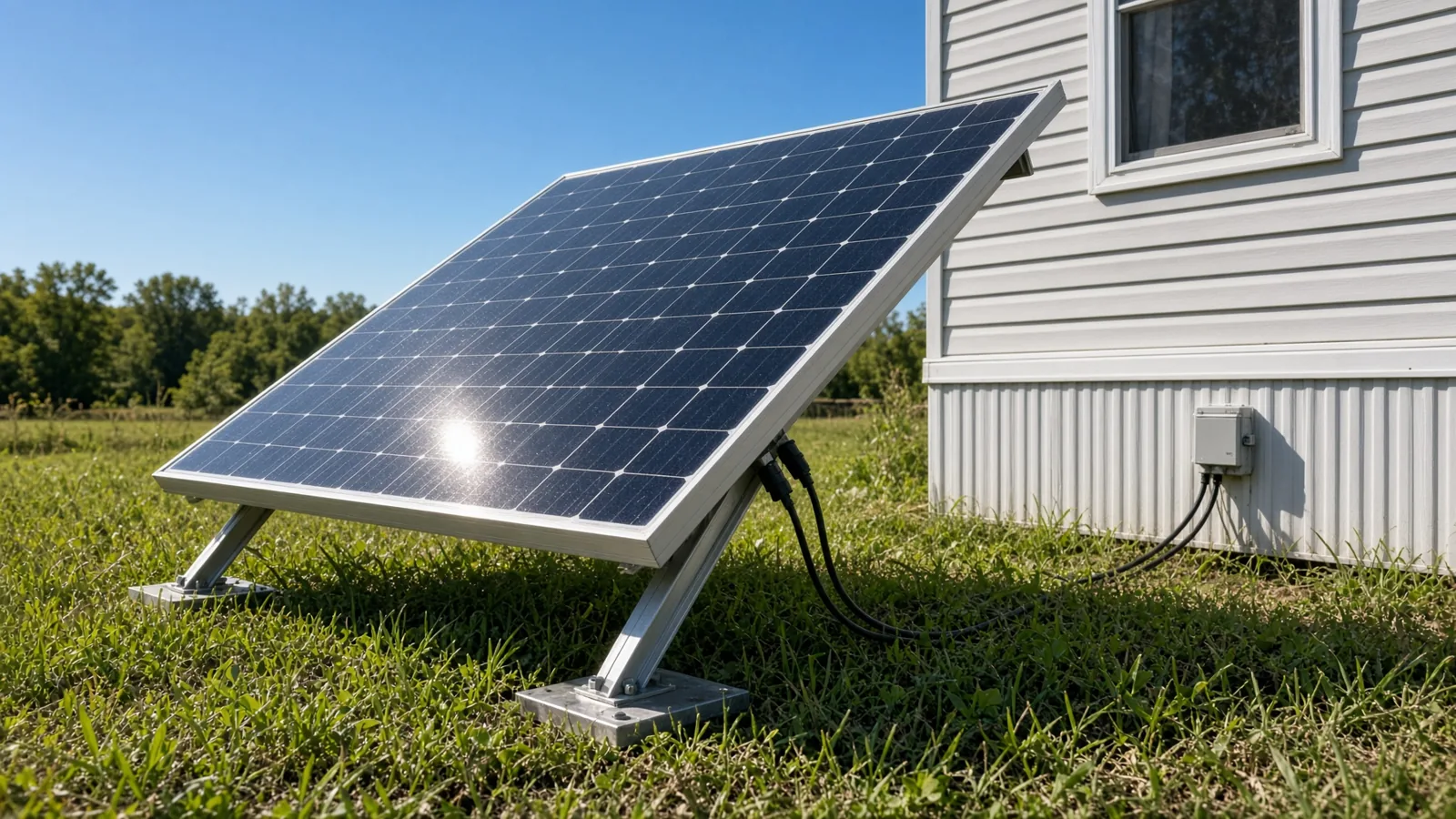
A solar panel is a silent chemical sandwich: sunlight knocks electrons loose inside silicon, an electric field built into every cell pushes them one way, and metal fingers collect them as direct current. On a manufactured home or an RV roof the physics is identical, but heat, roof load and mounting angle decide how much of the nameplate rating you keep. A 400 W panel is a useful worked example: expect roughly 478 to 792 kWh a year in the US, depending on where you live.
What happens inside a solar cell
Silicon absorbs light only above a threshold. Photons carrying more than silicon's band gap of about 1.1 electron-volts lift an electron out of its bond, leaving a positively charged "hole" — one pair per absorbed photon. That threshold is why a single silicon junction tops out in the high twenties for efficiency.
The junction does the separating. Each wafer is doped so one side carries extra electrons (n-type, usually phosphorus) and the other extra holes (p-type, usually boron). Where they meet, a depletion region forms with a built-in electric field that sweeps electrons toward the n-side and holes toward the p-side before they recombine. A voltage appears across the cell — about 0.6 to 0.74 V open-circuit, whatever its size. The Department of Energy's photovoltaics primer walks through the sequence. Cell size changes current, not voltage, so cells are wired in series: 60 cells at roughly 0.62 V gives the 37 to 41 V a residential module lists on its label.
Layer by layer: what a panel is made of
From the front: tempered glass about 3.2 mm thick, an EVA or POE encapsulant, the strung cells, a second encapsulant, a polymer backsheet (or rear glass on bifacial modules), and an aluminum frame that supplies stiffness, mounting points and a grounding path. A junction box carries the output cables and three bypass diodes, each spanning a third of the module so a shaded substring routes current around itself instead of collapsing the panel into a hot spot. EnergySage's explainer covers the construction in more depth.
From DC to AC: what the inverter is doing
The inverter re-synthesizes panel DC into 60 Hz, 120/240 V AC, tracking the maximum power point as light and heat move. PVWatts assumes 96% nominal inverter efficiency, so reserve about 4% of production for conversion.
Why a 400 W panel almost never makes 400 W
Nameplate ratings are measured at Standard Test Conditions: 1,000 W/m², a 25 °C cell, AM1.5 spectrum. A roof panel in July is nowhere near 25 °C. Cells run 20 to 30 °C above ambient in full sun, and each degree above 25 °C costs output at the module's temperature coefficient — about 0.29 to 0.32 %/°C for the n-type TOPCon modules that dominate the 2025–26 market, and 0.39 to 0.43 %/°C for older polycrystalline or flexible panels.
Manufacturers also publish NMOT (the IEC 61215 replacement for NOCT), measured at 800 W/m², 20 °C ambient air and 1 m/s wind; NMOT power typically lands at 74 to 76% of STC. PVWatts applies a 14.08% loss stack by default — soiling 2%, shading 3%, mismatch 2%, wiring 2%, connections 0.5%, degradation 1.5%, nameplate tolerance 1%, availability 3% — plus roughly 4% for the inverter. That is a derate near 0.83 before temperature is counted.
Real output: one 400 W panel in four US cities
The same 400 W module, fixed and south-facing, produces very different energy by geography: Phoenix 2.17 kWh/day (about 792 kWh a year), Los Angeles 1.86 (679), Chicago 1.42 (518), Seattle 1.31 (478). The seasonal gap is wider than the annual one — December output in Phoenix falls to 58% of June, while Seattle collapses to about 26%. That is why off-grid RV systems get sized to the worst month, using NREL's PVWatts calculator with real tilt and azimuth.
Do solar panels work in clouds, rain and at night?
Clouds and rain yes, night no. Heavy overcast leaves 10 to 25% of rated output because diffuse skylight still reaches the cells; steady rain drops that to 5 to 15% while rinsing off dust that cost you a couple of percent anyway. At a cloud edge, irradiance can briefly spike to 1,100–1,400 W/m² and push a system 5 to 30% above STC, which is why controllers and fuses need headroom. At night output is zero: batteries or the grid carry the load.
What changes on a manufactured home or RV roof
Structure comes first. HUD Code roof design loads are 20 psf in the South zone, 30 psf in the Middle and 40 psf in the North, meant for snow and live loads; an array adds 2 to 4 psf permanently. On an older single-wide with light trusses that is not automatically safe — read the data plate, and if the roof is past about 20 years or in a snow zone, price a ground mount first.
Heat comes second, and the mounting gap decides it. An open rack is the baseline; a 4-inch standoff adds 3 to 5 °C, a close 2-inch roof mount adds 8 to 12 °C, and a flexible panel glued flat adds 15 to 25 °C. At −0.35 %/°C that last case costs 5 to 9% of output at identical irradiance. Rigid panels on standoffs with an MPPT controller are the better RV answer; keep 12 V systems under roughly 600 W and move to 24 V or 48 V above 800 W.
NEC 690.12 rapid shutdown covers PV on or in buildings, including a sited manufactured home: conductors more than 1 ft outside the array boundary must fall to 30 V within 30 seconds, which in practice means microinverters or optimizers.
What it costs in 2026, and the credit that ended
LBNL's Tracking the Sun puts the median 2024 US residential system at 7.2 kW and $4.0/W, with cash purchases at $3.5/W. EnergySage's 2026 marketplace data shows a much lower median quote, around $2.57/W in the first half of the year, but small systems carry more fixed cost per watt — and a manufactured-home array is usually small. Policy changed more than prices: the 30% Section 25D credit ended for expenditures made after December 31, 2025, and the IRS treats an installation completed after that date as made after it even if you paid earlier. A $25,000 system that netted $17,500 in 2025 now costs the full amount, stretching payback by roughly 40%. EIA's solar explainer covers the wider US picture.
FAQ
How does a solar panel work step by step?
Photons free electrons in silicon, the junction's field separates them, metal fingers collect DC current, and an inverter converts it to AC.
Do solar panels work on cloudy days?
Yes — 10 to 25% of rated output under heavy overcast and 50 to 80% under broken cloud.
Do solar panels work at night?
No. No photons means no current, and moonlight is negligible; batteries or the grid cover the night.
Do solar panels work in the rain?
Yes, at roughly 5 to 15% of rated output, and rain rinses off soiling. Heavy snow is the one event that can zero output for days.
Why is my electric bill high with solar panels?
Usually an undersized array, a grid-tied system without batteries, or an unnoticed fault; roughly one in ten systems runs 17% or more below model.
What are the disadvantages of solar panels on a mobile home?
Roof load (20–40 psf design versus 2–4 psf added), heat build-up on low-slope metal roofs, and the loss of the federal 25D credit in 2026.
How much do solar panels cost for a mobile home in 2026?
Budget from about $2.60/W in competitive quotes up to $3.50/W for a completed cash purchase, with no federal residential credit after 2025.