
Guide
How Long Do Solar Panels Last? Lifespans for Mobile Homes and RVs
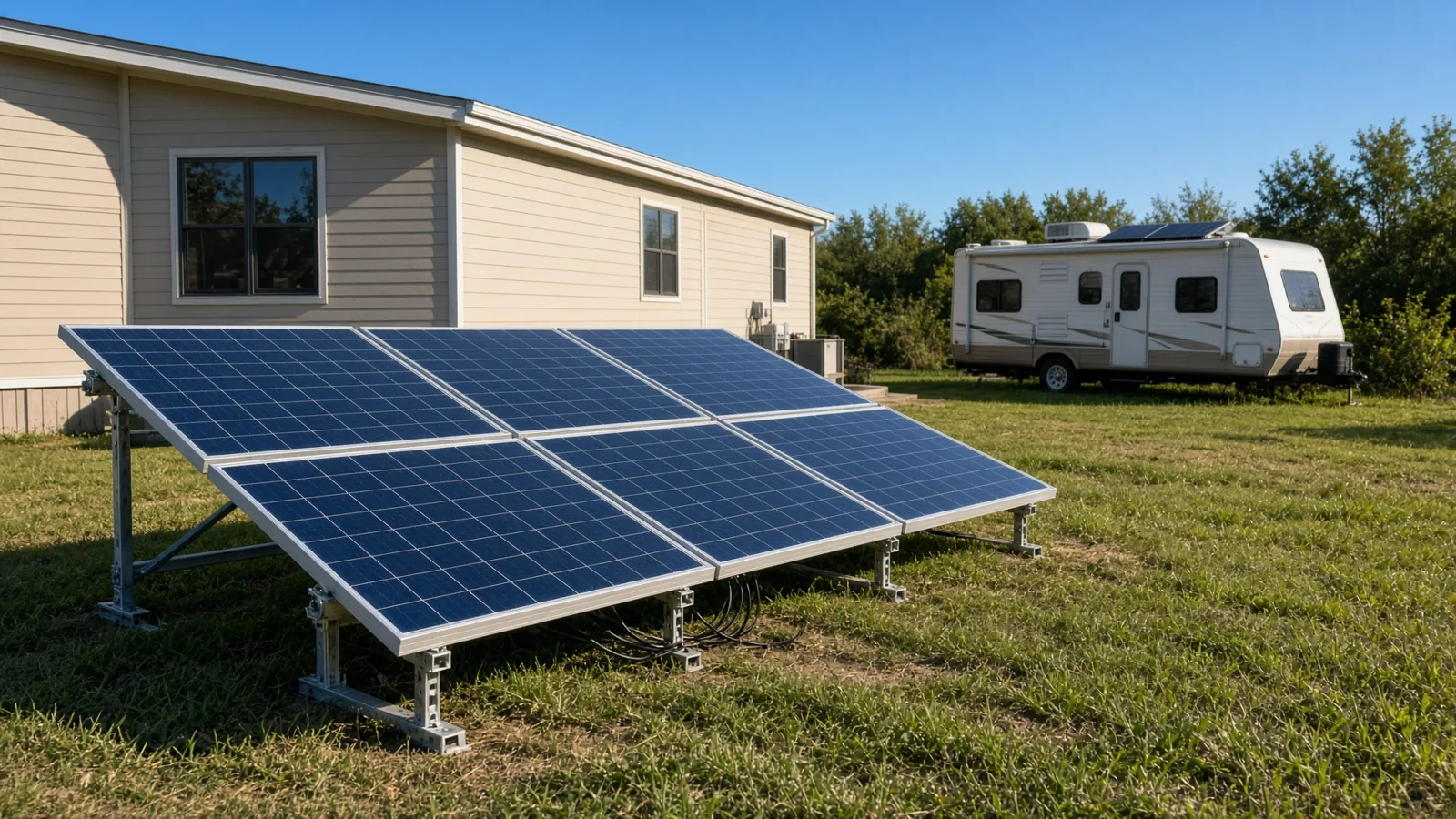
The short answer
A rigid monocrystalline solar panel bolted to a mobile home or RV roof is built to keep producing useful power for 25 to 30 years, and most of them do. Solar cells do not die, they fade: manufacturers define the end of a panel's life as the point where it falls below 80% of its rated wattage.
What actually ends a panel's working life on a manufactured home is rarely the silicon. It is the mounting, the heat, the road vibration and the wiring around it. Flexible panels are a different story altogether: budget expect 3 to 5 years of real service (up to 10 with premium ETFE or CIGS laminates), not the 25 years printed on the box.
What "end of life" really means
The 80% rule matters because it is the floor most performance warranties guarantee at year 25 or 30. A 400 W panel that has faded to 340 W is still perfectly usable - it just no longer matches the maths you did when you sized the charge controller and battery bank. If you built your system with a 20% safety margin, a 20-year-old array will still run your loads.
Real degradation rates, by panel technology
The most cited field data is the NREL meta-analysis by Jordan and Kurtz, which pooled more than 2,000 systems worldwide (later expanded past 54,000) and found a median degradation rate of about 0.5% per year for crystalline silicon, with a spread from 0.2% per year for premium modules to more than 1.4% per year in harsh desert conditions.
- N-type mono (TOPCon, HJT): 0.25-0.4% per year. No boron-oxygen light-induced degradation.
- P-type mono (PERC): 1-2% in the first days of sun exposure, then 0.5-0.7% per year.
- Polycrystalline: 2-3% initial light-induced degradation, then 0.7-1.0% per year.
- Thin film (CdTe, CIGS): 0.35-0.8% per year, with a gentler temperature coefficient that
helps in hot climates.
That compounding is what turns a spec sheet into a lifespan. A panel losing 0.5% a year keeps about 87% of its output at year 25; one losing 1.0% a year is down to 78% - below the industry's own definition of end of life, two decades early.
How long do solar panels last on a mobile home or RV?
Mechanically, the same 25-30 years applies - but only if the panel is mounted properly. Mobile installations add three stressors that fixed rooftop systems never see:
Vibration and microcracks
Highway and dirt-road travel send high-frequency shocks through the frame. In glass-laminated panels this shows up as microcracks 0.1-0.3 mm wide inside the cells. Field studies find that severely microcracked modules lose more than 10% of their power after six years of continuous high-vibration service compared with intact panels. On flexible laminates, wind buffeting at highway speed flexes the panel cyclically until the internal busbars fracture.
Heat and mounting height
Z-brackets lift a rigid panel 2.5-5 cm off the roof and let air convect underneath, keeping cells 15-25 C cooler than a flush mount. Because silicon loses 0.35-0.45% of output per degree above 25 C, that airflow can recover close to 10% of instantaneous production - and it slows the cooking of the encapsulant. Flexible panels glued straight to the roof with polyurethane or VHB tape have no airflow at all. On a 35 C day the metal or fibreglass roof skin under them can exceed 70 C, which yellows the EVA and can cut panel life to 2-5 years. If you want a step-by-step parts list for this kind of build, this complete RV camper solar guide walks through mounting, wiring and controller sizing.
Soiling and shade
Flat or low-tilt mounting collects dust, sand, soot and bird droppings. NREL puts the global average soiling loss at 4-7% a year, but in the arid Southwest or after a stretch of dirt-road travel, dirty glass can cost 15-30% of daily production. Uneven soiling is worse than uniform dirt: it acts as permanent shade and drives hotspot formation. Rooftop AC units, antennas and ladders cause the same problem.
Warranty fine print for DIY and RV brands
- SunPower / Maxeon (rigid residential): 40-year product and performance warranty, 98% of
rated output at year 10, 92% at year 25, 88.25% at year 40.
- Panasonic EverVolt: 25 years, 92% at year 10 and 86% at year 25.
- Renogy rigid monocrystalline (DIY / RV): 10-year product warranty, 25-year performance
warranty (90% at year 10, 80% at year 25).
- Renogy flexible monocrystalline: 5 years on both product and performance.
- Rich Solar rigid monocrystalline: 10-year product, 25-year performance (90% / 80%);
the Mega Pro line promises 95% at year 10.
The gap between a 10-year product warranty and a 25-year performance warranty is where DIY buyers get hurt. Performance warranties only cover gradual power loss. Leaks, corroded frames and cracked junction boxes are product defects, and on most budget panels that coverage ends after a decade.
What wears out before the panels do
In a mobile or off-grid system the panels are usually the longest-lived component. Budget for replacing everything downstream of them at least once:
- Off-grid/RV inverter-charger (2-3 kW): 5-10 years, $400-1,200 to replace; fixed
residential string inverters last 10-15 years and cost $1,000-2,500.
- Microinverters: 20-25 years, $150-250 each.
- MPPT charge controller: 10-15 years, $100-400. A cheap PWM controller lasts 3-5 years,
costs $20-60, and throws away 20-30% of what the array produces.
- AGM battery: 300-500 cycles at 50% depth of discharge, which works out to 3-5 years of
daily use, $150-300 per 100 Ah.
- LiFePO4 battery: 3,000-5,000+ cycles at 80-90% depth of discharge, or 10-15 years,
$300-800 per 100 Ah. This LiFePO4 vs AGM comparison covers the cycle-life trade-off in detail.
Common failure modes - and when they show up
The IEA PVPS Task 13 review of field failures groups module problems by when they occur:
- Years 0-2: junction box and bypass diode failures, about 12% of module failures.
Boxes sealed below IP67/IP68 let moisture corrode the busbars, and repeated partial shading thermally destroys the bypass diodes. Potential-induced degradation can cost up to 30% of output on long, high-voltage series strings in humid conditions.
- Years 3-10: hotspots and burn marks, about 10% of failures. A shaded, soiled or
microcracked cell is forced to carry the current of its neighbours and can exceed 150 C; module output drops 35-46% as the damage spreads.
- Year 10 onward (rigid) or years 2-4 (cheap flexible): delamination and encapsulant
failure, about 9% of failures. Moisture gets between the glass and the cells, corrosion follows, and output falls by 10-20%.
Making yours last longer
- Mount rigid panels on Z-brackets, never flush, and leave the air gap clear.
- Wash the array every few months, and always after dirt-road travel.
- Re-torque and inspect mounting hardware and cable glands each season - vibration is
what kills mobile installs.
- Pair panels with an MPPT controller and LiFePO4 storage so the array is not strangled
by the rest of the system.
- Cut the shade: relocate antennas and stow ladders when parked.
- Track output with a cheap shunt monitor so a 5% annual slide is visible instead of a
surprise.
End of life: recycling
A standard rigid crystalline module is roughly 76% glass, 10% aluminium frame, 8% polymers, 5% silicon and 1% conductor metals (copper, silver, tin, lead). Industrial recycling recovers 90-95% of that mass - 100% of the aluminium, 90-95% of the glass, 95% of the copper and 85% of the silicon - which is why rigid panels are worth handing to a dedicated PV recycler. Flexible laminates are the opposite problem: separating PET/ETFE layers from thin silicon recovers less than 50% of the material, so they are far more likely to end up in landfill. A solar panel recycling explainer covers what the recovery process actually captures.
Bottom line
Rigid monocrystalline panels on a mobile home or RV should give 25-30 years of service, and a good N-type module will still be at roughly 92% of its rating at year 25. Flexible panels are a consumable: assume 3-5 years and buy them knowing that. Budget for the inverter, controller and batteries to be replaced once or twice along the way - and treat mounting and cleaning as maintenance, not afterthoughts, because on a moving home they are what decide whether you get 8 years or 25 out of the same panel.
Sources
- IEA PVPS Task 13 - Review of Failures of Photovoltaic Modules
- Jordan & Kurtz (NREL) degradation-rate data, via a year-25 production calculator
- SOLARCYCLE - Quantifying the Impact of Solar Panel Recycling
- Solar Tech Online - Complete Guide to RV Camper Solar System Panels
- EV Lithium - LiFePO4 vs AGM batteries for RV and solar