
Guide
Maxeon Solar Panels in 2026: Specs, Warranty Risk and a Mobile Home Verdict
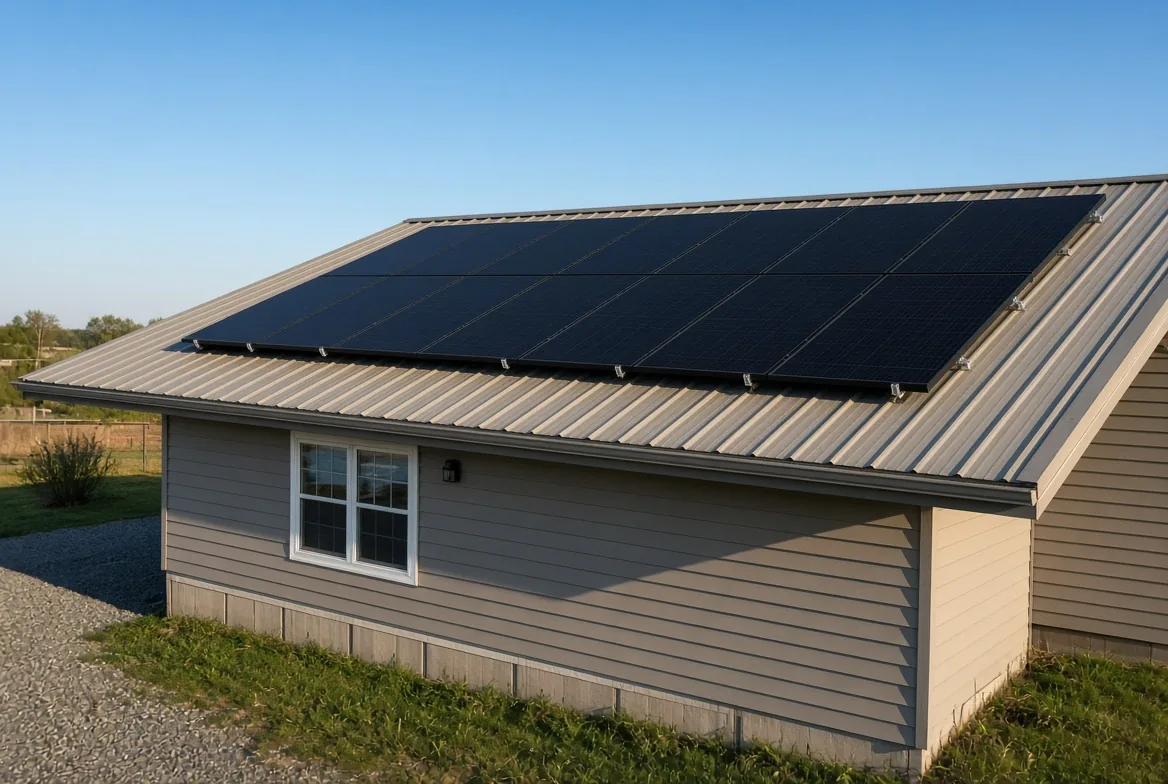
The short answer for mobile and manufactured home buyers
Maxeon solar panels are still among the best-performing modules you can buy in 2026: up to 445 W, 24.1% module efficiency, a -0.27%/C power temperature coefficient, and a warranted degradation rate of just 0.25% per year. What has changed is everything around the panel. The company that makes it has been in court-supervised restructuring since May 29, 2026, and no one has publicly committed to honouring its 25- to 40-year warranty.
For a mobile home or manufactured home owner, that changes the maths. On a small roof a Maxeon array saves roughly 2 square feet versus a top TOPCon array of the same capacity, and costs about $2,300 more. That is a lot of money to spend on a warranty that may never be paid out.
What Maxeon is today
Maxeon Solar Technologies was spun off from SunPower in 2020 and has been controlled by TCL Zhonghuan Renewable Energy Technology (TZE) since August 30, 2024, when a recapitalisation converted $137.2M of second-lien bonds and added a $100M equity purchase at $0.1206 per share. Shares outstanding went from 55.7 million to roughly 1.4 billion.
The 2026 timeline is the part every buyer should read before signing anything:
- November 2025: Maxeon surrendered its Albuquerque brownfield lease; the landlord sued for rent through November 30, 2029.
- February 5, 2026: the company settled its back-contact patent litigation with Aiko. Aiko licensed the patents outside the US only.
- April 1, 2026: Maxeon applied for judicial management in Singapore, citing customer claims of more than $70M.
- April 24 - May 1, 2026: Nasdaq issued a delisting determination and trading was suspended.
- May 22, 2026: Maxeon sold TZE Hong Kong a non-exclusive worldwide licence to its patents and trade secrets for $8M.
- May 29, 2026: the High Court of Singapore ordered full judicial management.
- June 18, 2026: the bond trustee declared all first- and second-lien notes immediately due.
Judicial management typically runs 180 days from that order, so the first real decision point falls in late 2026. PV Tech reported on the application and pv magazine USA covered the Singapore filing; the filings themselves are on SEC EDGAR.
Two practical consequences matter on a mobile home:
US supply is now a patchwork. US Customs and Border Protection has been detaining Maxeon 3, Maxeon 6 and Performance 6 modules assembled in Mexico, and in 2025 CBP denied the company's protests, as Solar Power World reported. Maxeon's filings say it now sells US-assembled back-contact modules through distribution partners, and Greentech Renewables is the main channel. Everything else is distributor stock of uncertain age.
SunPower is not Maxeon. SunPower Corp. went bankrupt in August 2024; Complete Solaria bought parts of the business and rebranded as SunPower in 2025. "SunPower Maxeon" panels and SPR- part numbers are Maxeon hardware, but a 2026 SunPower-branded panel is a different company's product.
Maxeon panel specs in 2026
All figures are from manufacturer datasheets unless noted. The 40-year warranty applies only to registered installations by a Maxeon Partner installer; standard terms are 25/25.
Maxeon 3 (SPR-MAX3, 112-cell) - 415-430 W, 22.7% max efficiency, -0.27%/C, 98% in year 1 then -0.25%/yr with 92.0% warranted at year 25, 1812 x 1046 x 40 mm, 21.2 kg (46.7 lb).
Maxeon 6 (SPR-MAX6, 66-cell) - 425-440 W, 22.8%, -0.29%/C, same 0.25%/yr degradation curve, 1872 x 1032 x 40 mm, 20.9 kg (46 lb). The Maxeon 6 datasheet lists a 48.2 V maximum-power voltage, which matters off-grid.
Maxeon 7 (SPR-MAX7-PT, 112-cell) - 435-445 W, 24.1%, -0.27%/C, 1787 x 1035 x 40 mm, 20.7 kg (45.6 lb).
Maxeon 7 (SPR-MAX7, 120-cell) - 465-475 W, 24.0%, -0.27%/C, 1913 x 1035 x 35 mm, 21.1 kg (46.5 lb).
Performance 3 / 6 / 7 (shingled) - the value tier: 370-385 W at 19.6%, 395-425 W at 21.1% and 440-455 W at 22.4%. Degradation is -0.45%/yr, the warranty is 25/25, and the temperature coefficient is worse at -0.34%/C.
What the back-contact design actually buys you
Interdigitated back contact (IBC) cells move both the positive and negative contacts to the back of the cell, so there is no metal grid on the front face. Every square millimetre of the front collects light, which is why back-contact panels have historically topped efficiency tables. Maxeon bonds its cells to a plated solid-copper foundation that the company says stops micro-cracks from spreading into the cell.
Datasheets claim an "electrical architecture that mitigates the impact of shade and prevents hot-spot damage". Those claims rest largely on Maxeon- and SunPower-commissioned testing, so treat them as vendor claims rather than independent results.
Heat, by contrast, is measurable. At a 65C cell temperature, 40C above test conditions, a -0.27%/C coefficient leaves about 89.2% of nameplate against 86.4% for Performance 3/6 modules and 86.0% for a generic mono PERC panel. In a hot, low-pitch mobile home install that gap is real.
Maxeon no longer leads on efficiency
Clean Energy Reviews' 2026 efficiency ranking puts Aiko's Neostar 3P54 (ABC, 25.0%), Recom's Black Tiger (24.8%) and LONGi's Hi-MO X10 (HPBC 2.0, 24.3%) ahead of the Maxeon 7. Jinko's Tiger Neo III (TOPCon, 24.0%) and Trina's Vertex S+ (TOPCon, 23.8%) sit within 0.1-0.3 points of it, and TOPCon is now the mass-market standard, so it is widely available and cheap. No commercial release of a Maxeon 8 has been confirmed.
The price premium, in numbers
EnergySage's Maxeon review recorded an average of $3.35/W installed across more than 10,000 quotes in the first half of 2024, roughly 20% above its own marketplace average, which stood at $2.60/W for all brands in 2026. Mid-range brands such as Q CELLS, Canadian Solar and Jinko land at $2.60-$3.00/W installed.
These price figures are the weakest data in this guide. They mix 2024 and 2026 sources and rely partly on secondary reporting, and there is no verifiable current US retail price because Greentech Renewables is quote-only. Get written quotes before you compare.
Two on-site realities matter more than the sticker:
- Space: a 3.1 kW array needs about 12.9 m2 with 24.1% modules and about 14.8 m2 with 21% modules. On a single-wide that is the difference between using the roof you already have and running out of it.
- Money: at EnergySage's historic $0.75/W Maxeon premium, the same 3.1 kW array costs roughly $2,300 more.
Will a Maxeon panel work on your mobile home roof?
Roof load beats panel brand
Maxeon panels weigh 20.7-21.2 kg (45.6-46.7 lb) each, about 2.2-2.3 lb per square foot for the module alone, essentially identical to competitors. A complete array with racking is usually estimated at 2-5 psf. Under the HUD Code, roof structural capacity typically runs 20-30 psf, and the HUD data plate, usually inside a kitchen cabinet or utility closet, lists your home's roof load and wind zone. Homes built before June 15, 1976 are generally unsuitable for roof arrays, and California's HCD requires a licensed engineer's stamped structural analysis for roof PV on manufactured homes.
Mounting and racking
Maxeon DC panels use standard 35-40 mm Class 1 anodised frames, so they fit ordinary rails and rail-less mounts. Test loads differ sharply by model: the Maxeon 6 is rated 4,500 Pa wind and 7,400 Pa snow (6,000/9,000 Pa with three rails in hurricane zones), the Maxeon 7 445-PT only 2,400 Pa wind and 5,400 Pa snow, and the Maxeon 7 475 W 4,050 Pa wind and 5,400 Pa snow. For a windy or high-snow site, or a tiny home that travels, the Maxeon 6 carries the strongest rating.
The off-grid catch
The 112-cell Maxeon 3 and Maxeon 7-PT run at roughly 70-71 V at maximum power and 81-83 V open-circuit, and that voltage rises further in cold weather. On a common 150 V charge controller that means one panel per series string. If you are building a 12/24/48 V off-grid system, the Maxeon 6 (48.2 V) and the Maxeon 7 475 W (44.5 V) are far easier to wire.
Be equally careful with flexible "Maxeon cell" panels sold for RVs and vans. Those are third-party products built from cells or surplus stock and they carry no Maxeon module warranty.
The 2026 tax credit reality check
Several 2026 guides still advertise the 30% federal residential solar credit under Section 25D. For homeowners who buy their system outright, that credit ended after December 31, 2025. Budget the full system cost unless you can claim a different incentive.
Where to buy Maxeon panels in the US in 2026
- Through an installer who purchases from Greentech Renewables, which is quote-only and sells to trade accounts.
- Through a Maxeon Partner installer, which is also what the 40-year warranty requires.
- A1 SolarStore has listed Maxeon modules, but stock has been intermittent, so check before planning around it.
- Avoid lookalike retail sites: maxeonus.com is not an official Maxeon domain.
The verdict for mobile and manufactured homes
Maxeon hardware is excellent and its 0.25%/yr warranted degradation is still class-leading: 92.0% retained at year 25, against about 89.4% for a typical TOPCon warranty. But you are paying roughly $0.30-$0.75/W extra for that lead on a roof where the structural limit will bind long before efficiency does, and buying from a company in judicial management that has said nothing public about honouring long-term warranties.
The sensible position is to buy TOPCon or a competing back-contact panel from a financially stable manufacturer, and to treat Maxeon as a discounted opportunity rather than a premium purchase. If a distributor offers genuine US-assembled Maxeon 3 stock at or below mainstream pricing, it is a very good panel. Just do not pay extra for the badge, and do not count the 40-year warranty as a hard asset.
Figures come from Maxeon and SunPower datasheets, SEC filings, Clean Energy Reviews, EnergySage, and PV Tech and pv magazine reporting, as linked above. Prices are the least reliable data here and mix 2024 and 2026 sources. The outcome after the 180-day judicial management window is a judgement call, not an announced fact.