
Guide
Monocrystalline Solar Panels for Mobile Homes: 2026 Efficiency, Heat & Cost Guide
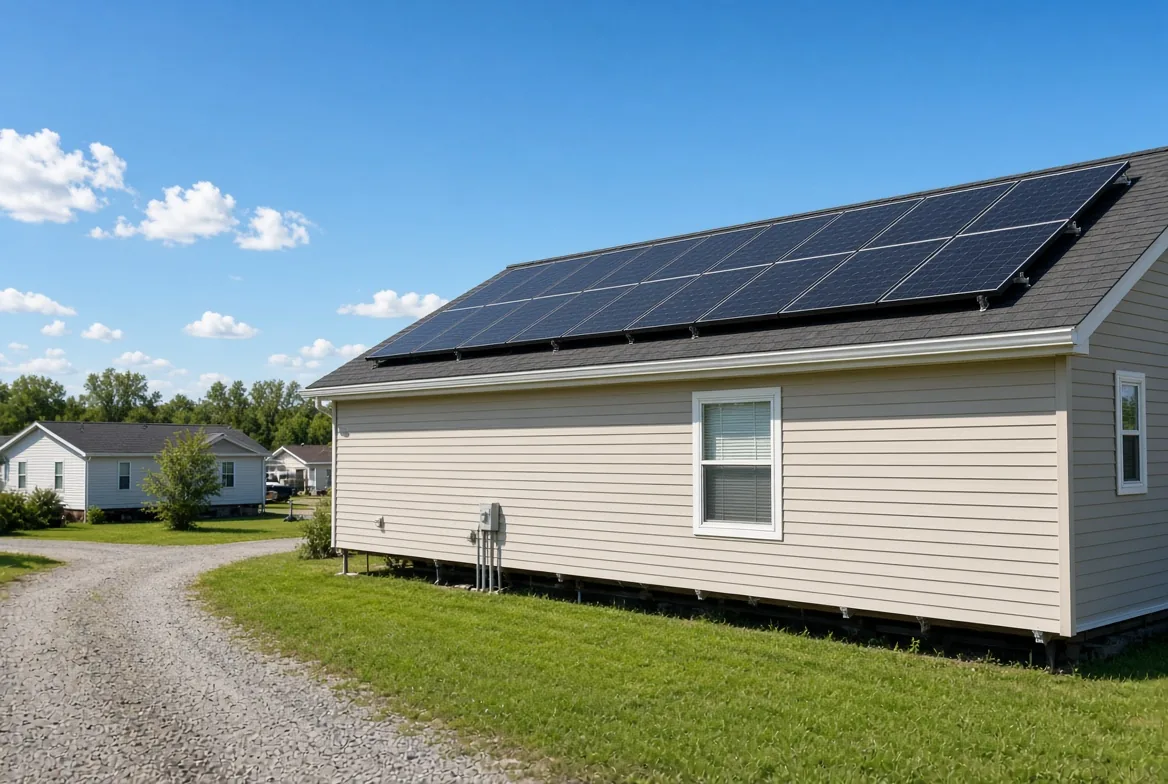
Monocrystalline solar panels have effectively taken over the residential market, and on a mobile or manufactured home that takeover is not fashion — it is arithmetic. Every extra point of module efficiency means fewer panels, less weight on a lightweight roof, and fewer penetrations through a membrane you would rather not drill.
Here is what monocrystalline actually buys you on a single-wide or double-wide in 2026, what it costs, and where the limits are.
Why monocrystalline wins on a manufactured-home roof
A monocrystalline panel converts sunlight into electricity using a single continuous crystal. Manufacturers pull a cylindrical ingot from molten high-purity silicon using the Czochralski process, then slice it into wafers with an unbroken crystal lattice. That lattice lets electrons move with far fewer losses than the grain boundaries found in cast polycrystalline blocks.
In practice: polycrystalline modules now sit at 17%–19% module efficiency, while monocrystalline modules run from 20% (legacy PERC) to 25.5% (back-contact). On a roof that is already carrying a live load, that gap is the whole argument. A 20.92 W/ft² panel needs roughly 250 ft² of module area for a 5 kW array; a 17% poly panel would need closer to 310 ft² — more panels, more rails, more dead weight.
Thin-film is not a serious contender for the roof either. Cadmium telluride (CdTe) panels such as First Solar's Series 7 excel on utility-scale ground mounts because of low manufacturing cost, but their 18.8%–19.7% module efficiency needs far more area than a manufactured home can spare.
The four cell architectures you will actually see in 2026
- PERC — the workhorse from 2015 to 2023. Commercial efficiency tops out near 24.5%, and p-type boron-doped wafers suffer light-induced degradation (LID) of 1.5%–2.5% in their first weeks.
- TOPCon — roughly 65% of global production in 2026. N-type phosphorus-doped wafers, tunnel-oxide passivation, cell efficiencies above 26% and effectively no boron-oxygen LID.
- HJT — heterojunction cells with amorphous silicon passivation layers on both sides, open-circuit voltages above 750 mV, and the best temperature behaviour of any mainstream architecture. Expect a 15%–30% price premium over TOPCon.
- IBC / ABC — all contacts moved to the rear, so the entire front face collects light. LONGi's HPBC 2.0 and Aiko's ABC series are the highest-efficiency residential modules you can buy.
The PERC vs TOPCon vs HJT comparison from Tongwei is a useful reference for how the three architectures differ in production, and Clean Energy Reviews keeps a running ranking of the most efficient modules on the market.
Efficiency, size and weight, panel by panel
The specs that decide whether an install works on a manufactured home are not the headline watts — they are watts per square foot and pounds per square foot.
- 400W compact (54-cell): 1722 × 1134 × 30 mm, 21.01 ft², 47.4 lb, 20.49% efficiency, 19.04 W/ft², 2.26 lb/ft².
- 450W standard (TOPCon): 1762 × 1134 × 30 mm, 21.51 ft², 48.5 lb, 22.52% efficiency, 20.92 W/ft², 2.25 lb/ft².
- 550W large-format: 2278 × 1134 × 35 mm, 27.81 ft², 61.7 lb, 21.29% efficiency, 19.78 W/ft², 2.22 lb/ft².
Modern monocrystalline modules of every format land between 19 and 21 watts per square foot, which is the number to use when you sketch an array onto your roof plan.
Heat is the hidden cost on a mobile-home roof
Manufactured homes often have low-slope metal decks or asphalt membranes with almost no attic space underneath. Mounting panels flush against that surface chokes off convective cooling, and cell temperature climbs.
The arithmetic is unforgiving. At 40°C–45°C ambient with 1000 W/m² irradiance, cell temperature routinely reaches 65°C — a 40°C rise over the 25°C rating. Because power falls with the temperature coefficient, the derate is large and technology-dependent.
A legacy PERC panel (γ = −0.35%/°C) keeps 86.0% of nameplate. TOPCon (−0.30) keeps 88.0%. HJT (−0.25) keeps 90.0%. Thin-film CdTe (−0.32) keeps 87.2%, and old polycrystalline (−0.40) keeps just 84.0%.
For a Sunbelt manufactured home that means an n-type TOPCon or HJT array can deliver 2%–4% more annual generation than PERC from the same roof, compounding over 30 years. A ground-mounted pole system does better still: open airflow keeps cells 10°C–15°C cooler than a flush roof mount, worth 3%–5% of summer output.
Warranty and degradation: what 25 to 30 years really looks like
N-type monocrystalline has largely eliminated the classic failure modes: no boron-oxygen LID, PID controlled with anti-PID coatings and non-porous POE encapsulants, and better resistance to LeTID at operating temperatures above 50°C.
Tier-1 warranties now reflect that:
- REC Alpha Pure-R (HJT): 25-year product plus 25-year linear, 92.0% at year 25, 0.25%/yr.
- Qcells Q.TRON (TOPCon): 90.6% at year 25, 0.33%/yr.
- LONGi Hi-MO / HPBC 2.0, JinkoSolar Tiger Neo 3.0, Canadian Solar TOPHiKu6: 87.4% at year 30, 0.40%/yr.
- Trina Vertex S+ (TOPCon): 88.5% at year 30, 0.40%/yr.
Real-world monitoring at NREL's Golden, Colorado test site shows well-encapsulated silicon modules retaining more than 88% of initial capacity after 25 years, and n-type modules installed in 2026 are projected to stay productive for 35–40 years.
What monocrystalline solar costs on a mobile home in 2026
Turnkey installation on a manufactured home averages $2.80–$3.20 per watt gross. Costs split roughly into thirds: about 35% for modules, inverter and racking; about 30% for labour and structural reinforcement; and about 35% for permitting, engineering stamps, interconnection fees and customer acquisition.
- 3 kW @ $3.20/W: $9,600 gross → $6,720 net after the 30% federal credit; 4,350 kWh/yr; $696/yr saved; 9.65-year payback.
- 5 kW @ $3.00/W: $15,000 gross → $10,500 net; 7,250 kWh/yr; $1,160/yr; 9.05-year payback.
- 10 kW @ $2.80/W: $28,000 gross → $19,600 net; 14,500 kWh/yr; $2,320/yr; 8.45-year payback.
Those figures assume 1,450 kWh per installed kW per year and $0.16/kWh retail power, and they include the 30% federal Residential Clean Energy Credit under IRC §25D. State programs stack on top — Massachusetts, for example, adds a 15% state credit capped at $1,000 plus SMART performance payments. Skyworth's 2026 cost breakdown tracks how these per-watt prices have moved, and the structural premium for manufactured housing is real: reinforcement and engineering review are line items you will not see on a site-built quote.
Can the roof carry the array? HUD limits and the ground-mount escape hatch
HUD-code manufactured homes fall under 24 CFR Part 3280, which sets roof live loads by design zone: 20 psf in the South, 30 psf in the Middle zone, and 40 psf in the North. Those figures cover temporary foot traffic and snow — they do not include a dead-load allowance for equipment bolted on afterwards. This breakdown of allowable roof loading on manufactured homes explains the distinction.
A 450W rigid panel weighs about 2.25 psf on its own. Add aluminium rails, roof anchors and microinverters and the total added dead load reaches 3.2–3.8 psf. On a home built with lightweight 2×2 or 2×4 trusses at 16–24 inches on centre, that is enough to require a structural assessment and sign-off from your local Authority Having Jurisdiction.
Wind matters too: lag bolts must anchor into the centre of the truss top chord through a flashed assembly. Systems held down by sheet-metal clamping alone are the ones that end up in the yard after a storm.
If the numbers do not work, a ground-mounted pole system ("PV on a Pole") removes the roof load entirely, allows ideal tilt and azimuth, and runs cooler — at a cost of roughly $0.35–$0.60 per watt extra for trenching, conduit and concrete footings.
Hail, hot spots and shade
IEC 61215 requires every module to survive a 25 mm ice sphere at 23 m/s (about 51.5 mph). Tier-1 monocrystalline panels with 3.2 mm tempered glass — or 2.0/2.0 mm dual-glass — clear that bar comfortably, and hail-rated heavy-duty models take 35–45 mm impacts at over 30 m/s without cracking cells.
Two design features matter once the array is up:
- Half-cut cells halve operating current, and because resistive heating scales with current squared, that cuts internal thermal losses by about 75% and drops hot-spot temperatures by 10°C–20°C. Three sub-strings with bypass diodes in an IP68 junction box do the rest.
- Split-cell layouts keep half the module producing when shade covers the other half — about 50% output retained — while module-level power electronics (microinverters or DC optimisers) stop one shaded panel from dragging down the string, and satisfy NEC rapid-shutdown rules.
A 2026 buying checklist for mobile-home owners
- Specify n-type TOPCon first (roughly $0.65–$0.90/W, 22%–24% module efficiency); step up to HJT or back-contact if roof area is tight or you are in extreme Sunbelt heat.
- Check the HUD data plate for roof load capacity, then keep total added dead load under about 3.5 psf — or switch to a ground mount.
- Insist on microinverters or DC optimisers, especially with vent pipes, swamp coolers or tree shade nearby.
- Confirm IEC 61215 hail certification and IEC 61730 safety certification, and ask for POE encapsulation against PID.
- Avoid flexible or portable panels for permanent home power — they are 0.5–0.8 psf and need no drilling, but their polymer top sheets degrade in 3–5 years under UV and they trap heat. Save them for RV trips and shed kits.
- Claim the 30% federal credit and stack any state rebate; on typical numbers that puts payback between 8.5 and 9.7 years, with two decades of free generation after it.