
Guide
Plug-In Solar Panels for Mobile Homes (2026 Costs)
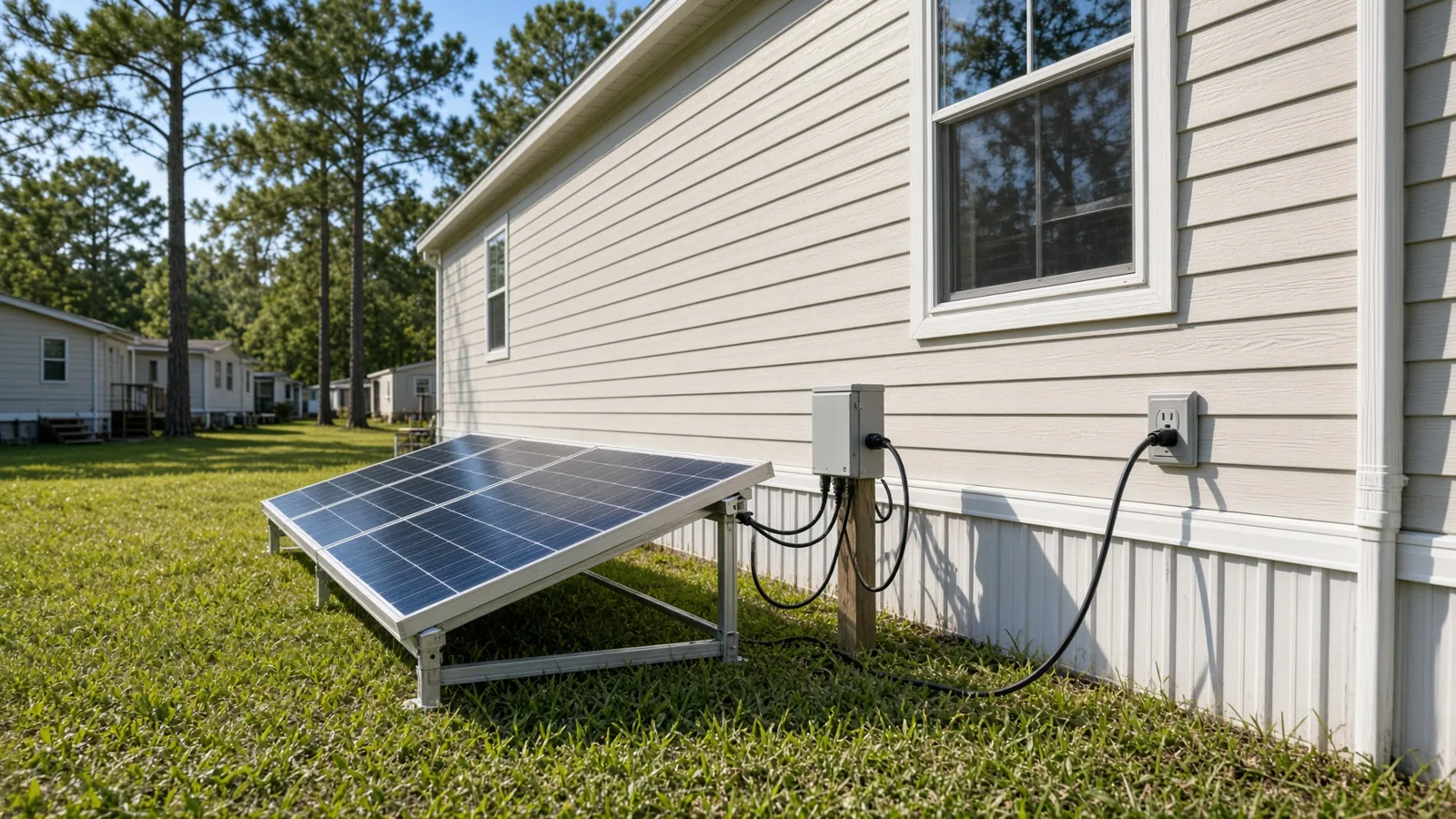
Plug-in solar panels are one to four panels wired to a microinverter and plugged into an ordinary 120 V outlet: no roof penetration, no battery, and, in the ten states that have passed plug-in laws, no utility interconnection study. An 800 W kit costs $1,100-$1,400 delivered and makes 1,085-1,192 kWh a year in most US climates, roughly 6-10% of a mobile home's electricity.
Why plug-in solar fits a manufactured home
Rooftop solar on a manufactured home means drilling a membrane, loading trusses sized for shingles and snow, and altering a structure you may not own. Many parks ban roof mounts outright. A plug-in kit sidesteps all three: the panels sit on a ground rack or porch rail, the only connection to the house is a cord, and the system moves when you do.
What is actually in a plug-in kit
Every kit is panels, a microinverter that turns DC into 120 V AC, and a cord ending in a standard plug. There is no battery and no charge controller, so it produces only while the house has grid power.
- 400 W - one panel and an inverter, the entry size.
- 800 W - two panels, the sweet spot for a single-wide or small trailer.
- 1,200 W - four panels, the ceiling in most new state laws.
- 1,800 W - no outlet-connected kit is sold nationally; only Colorado's 1,920 W cap would allow one, on a 20 A circuit.
Buy the inverter first, and ask for a listing to UL 3700, the new plug-in standard, or at minimum UL 1741 SB. Hoymiles' HiFlow Pro and APsystems' EZ1-LV were first to clear UL 3700 (Electrek).
What plug-in solar panels cost in 2026
- 360-400 W: $414 for Bright Saver's member-priced 360 W kit ($1.15/W), $699 at list, or about $799 for an EcoFlow STREAM inverter plus one 400 W panel ($2.00/W).
- 800 W: $1,099 for a STREAM plus two 400 W panels ($1.37/W), or $1,100-$1,400 delivered with a rack.
- 1,200 W: $1,899 for a STREAM plus four 400 W panels, or $1.58 per AC watt.
- DIY: about $635 for an APsystems EZ1-LV and used panels, $0.66/W.
The market range runs about $1.20-$1.75 per watt (Plug and Sun). Add $100-$300 for a ground rack, and assume no federal help: the residential clean energy credit ended for systems placed in service after December 31, 2025.
How much power an 800 W kit really makes
Nameplate watts are not kilowatt-hours. These figures start from third-party PVWatts runs and take a further 15% off for the flat, shaded, cord-limited reality of a plug-in install - an estimate, not a promise.
- Phoenix: 1,192 kWh a year
- Los Angeles: 1,161 kWh
- Miami: 1,104 kWh
- Denver: 1,085 kWh
- Seattle: 740 kWh
That output repays an $1,100-$1,400 kit in about three years in Los Angeles and six to seven years in Phoenix, Denver and Miami. Seattle is the exception: at 740 kWh a year the same kit needs roughly 14 years.
Where plug-in solar is legal in 2026
Ten states have signed plug-in laws: Utah (HB 340), Maine, Virginia (HB 395), Colorado, Maryland, Connecticut, New Hampshire, Vermont, New Jersey and California, where SB 868 opened the largest balcony-solar market in the country (pv magazine). Most cap inverter output at 1,200 W, none pays for exported power, and several take effect only in early 2027. New York's bill awaits the governor's signature.
Pros and cons on a manufactured home
For
- No holes in a roof you may not own, and nothing to undo when you leave.
- One afternoon of work, no permit in the states that legalized it.
- The array follows you to the next home or resells on its own.
Against
- No backup power: when the grid drops, the inverter shuts off by design.
- An 800 W kit offsets 6-10% of the bill, not all of it.
- A park, HOA or landlord can still forbid it, because state laws restrain government and utilities, not private rules.
How to install one safely
- Get written permission from the park, HOA or landlord before buying.
- Anchor a ground rack facing south. Skip the roof and the vinyl skirting: both are light, and both leak when you bolt through them.
- Mount the microinverter on a shaded post, run the panel leads to it, and bring one cord to an outdoor outlet.
- Have an electrician confirm the circuit is dedicated. A shared 15 A circuit behind a GFCI outlet is the wrong home for an inverter: the breaker cannot see the solar current, so the wire can overheat before anything trips. Without a dedicated circuit, stay at 360 W or less (Bright Saver).
Who should buy one
It suits a park resident barred from roof mounts, a renter in one of the ten states, or anyone with a sunny south yard and a spare circuit. It is the wrong tool in the Pacific Northwest, on a shaded lot, or for an owner who wants backup power or a whole-bill offset - that takes a rooftop array and a battery.
FAQ
Are plug-in solar panels legal in my state?
Only where a plug-in law has passed and your utility has rules for it: Utah, Maine, Virginia, Colorado, Maryland, Connecticut, New Hampshire, Vermont, New Jersey and California so far.
Can I plug a solar panel into a regular wall outlet?
Yes, that is the design: a UL 3700 or UL 1741 SB microinverter feeds a standard 120 V plug. The outlet still needs to be on a circuit sized for the inverter's output.
Will plug-in solar overload my wiring?
Not on a dedicated circuit sized for the inverter. On a shared circuit it can, because the breaker sees only the load drawn from the panel, not the power fed back into it.
Can I mount plug-in panels on a mobile home roof?
You can, but it is the worst option: light trusses, a membrane that leaks when penetrated, and wind uplift. A ground rack produces more and voids nothing.
Is there a federal tax credit for plug-in solar in 2026?
No. The residential clean energy credit ended for systems placed in service after December 31, 2025, so a 2026 install does not qualify.