
Guide
Recreational Vehicle Solar Panels: Sizing & Cost
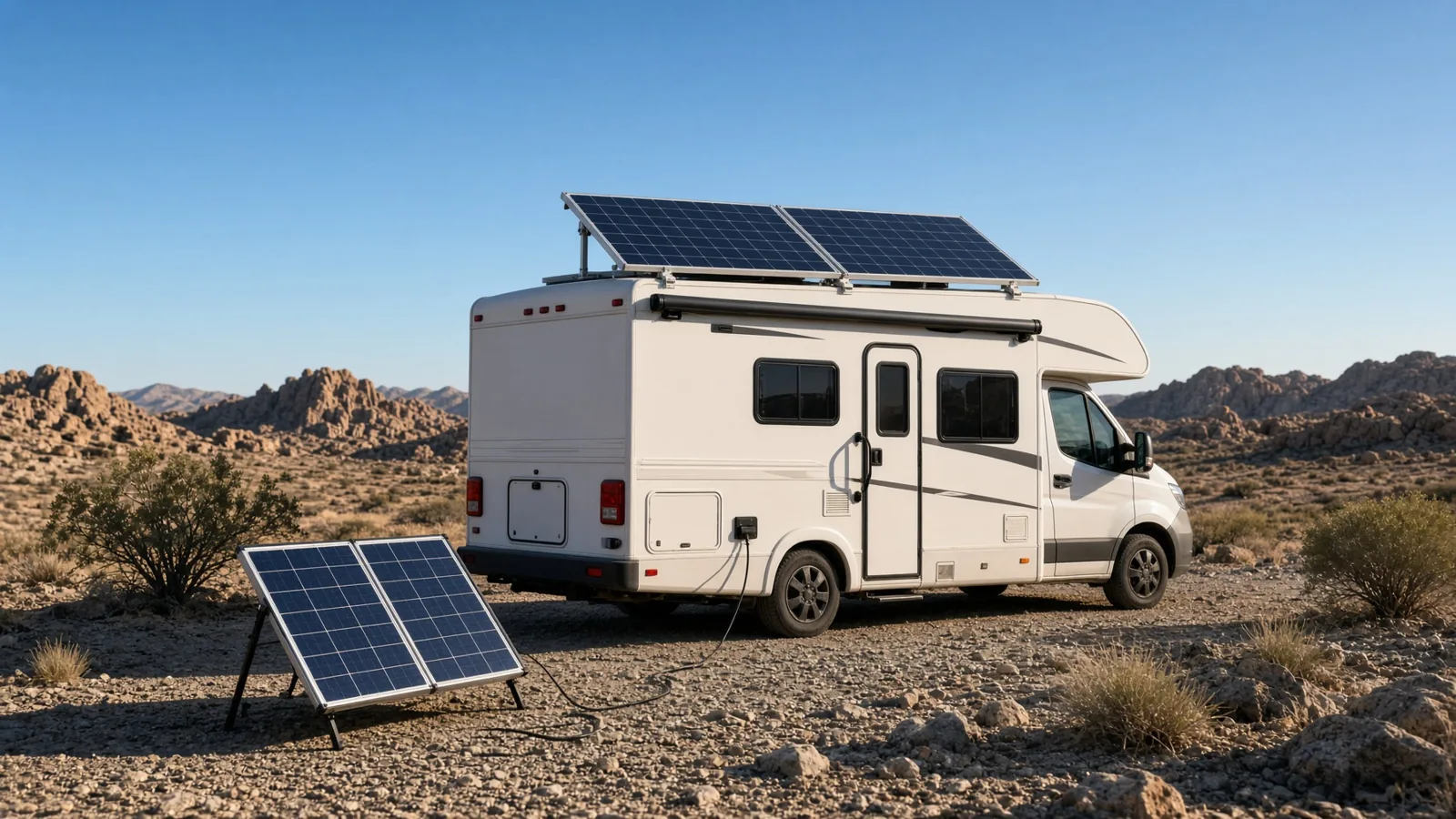
A typical recreational vehicle solar system is 400-800 W of panels, a 200-400 Ah LiFePO4 battery and an MPPT charge controller, costing about $1,100-2,700 if you install it yourself. That runs a 12 V compressor fridge, LED lights, laptops, a TV and a roof vent fan, but it will not run a rooftop air conditioner for more than an hour or two. Weekend trips use about 1-1.5 kWh a day, full-time living without air conditioning 2.5-3 kWh, and one 13,500 BTU air conditioner adds 5-6 kWh for every four hours it runs.
Panel types and mounting options for RVs
Three families of recreational vehicle solar panels are on the market, and most rigs mix at least two.
- Rigid monocrystalline. Cheapest per watt and longest lived. A 200 W module is about 49.7 x 30.1 in and 23.4 lb, so it fits between a roof vent and an air-conditioner shroud. This is the default for a permanent roof array.
- Flexible. About half the weight (roughly 0.05 lb/W against 0.12 lb/W) and only 0.1 in thick, so they follow a curved roof. They cost around 1.5x more per watt and run hotter, because they are glued down with no air gap.
- Portable suitcases and blankets. Folding 200 W panels you aim at the sun. The highest cost per watt, but the only type you can tilt and move out of shade while the rig stays parked in it.
A roof array charges all day, including while you drive, but it sits flat. A ground-deployed panel on a 20-30 ft lead can tilt 25-40 degrees, worth 10-25% more output in summer and 25-35% or more in winter. Most full-timers run a flat roof array plus one 200 W portable panel.
Roof space caps everything. A travel trailer roof is 100-200 sq ft and fits 3-6 panels, a Class C 4-6, a Class A 6-10. Subtract air-conditioner shrouds, vents and skylights and only 50-70% is usable, which is why 400-800 W is the real-world result.
Pros and cons of RV solar versus a generator
Solar and a generator solve different halves of the same problem.
Solar wins on
- No fuel, no oil changes, no exhaust, and no idle noise during the quiet hours most campgrounds enforce.
- Energy cost falls the more you use it: a full-time boondocker pays about $0.39/kWh over ten years on a mid-range system.
- It charges while you drive, so the battery is full when you arrive.
A generator still wins on
- Air conditioning. A 13,500 BTU rooftop unit draws 1,300-1,500 W running with a 3,000-4,000 W start surge, and the 2-3.6 kW array that could carry it almost never fits on an RV roof.
- Cloudy weeks and high-latitude winters, where a flat array can make a third of its summer energy.
- Cash payback for occasional users: a $520 kit used 40 nights a year avoids only about $60 of generator fuel.
The Honda EU2200i holds 0.95 gal and runs 8.1 hours at quarter load or 3.2 hours at its 1,800 W rated load (Camping World's EU2200i specs), which is 0.12 gal/h at 450 W and 0.30 gal/h at 1,800 W. U.S. regular gasoline averaged $4.465/gal on September 28, 2026 according to the EIA weekly fuel update. Charging through a converter loses another 15%, so generator power reaching the battery costs roughly $0.90-1.40/kWh before oil and wear.
Specs: what today's RV panels actually deliver
- 100 W rigid N-type: 13.0 lb, 34.1 x 22.8 x 1.2 in, 25% cell / 20.0% module, about $110-120.
- 200 W rigid N-type: 23.4 lb, 49.7 x 30.1 x 1.2 in, 25% cell, $179.99 (about $0.90/W).
- 200 W anti-shading rigid: same footprint, 28 bypass diodes against 2-3 on a standard module, $239.99.
- 450 W mono PERC: 52.7 lb, 75.2 x 44.6 x 1.4 in, 22.8% module, $742.99 per two-pack (about $0.83/W) - a fifth-wheel or Class A module, not a travel-trailer one.
- 200 W flexible: 10.8 lb, 63.2 x 29.4 x 0.1 in, 22% cell, $243-275 (about $1.22-1.38/W).
- 200 W suitcase kit: folds to a case, about 34 lb, up to 25% cell, $262-323 with a 20 A PWM controller.
N-type cells reach about 25% cell efficiency and modules land at 20-23%. Rated output is measured at 25 degrees C, and with a -0.26 to -0.29%/degree C temperature coefficient a cell sitting at 65 degrees C on a July roof runs 10-12% below nameplate. Cold helps instead, so check that the string's cold open-circuit voltage stays under the controller's limit.
Comparison: rigid, flexible, suitcase and blanket panels
Ranked on the four things that decide an RV install:
- Cost per watt. Rigid wins at about $0.83-0.94/W for commodity modules. Flexible runs $1.22-1.38/W, suitcases and blankets $1.31-1.61/W, and premium RV-specific kits such as Zamp's Legacy Black line $3.16-4.21/W.
- Weight. 0.05 lb/W flexible against 0.12 lb/W rigid, so 400 W of flexible panels saves roughly 28 lb on a weight-limited trailer.
- Warranty. Renogy's flexible datasheet lists 5 years on output against up to 25 years for rigid glass. Delamination and hot spots are the documented field failures, and Renogy's own install guide offers an air-gap mount as an option.
- Yield. A portable panel that can be tilted and moved beats a flat 200 W roof panel whenever shade or low winter sun is in play.
600 W is an array, not a module: three 200 W rigid panels weigh about 70 lb and cost about $540.
How to size and wire an RV solar system
Sizing starts with the daily energy budget, not the panel count.
- Weekend use: about 1.4 kWh/day (fridge 600 Wh, lights 150, laptop 180, TV 120, fan 100, microwave 170).
- Full-time, remote work: about 2.6 kWh/day, adding a second laptop and a Starlink-class router.
- Full-time with air conditioning: about 8.6 kWh/day, of which 5,200-6,000 Wh is the air conditioner.
Then convert to panel watts: daily kWh / (peak sun hours x 0.80). Most of the US gets 4-6 peak sun hours in summer and 2-4 in winter, and the 0.80 factor covers heat, dirt, wiring, controller and battery losses on a flat-mounted array. That puts 1.4 kWh/day at roughly 350-600 W of panels and 2.6 kWh/day at 650-1,100 W. Battery sizing is daily watt-hours x 1.5 / 0.8, so 1.4 kWh/day needs 2.6 kWh of storage (a 200 Ah 12 V LiFePO4) and 2.6 kWh/day about 4.9 kWh (roughly 400 Ah).
Wiring loses the most at low voltage: at 12 V every volt lost is about 8% of the system, so keep each run under about 3% drop. Copper resistance is roughly 1.0 milliohm/ft for 10 AWG, 0.63 for 8 AWG and 0.40 for 6 AWG. Four 100 W panels (Vmp 20.8 V, Imp 4.81 A) on a 25 ft roof run, 50 ft round trip: 4 in parallel (20.8 V / 19.2 A) drops 0.96 V, or 4.6%, on 10 AWG, while 2 series x 2 parallel (41.6 V / 9.6 A) drops only 0.48 V, or 1.2%. Series wiring with an MPPT controller is what lets you use cheap 10 AWG cable. A 2,000 W inverter at 12 V pulls about 185 A, which needs a short 2/0 AWG run behind a class-T fuse.
What an RV solar system costs in 2026
The battery, not the panels, is the largest line item in every tier.
- Budget, 400 W, weekend use: about $1,120. Renogy's 400 W starter kit with a 40 A Rover MPPT is $439.99, a Redodo 12 V 200 Ah LiFePO4 about $500, a 1,000 W inverter about $100, wiring and mounts $80. That is $2.80 per watt of array.
- Mid-range, 600 W, full-time without AC: about $2,740. Three Renogy 200 W N-type panels $540, a Victron 100/50 MPPT $200, two 200 Ah LiFePO4 batteries $1,400, a 2,000 W pure sine inverter about $400, wiring and mounts $200. That is $4.57 per watt.
- Premium, 760 W, full-time: about $6,550-6,850. Zamp's 760 W Deluxe kit $2,599.99, a Victron 100/50 MPPT $200, three Battle Born 100 Ah batteries $2,850, a Victron-class inverter/charger $400 or more, mounts and cabling $200, and $300-600 for professional installation. That is $8.60-9.00 per watt.
Compare those with TheGreenWatt's RV solar calculator, which prices the same 400 W build at $910 budget, $1,510 mid-range and $2,250 premium. Most owners land between $1,200 and $2,000 for a reliable mid-range system once they buy locally.
How an RV solar system differs from a home rooftop array
An RV system is a small off-grid DC power plant: panels charge a 12 V battery bank through a charge controller, and an inverter makes 120 V AC only when an appliance needs it. A home rooftop array is usually grid-tied, has no battery, and pushes 240 V AC straight into the house and the utility.
- Low voltage, high current. 1,000 W at 12 V is about 83 A, so wire size and voltage drop matter far more than on a home roof.
- Battery-centric. There is no grid to sell to, so panels, controller and battery have to be matched or the surplus is wasted.
- Space limited. A travel trailer roof fits 400-800 W, against the 6-12 kW of 400-450 W modules a house roof carries.
The same MPPT controllers, lithium batteries and DC wiring logic run in park-model RVs and in manufactured homes wired for a small off-grid array.
Is RV solar worth it? Payback math
For full-timers and frequent boondockers, yes: a $2,740 mid-range system pays for itself in about 6-12 months. For a weekend camper using solar 40 nights a year it rarely pays back in cash; the value is quiet, fuel-free power and not buying a $1,049 generator at all.
- Weekend, 40 nights a year, versus a generator running about 2 h/day (0.34 gal, $1.51/day): $520 of panels, controller and wiring avoids roughly $60 of fuel a year, an 8.7-year payback.
- Full-time boondocking, 2.6 kWh/day versus a generator running 3.8 h/day (0.63 gal, $2.80/day): $940 avoids about $1,020 of fuel a year, a payback of roughly 11 months.
- Full-time, half the nights dry camping instead of a $45 hookup site: the $2,740 system avoids about 182 nights x $30, close to $5,500, a payback of roughly 6 months.
Private RV parks with full hookups run about $40-80 a night, KOA sites $40-70, and public campgrounds $15-40. Hookups also supply water and sewer, so the real saving is the gap between a hookup site and a dry site, roughly $25-45 a night - and solar is the only answer where generators are banned.
Four limitations explain why a "400 W" roof can make 1 kWh on a winter day instead of the 1.6-2 kWh a summer calculator promises:
- Partial shade. Cells are wired in series, so one shaded cell group throttles the rest; one shaded panel in a series string can cut output by 30-50%. Wire frequently shaded panels in parallel instead.
- Winter sun. At 40 degrees north in December the noon sun is only 26.6 degrees above the horizon, so a flat panel collects about 44% of what a tilted panel does at midday. With 2-4 peak sun hours instead of 5-6, a flat array can make a third of its summer energy.
- Heat, especially on glued flexible panels. In a side-by-side test at about 44 degrees C ambient, a flexible panel with no air gap produced about 9% less than an identical panel with an air gap (Solar 4 RVs' air-gap test).
- Undersized wiring. 10 AWG over a long parallel run is the most common self-install mistake.
Daytime load figures for a 12 V compressor fridge come from Bluetti's runtime data, and panel pricing and specs are cross-checked against Renogy's panel comparison.
FAQ
How many solar panels does an RV need?
Weekend trips need 350-600 W, or two to three 200 W panels. Full-time living without air conditioning needs 650-1,100 W. Running a rooftop air conditioner needs 2-3.6 kW, which does not fit most RV roofs.
Will RV solar panels run an air conditioner?
Not for long. A 13,500 BTU unit uses 5,200-6,000 Wh over four hours, more than everything else in the rig uses in a day. Most owners run air conditioning on a generator or hookup.
How much do recreational vehicle solar panels cost?
Panels run $0.83-1.40 per watt for commodity brands and $3.16-4.21 per watt in premium RV kits. A complete DIY 400 W system is about $1,100 and a 600 W full-time system about $2,700; installation adds $300-600.
Can I mount flexible solar panels flat on an RV roof?
You can, but plan for heat and warranty. Glued-down flexible panels produced about 9% less output than an air-gap mount in a 44 degrees C test, and output warranties are typically 5 years against 25 for rigid glass.
How long do RV solar panels last?
Rigid glass-and-aluminum modules carry output warranties up to 25 years and are the longest-lived part of the system. Flexible panels are typically warranted 5 years on output, and batteries usually reach end of life first.
Do RV solar panels work while driving?
Yes. A roof array charges whenever the panels see sun, including at highway speed, so many owners arrive at camp with a full battery. Portable panels must be packed away before you move.
How much power does a 400 W RV array make in a day?
About 1.6 kWh a day in summer, with 5 peak sun hours and 0.80 system losses. In winter, at 2-4 peak sun hours on a flat mount, the same 400 W array drops to roughly 0.6-1.0 kWh.
Do I need a lithium battery for RV solar?
Not strictly, but it is the default: a 200 Ah 12 V LiFePO4 pack stores about 2.6 kWh and tolerates deep discharge, while lead-acid pairs want to stay above 50% state of charge. Budget 200 Ah for weekends, 400 Ah for full-time.
Is RV solar worth it for weekend campers?
Rarely in cash, usually in comfort. A $520 solar spend used 40 nights a year avoids only about $60 of generator fuel, but it removes the need to buy a $1,049 generator.