
Guide
Renogy Solar Panels for Mobile Homes: 2026 Prices, Kits and Battery Sizing
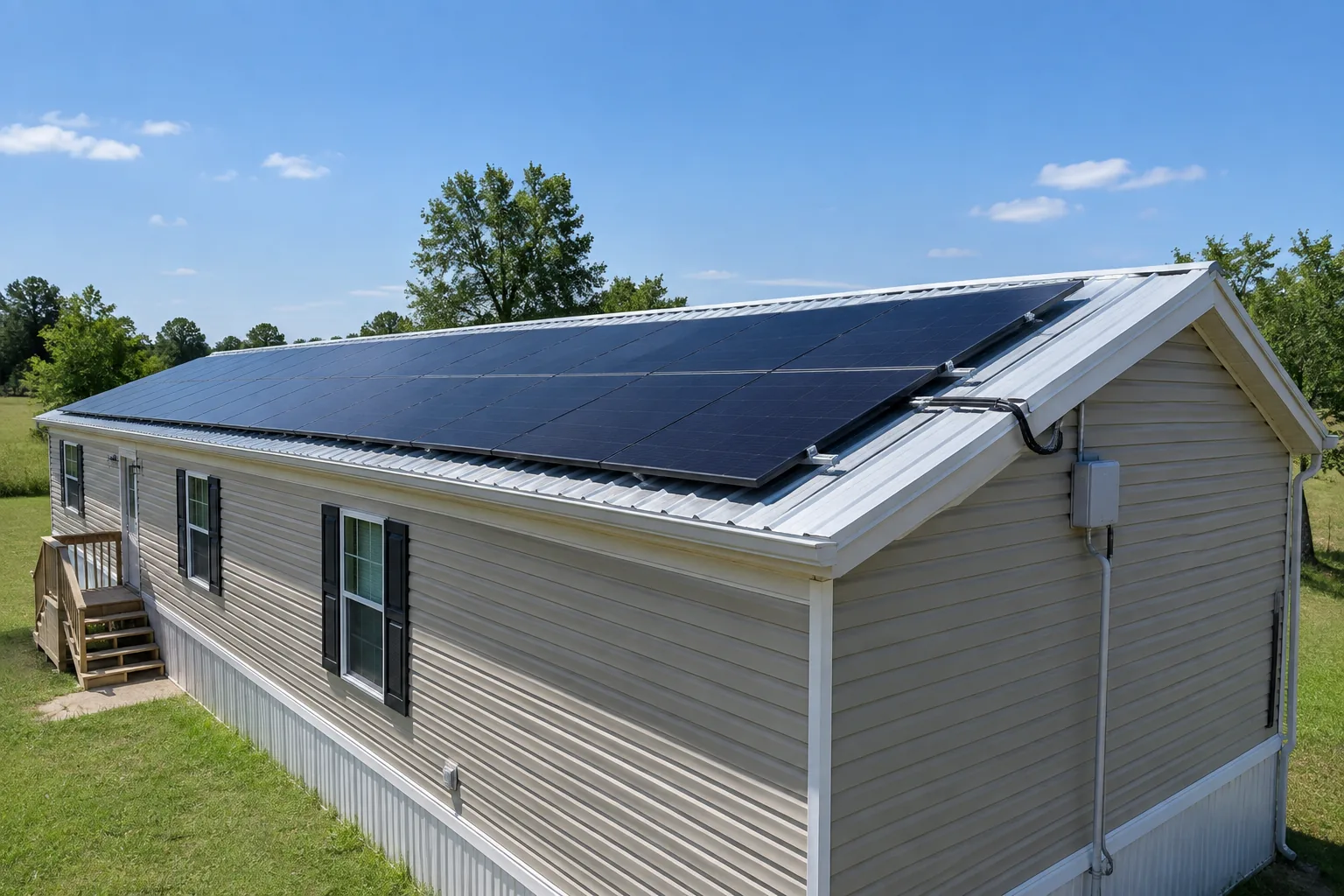
The short answer
Renogy is the brand most mobile and manufactured home owners meet first, and in 2026 it is a legitimate, established off-grid brand with a genuinely broad catalog. It also hides three traps: a "2,000W kit" that contains only 800W of solar, kits that ship without an inverter, and product pages still advertising a 30% federal tax credit that ended on 31 December 2025.
For a manufactured home using 10-30 kWh a day, every number points the same way: Renogy's 400W and 800W kits are RV-scale, not house-scale. Even Renogy's own 1,280W cabin array works out to roughly 5.1 kWh a day at five peak sun hours once a realistic 80% system factor is applied - about a third of what a modest mobile home draws.
What Renogy actually sells in 2026
Renogy's current solar panel collection spans legacy PERC modules, the newer N-Type line, ShadowFlux anti-shading panels, bifacial N-Type modules and flexible laminates. On a manufactured home roof, only the rigid framed modules are worth considering.
| Model | Rated power | Module efficiency | Weight | Warranty | |---|---|---|---|---| | 100W 16BB N-Type | 100 W | ~20% | 13.0 lb | 10-year | | 200W 16BB N-Type | 200 W | 20.7% | 23.4 lb | 10-year | | 200W ShadowFlux N-Type | 200 W | 20.7% | 23.8 lb | 5-year + 25-year 80% | | 400W N-Type bifacial | 400 W | 21.5% | 45.4 lb | 10-year + 25-year | | 450W bifacial | 450 W | 20.8% | 50.9 lb | 10-year + 25-year | | 590W N-Type bifacial | 590 W | 22.8% | 58.4 lb | 10-year + 25-year |
Two details in that table matter more than the headline numbers. First, the 100W and 200W N-Type panels advertise 25% cell efficiency, but the finished 200W module is rated at 20.7% module efficiency - those are different measurements, and only the second one describes the product you bolt down. Second, there is no current 550W Renogy module in the U.S. catalog; the range jumps from 450W to 590W, so any 2026 build sheet quoting a "Renogy 550W" is quoting something Renogy does not sell.
Temperature coefficient is missing, and that matters
Renogy's pages publish an operating range of -40F to 185F for these panels, but they do not consistently expose the Pmax temperature coefficient. That figure is what tells you how many watts a panel loses per degree above the 25C Standard Test Condition cell temperature. On a manufactured home roof, where modules sit close to a hot metal or membrane surface, it is the difference between a 400W array behaving like 400W in July and behaving like something noticeably less. Ask for the datasheet of the exact SKU.
What Renogy panels cost per watt
Renogy's pricing is volatile - promotional bundles and bulk tiers move constantly. The cleanest way to see it is the 590W panel's own quantity ladder from the observed 2026 promotion.
Two panels were listed at $989.99, four at $1,701, six at $2,508 and ten at $3,916. Shipping was separately quoted at $299 for the two-panel option before promotions - which is exactly why the cheap-per-watt pallet price and the single-panel price should never be compared without freight. The other stand-out is the 200W N-Type at roughly $109.99, or about $0.55 per watt.
Renogy kits: what is inside, and what they really make
Kit naming is inconsistent, so read the contents, not the label.
- 400W premium kit - about $639.99. Four 100W N-Type panels, a Rover Li 40A MPPT charge controller, BT-2 Bluetooth module, Z-brackets, Y connectors, an ANL fuse and a 20 ft 10 AWG adapter cable. No inverter.
- 800W Essential kit - $1,319.99. Four 200W N-Type panels, a Rover Li 60A MPPT controller, Z-brackets, Y connectors, fuses and the BT-2 module. No inverter either.
- 1,200W/2,500W cabin kit - from $2,499.99. Despite the name it ships with four 320W panels, so the array is 1,280W. It adds a 48V 3,500W pure-sine inverter/charger, an 80A/150V MPPT controller, combiner box, DC breakers and cabling, with a 9.6 kWh battery bank optional. Renogy describes this kit as suitable for mobile homes, sheds and small cabins.
- 7.68 kWh Power Kit - observed at $3,499.99. An 800W ShadowFlux array, 7.68 kWh of battery, a Rover 60A MPPT controller and a 2,000W pure-sine inverter.
The arithmetic above uses an 80% system factor for wiring, heat, soiling and inverter losses. Note what it means: the "2000W" in that Power Kit is the inverter's output rating, not solar generation - the array behind it is 800W, about 3.2 kWh a day in good sun. That single naming choice is the difference between a system that looks like it can run a house on paper and one that can actually run a fridge.
Battery sizing for a mobile home
Renogy specifies its LiFePO4 cycle life at 80% depth of discharge, so that is the column to compare. Usable energy matters, not nominal: a 12V 200Ah Core battery is 2.56 kWh nominal but 2.05 kWh usable, at about $599.99-$769.99 and 5,000 cycles. The 12V 100Ah Core is 1.28 kWh nominal, 1.02 kWh usable, at roughly $279.99. The 48V 50Ah is 2.40 kWh nominal, 1.92 kWh usable, priced at $701.99 and rated above 6,000 cycles.
Fully covering a mobile home's daily consumption from battery alone therefore looks like this: 10 kWh a day needs 10 x 12V 100Ah, 5 x 12V 200Ah or 6 x 48V 50Ah; 20 kWh a day needs 20, 10 or 11 respectively; 30 kWh a day needs 30, 15 or 16. That is why nobody should build a 30 kWh-a-day manufactured home around dozens of 12V batteries. Ten 48V 50Ah units give 24 kWh nominal and about 19.2 kWh usable on a far cleaner 48V architecture.
How Renogy compares
For a DIY buyer, Renogy competes with Rich Solar and other off-grid brands, not with the professional installer channel. Rich Solar's MEGA 550 bifacial is 550W at 23% module efficiency with a 25-year output warranty and UL certification. That is marginally more efficient than the 590W Renogy, but Rich Solar's displayed pricing sits in quantity/pallet tiers, so a like-for-like single-panel comparison is not available. EcoFlow and Bluetti sell integrated portable and home battery ecosystems, where price per watt of a folding panel says nothing useful about a rooftop module. Canadian Solar builds conventional 20-23% modules for professional installs.
The practical read: Renogy's advantage is the ecosystem - panels, MPPT controllers, inverters and 12/24/48V batteries from one vendor with documented pairing. Its disadvantage is that individual panel prices look cheap until freight is added, and several "kits" still leave you buying the inverter separately.
Certification and the 30% tax credit
Certification is model-specific. The current 450W bifacial page lists ETL Listing to UL 61730, TUV IEC 61215 and IEC 61730, plus ISO 9001 manufacturing. UL 1703 and UL 61730 are not interchangeable labels - UL has harmonised 1703 into the newer UL 61730 framework, and newer products are evaluated under it. For a 2026 installation, get the certification document for the exact model rather than accepting "Renogy panels are UL certified" as a blanket statement.
The tax credit is where most 2026 articles are wrong. The IRS states the 30% Residential Clean Energy Credit under section 25D is not allowed for expenditures made after 31 December 2025. A new Renogy installation in 2026 does not qualify, even though Renogy product pages still display "eligible for up to a 30% Residential Clean Energy Credit". Mobile homes and qualifying manufactured homes could count as a "home" under the prior rules - that is not the problem. The credit itself expired.
Mounting on a manufactured home roof
Panel-only loading is modest: about 2.25 lb/ft2 for the 200W, 2.15 for the 400W, 2.17 for the 450W and 2.10 for the 590W. Those figures exclude rails, clamps, roof attachments, flashing, conduit, snow and wind loads, ballast and installer walking loads - so a 590W panel does not impose 2.1 lb/ft2 on the finished roof system. Four 590W panels are about 234 lb of glass and aluminium; ten are about 584 lb, before hardware.
A manufactured home has lighter roof framing, thinner decking, and often standing-seam metal or an EPDM membrane. On standing seam, non-penetrating seam clamps rated for that exact profile are preferred - no holes, lower leak risk. On EPDM the choice is a penetrating mount fastened into structural framing and sealed to the roofing manufacturer's specification, or an adhesive mount where drilling is unacceptable; both demand membrane compatibility. Ballast is generally the wrong answer on a lightweight roof because the ballast is itself dead load. Whatever the roof, attachment should tie into the framing system, not the thin roof skin, and the local authority having jurisdiction should be consulted before you buy.
Budget $1-$2 per watt for electrician or solar labour on a straightforward install, more for complex rooftop work, plus structural reinforcement, trenching and permit fees.
Reliability and warranty
Renogy was founded in 2010 by students from Louisiana State University and opened its first warehouse in Chino, California, making it about 16 years old in 2026. Independent performance data is mixed in an instructive way. OutdoorGearLab measured Renogy's 200W portable panel at 177W over a two-hour efficiency test - 88.5% of nameplate - with power-station snapshots averaging about 192W, and called it one of the strongest 200W portables it had tested. Against that, the Better Business Bureau complaint file contains 124 complaints in three years, including 19 in the last 12 months, with allegations of a 220W panel producing about 130W and a 175W panel producing about 30W. Those are customer claims, not controlled tests, and complaints without a denominator do not establish a failure rate.
What the pattern does show is where friction lives: warranty processing. Renogy's procedure requires proof of purchase, photographs or video, troubleshooting and sometimes multimeter readings before an RMA is authorised, and third-party purchases normally route back through the original seller. On a permanent rooftop array, a warranty replacement means removal and reinstallation labour - which is the real reason panel price per watt should never outrank roof capacity and inverter quality.
The bottom line
For a mobile home, the build order is 48V architecture, then a roof structural assessment, then adequate solar, then adequate battery, then inverter quality - and only then panel price per watt. A 10 kWh a day home is looking at roughly 3-4 kW of solar, 10-15 kWh of usable battery and a 3-5 kW inverter; a 20 kWh a day home at 6-8 kW, 20-30 kWh usable and a 5-8 kW inverter. Those are planning numbers, not an engineering design, and air conditioning, electric water heating or electric cooking will move them. Renogy can supply most of that system. Its 400W and 800W kits cannot.
Sources
- Renogy solar panel collection - 2026 model line, module efficiencies and warranty terms.
- Renogy 590W N-Type bifacial panel - 22.8% efficiency, 58.4 lb, 95%/90%/80% performance warranty curve and 2/4/6/10-panel pricing.
- Renogy 400W premium kit and 800W off-grid kit - kit contents, MPPT controller models and prices.
- Renogy 1,200W/2,500W cabin kit - 1,280W array, 48V 3,500W inverter/charger, 80A/150V MPPT, mobile-home suitability.
- Renogy 7.68 kWh Power Kit - 800W solar with a 2,000W inverter, showing the naming trap.
- Renogy 12V 200Ah Core and 48V 50Ah batteries - 2.56 kWh and 2.40 kWh nominal, 5,000 and 6,000+ cycles at 80% depth of discharge.
- OutdoorGearLab, Renogy 200W portable test - 177W measured over two hours, 88.5% of nameplate.
- Better Business Bureau, Renogy complaints - 124 complaints in three years, 19 in the last 12 months.
- IRS Residential Clean Energy Credit - section 25D not allowed for expenditures after 31 December 2025.
- UL Solutions, UL 1703 to UL 61730 transition - module safety standards.
- Rich Solar MEGA 550 bifacial - 550W at 23% efficiency, 25-year output warranty, UL certified.
Prices are Renogy promotional and street prices observed in October 2026 and change frequently. Daily kWh figures are calculations from the stated array sizes and an 80% system factor, not measurements.