
Guide
Ring Solar Panel: Specs, Winter Limits and Mobile Home Mounting
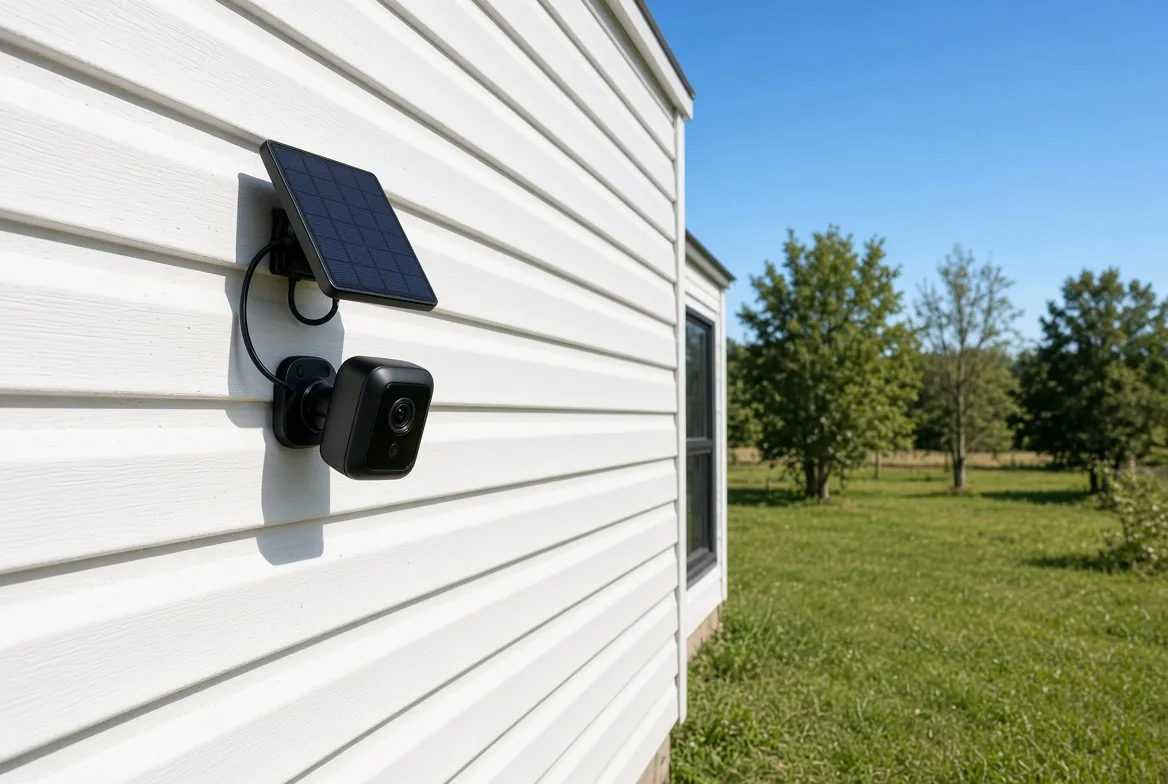
A Ring solar panel is not a power station. It is a small 5-volt trickle charger that clips into the camera's weather-sealed port, floats the internal battery at full charge, and keeps the camera recording without you climbing a ladder every few weeks. That matters more on a mobile home than almost anywhere else: the walls are thin, the roof is often awkward to reach, and pulling 120-volt wiring to a camera usually means calling an electrician.
Here is what Ring's four solar options actually deliver, how they behave in a real winter, and how to mount one on manufactured housing without drilling through the siding.
The Ring solar lineup, by the numbers
Every current Ring solar panel is a low-voltage DC charger, and all of them feed the camera's battery rather than running the camera directly. Ring publishes the ratings on its own product pages, which makes comparison straightforward.
Ring Small Solar Panel (USB-C) — 1.9 watts
The compact model is rated 1.9 W at 5.0 V DC, about 380 mA of charging current, and lists for $39.99. It ships with an integrated 6.5-foot (2 m) USB-C cable and measures roughly 6.9 x 4.4 x 0.5 inches. It is the right pick for a video doorbell or a camera that only wakes up when someone walks past.
Ring Solar Panel 2nd Generation (USB-C) — 4 watts
This is the mainstream option: 4.0 W at 5.0 V DC, up to 800 mA, $59.99, an integrated 6.5-foot cable, an IP55 weather rating and a temperature envelope of -5F to 120F (-20.5C to 48.5C). It measures about 8.1 x 6.7 x 0.5 inches and mounts on a 360-degree arm with 180 degrees of tilt. It works natively with USB-C cameras such as the Spotlight Cam Plus, Spotlight Cam Pro, Stick Up Cam Pro and Outdoor Cam Plus, and the box includes a USB-C to 3.5 mm x 1.35 mm barrel adapter for older camera generations. Ring's official product page lists the full compatibility matrix.
Ring Super Solar Panel — 5 watts
The Super is the high-output model for busy driveways or partial shade: 5.0 W at 5.0 V DC, up to 1,000 mA, a 13-foot (3.96 m) cable, IP55, and a list price between $79.99 and $99.99 depending on the bundle. Ring documents it in its Super Solar Panel support article. If your camera streams live view often, this is the panel that keeps up.
Legacy Ring Solar Panel (1st Gen) — 2.2 watts
The original panel is rated 2.2 W at 5.2 V DC, about 420 mA, with a longer 13-foot cable and a wider temperature range of -20F to 120F. It used a barrel or micro-USB connector, was originally listed at $49.99, and is now mostly a clearance or second-hand item. Ring still publishes the compatible camera list for it. It cannot charge newer USB-C cameras without an aftermarket adapter.
Battery capacity matters too, because it sets how much sunlight you need. The standard Ring Quick Release Battery Pack holds roughly 6,040 mAh at 3.65 V, and the Quick Release Ultra doubles that to about 10,000 mAh with USB-C fast charging.
How much sun does a Ring solar panel actually need?
In practice, two to four hours of direct sunlight per day is enough to keep a camera topped up with a 4 W panel. That number assumes the panel faces the sun with no shading. A panel that sits under a tree canopy or behind a porch post produces milliamps for most of the day, which is why Ring sells the 5 W Super for exactly those locations.
Manufactured homes have one advantage here: the long, low southern wall is usually free of dormers, chimneys and roof obstructions, so a panel mounted there sees more clean sun than the same panel on a two-story house.
The winter limit nobody mentions: charging stops at 0C
Here is the detail that surprises new owners. Ring cameras can discharge down to -20.5C, but the battery management system blocks charging below 0C (32F) to protect the lithium cells. During a cold snap your camera keeps running on stored charge while the solar panel contributes nothing at all. On a manufactured home in the upper Midwest or Canada, a 4 W panel that looks generous in July can be functionally absent for weeks in January.
Two practical fixes:
- Tilt the panel to your latitude plus about 15 degrees so it catches low winter sun instead of pointing at the sky.
- Size up. The 5 W Super buys back the shoulder-season hours that a 1.9 W panel loses.
Do cheap third-party solar panels work with Ring?
Often yes, and the savings are real. Wasserstein and similar brands sell 2 W to 6 W Ring-compatible panels for roughly $19.99 to $29.99, which is 50 to 70 percent below the official accessories. Wasserstein's Ring range is the best known, and Ring owners on r/Ring have been running them for years.
Two failure modes are worth knowing before you buy:
- Barrel-plug panels (3.5 mm x 1.35 mm) must be centre-positive and stay near 5.0 to 5.2 V. Unregulated 6 V panels can trip the camera's overvoltage protection or trigger an incompatible-panel warning.
- USB-C panels need the correct configuration (CC) resistors. A generic USB-C panel without them never starts the charging handshake, so it looks dead even in full sun.
If you are buying for a USB-C Ring camera, check that the listing explicitly says the panel is built for Ring's USB-C models.
Mounting a Ring solar panel on a mobile home without drilling
Vinyl siding is thin, and screwing a mount into it is the fastest way to create a leak path and void a warranty. The standard workaround is a no-hole siding hook that slides under the bottom edge of a lap and clips over the next one. A set of six stainless hooks costs a few dollars and each hook carries 4 to 5 kg, far more than a 4 W panel and a Stick Up Cam need. This hardware listing shows the style, and r/homerenovations has a long thread on whether vinyl siding holds a Ring camera and panel with photos from owners who have done it.
A few mounting notes specific to mobile and manufactured homes:
- Mount on a south-facing wall, as high as you can reach without a ladder, and leave the panel clear of the roof drip line.
- Keep the panel above the camera so the short cable hangs down into the port rather than looping up to collect water.
- Use the supplied cable clips and add a drip loop where the cable enters the camera.
- On skirting or a shed wall, screw the mount into framing rather than the skirt panel itself.
- If you are in a park with rules about exterior fixtures, siding hooks leave no holes and come out in seconds.
If you already have a 12-volt solar system on the property
Many mobile homes and off-grid cabins already run a 12 V array and battery bank. Feeding a Ring camera from that system is cheaper and more reliable than adding another panel, but the conversion matters: use a 12 V to 5 V USB buck converter ($8 to $12, roughly 90 to 95 percent efficient) rather than a small AC inverter. A camera draws only about 1.5 to 2 W continuously, so an inverter's idle drain can exceed what the camera uses.
Quick sizing rules
- Video doorbell or low-traffic camera: Ring Small Solar Panel, 1.9 W, $39.99.
- Standard outdoor camera: Ring Solar Panel 2nd Gen, 4 W, $59.99.
- Live view, busy driveway, or afternoon shade: Ring Super Solar Panel, 5 W, $79.99 to $99.99.
- Existing 12 V off-grid system on site: skip the panel and use a 12 V to 5 V USB converter.
A Ring solar panel will not make a camera self-sufficient in a hard northern winter, and it will not survive a permanent shade problem. Sized correctly and mounted on a no-hole siding hook, though, it turns a monthly battery chore into a one-time afternoon of work.
Sources
- Ring: Solar Panel (USB-C) product page and Small Solar Panel (USB-C)
- Ring support: Super Solar Panel and Solar Panel for Spotlight Cam and Stick Up Cam Battery
- Abt: Ring 4W Black Solar Panel (2nd Gen) listing
- Wasserstein: Ring camera solar panels
- Vetted Home Gear: Ring Solar Panel review
- r/Ring: You don't need to buy Ring's solar panel for the newer outdoor cameras