
Guide
Best Soft Brush for Solar Panel Cleaning: A Mobile Home Owner's Guide
Best Soft Brush for Solar Panel Cleaning: A Mobile Home Owner's Guide
Why a Soft Brush — and Not Anything Stiffer
If you've searched for a "soft brush for solar panel cleaning," it's because you already know what most solar installers will tell you outright: the wrong tool can permanently dim your panels. The front surface of a modern PV module isn't ordinary window glass. It's tempered low-iron glass finished with an anti-reflective (AR) coating, and on many panels, a hydrophobic layer designed to help water and dust slide off. Scrub that surface with a stiff deck brush, a wire brush, steel wool, or an abrasive scouring pad, and you can etch micro-scratches into the coating that reduce light transmission for good — not something a $30 brush purchase should ever cost you in lost output.
For mobile and manufactured homes, where arrays tend to be smaller (a handful of panels, ground-mounted or roof-mounted) and budgets tighter than a whole-house residential system, protecting that investment matters even more.
The safest brush materials are:
- Soft nylon bristles
- Polyester soft bristles
- Microfiber brush heads
- Water-fed soft brushes (bristles plus a hose connection)
Avoid wire brushes, stiff deck brushes, abrasive scrub pads, steel wool, hard plastic bristles, razor blades, and pressure washers — all of which can scratch the glass or force water under seals. Many installers also recommend rinsing with deionized water first, since hard tap water tends to leave mineral spots once it dries.
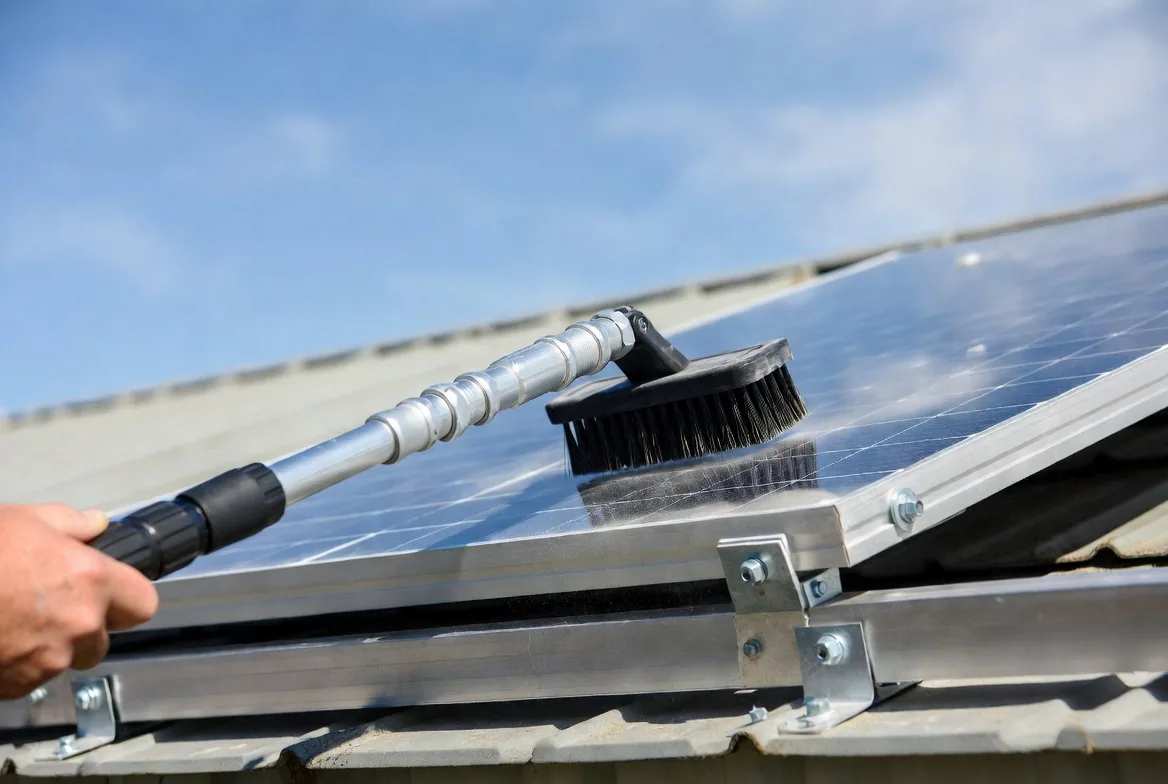
A telescoping extension pole is worth pairing with any soft brush. It lets you clean a ground-mounted array, or a low manufactured-home roofline, while standing safely on the ground instead of climbing up.
How Much Power Do Dirty Panels Actually Lose?
This is where the numbers get concrete — and surprising. Dust, pollen, and grime aren't just cosmetic; they measurably cut your energy output, and the loss compounds the longer you wait.
A 2026 systematic review of soiling mitigation strategies published in a peer-reviewed engineering journal found:
- Light dust: 2–5% output loss
- Moderate dirt buildup: 5–10% loss
- Heavy pollen or dust: 10–20% loss
- Desert or agricultural dust: 20–30%+ loss
- Extreme soiling (~10 g/m² dust loading): up to 34% loss
A field study out of a UAE university tested cleaning intervals of 10 days, 20 days, one month, and three months on real installations. After three months with no cleaning, panels had lost about 13% of their output. Cleaning roughly every 15 days kept losses down to around 4%.
A separate study published in the Solar Energy journal measured a specific dust loading of 4.6 g/m² and found monocrystalline panels lost 16.16% of output after one month uncleaned, while polycrystalline panels lost 11.54% — and a proper cleaning restored performance to about 98% of the panel's original rating.
How Often Should You Clean Panels on a Mobile or Manufactured Home?
There's no single fixed schedule — it depends on your rainfall, dust exposure, nearby roads or farmland, pollen season, and tree cover. As a practical starting point for mobile and manufactured homes:
| Environment | Suggested Cleaning Frequency | |---|---| | Frequent rain, suburban | Every 12 months | | Typical residential | Every 6 months | | Dry climates | Every 3–4 months | | Dusty or gravel roads nearby | Every 2–3 months | | Near farms or fields | Every 2–3 months | | Desert conditions | Monthly, or as needed |
Rain does a lot of the work for you in wetter climates, which is part of why the interval stretches out so much between environments. If your panels sit near an unpaved road, a construction site, or agricultural land, plan on checking them more often than the table suggests — visible film on the glass is a good trigger to grab the brush.
DIY Soft-Brush Cleaning Steps
- Check your system's shutdown guidance. Some manufacturers recommend powering down before cleaning; check your inverter or panel documentation.
- Pick the right time. Clean early morning, in the evening, or on a cloudy day — never a hot panel, since rapid cooling from cold water can add thermal stress to the glass.
- Rinse loose dust first with a garden hose on a gentle setting. Never use a pressure washer; the force can drive water under seals and connectors.
- Work the soft brush gently across the surface in overlapping passes. Let the bristles do the work — no scrubbing pressure needed. A telescoping pole keeps you off the roof for ground-level or low-roof cleaning.
- Treat stubborn spots — bird droppings, sap, or dried pollen — with a small amount of mild, panel-safe soap rather than pressing harder with the brush.
- Rinse thoroughly and let the panels air dry. Avoid wiping dry with a cloth, which can drag grit across the surface.
Safety Tips
- Ground-mounted arrays, common on many manufactured home lots, are the easiest and safest to clean — you never have to leave the ground.
- For roof-mounted systems, avoid walking directly on panels, never stand on a wet roof, and use an extension pole whenever the layout allows it.
- Skip cleaning on windy days, when you're more likely to lose your footing or drop equipment.
- If your roof access is difficult or steep, it's worth paying a professional rather than risking a fall to save on a cleaning kit.
Cost: DIY Brush Kit vs. Professional Cleaning
For most small mobile-home or manufactured-home arrays, a DIY soft-brush kit pays for itself after a single use compared to hiring it out:
DIY soft brush kits:
- Soft brush only: $20–40
- Extension pole: $30–80
- Complete solar cleaning kit (brush + pole): $60–150
- Water-fed telescoping kit: $120–300+
Professional cleaning services:
- Small residential array: $150–300 per visit
- Larger residential array: $300–500 per visit
- Very dirty or difficult-access roof: $500+
If you're cleaning two to four times a year, as many dry-climate mobile home owners do, a one-time $60–150 kit investment beats paying $150+ per professional visit within the first year. Professionals still make sense for steep or hard-to-reach roofs, or if you'd simply rather not be on a ladder.
Key Takeaways
A soft nylon or microfiber brush — never anything stiff or abrasive — is the only cleaning tool that protects a panel's tempered glass and anti-reflective coating. Typical residential soiling cuts output by 2–10%, while dusty, agricultural, or desert conditions can reach 20–30%+ losses, with documented cases up to 34% in extreme dust loading. Field studies report roughly 13% power loss after three months without cleaning in desert conditions, and 11–16% losses after just one month at moderate dust levels — losses a $60–150 soft-brush kit and 20 minutes of your time can mostly undo.
For most mobile and manufactured home owners, plan on cleaning every 6–12 months in rainy climates, every 3–6 months in dry or dusty regions, and more often near farms, fields, or unpaved roads.
Sources:
- Nature Scientific Reports — Machine learning-based prediction of soiling losses in photovoltaic modules
- MDPI Sustainability — The Influence of Cleaning Frequency of Photovoltaic Modules on Power Losses in Desert Climate
- Springer Nature — Systematic Review of Soiling Mitigation Strategies for Solar Photovoltaic Panels
- Solar Energy Journal — Experimental Investigation of Soiling Losses and a Cost-Effective Cleaning System for PV Modules
- Homebuilding & Renovating — How to Clean Solar Panels