
Guide
Solar Brackets for a 365W Solar Panel: The Mobile & Manufactured Home Buyer's Guide (2026)
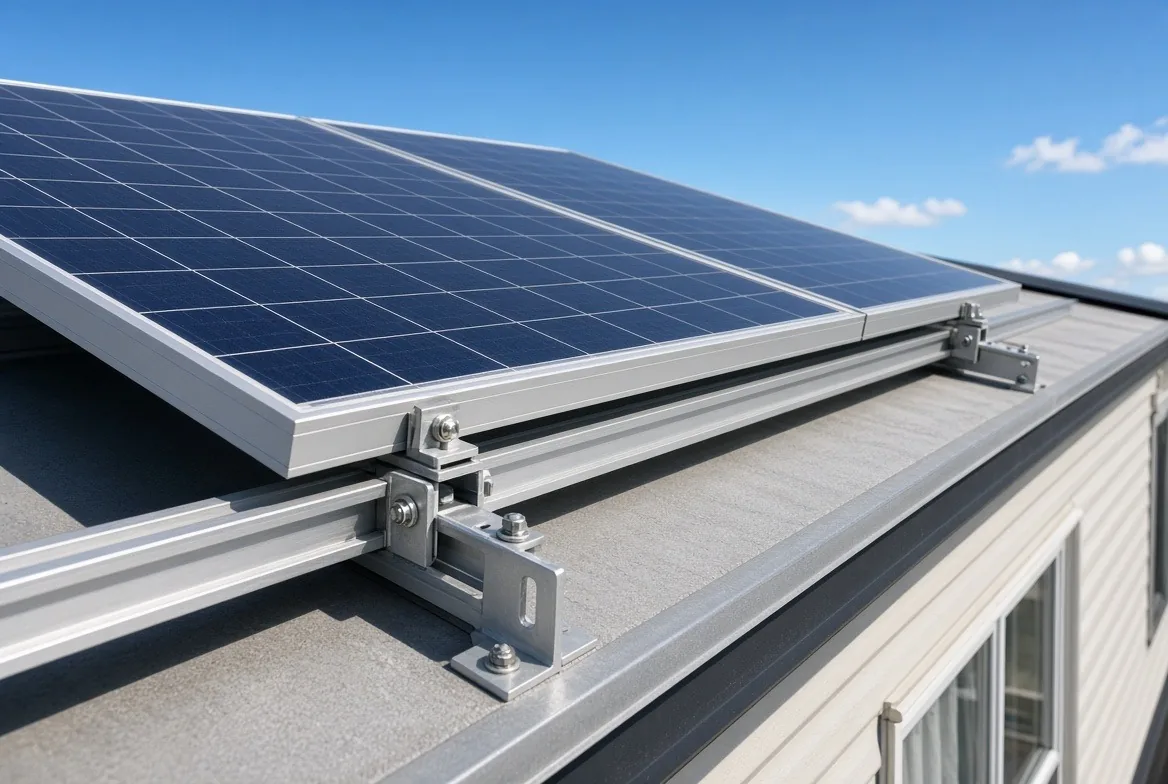
What "Solar Brackets for a 365W Solar Panel" Actually Means
If you're shopping for solar brackets sized for a 365W panel, you've picked one of the more common commercial-crossover wattages — big enough to be worth the mounting hardware investment, but still light enough (43–50 lbs) for a one- or two-person install. The catch is that "bracket" can mean five very different products: rigid Z-brackets, continuous rail-based racking, tilt-adjustable leg mounts, ground-mount pipe kits, or pole mounts. For a mobile or manufactured home, picking the wrong one isn't just a performance question — it can be a structural one.
A 365W module from a maker like Qcells, REC, or Suntech typically measures around 67–69 inches by 40–41 inches, weighs 43–45 lbs, and covers roughly 19 square feet. Larger 144-half-cell versions (like the Hyundai HiA-S365HI) stretch to nearly 79 inches and 50 lbs. That surface area matters: it's a sail under wind load and a loaded plate under snow, so the hardware holding it down has to distribute force correctly across the frame, not just clamp four corners and hope.
Z-Brackets vs. Rails vs. Ground Mounts
Z-brackets are the cheapest option — rigid aluminum L/Z-shaped feet that flush-mount a panel 1–2 inches above a flat surface. They work fine on small off-grid panels, but on a 365W module they create two problems: poor airflow underneath (which raises operating temperature and cuts output) and concentrated point loads at just four anchor points. On the thin plywood or sheet-metal decking common on manufactured home roofs, those point loads are a leading cause of loosened fasteners and roof-membrane tears.
Rail-based racking (IronRidge XR100, Unirac SolarMount, and similar) uses continuous aluminum rails that spread the panel's weight and wind/snow loads across multiple roof trusses instead of four spots. This is the industry-standard choice for pitched roofs, including manufactured home installs, precisely because it turns point loads into line loads the structure can actually carry.
Tilt-adjustable mounts let you angle the panel to match your latitude, which can boost annual yield 10–25%, but a tilted 365W panel acts like a sail — it needs heavier-duty legs and fasteners to resist uplift.
Ground mount kits (Tamarack GM series, IronRidge Ground Mount) move the entire load off the roof and onto a ground-based steel-pipe substructure. For manufactured homes with light-gauge trusses, this is often the safer route.
Pole mounts are space-efficient but concentrate an entire array's wind load on one or two posts, so they need serious torsional bracing.
Why Manufactured Home Roofs Are the Limiting Factor
This is the part most buyers miss. Manufactured homes are built under federal HUD Code (24 CFR Part 3280), not the same building codes as site-built houses, and their roofs are engineered with a much tighter safety margin. HUD's model installation standards set a baseline roof live-load capacity of just 20 pounds per square foot in non-snow regions.
A single 365W panel's dead load works out to about 2.3 psf on its own footprint. Add the rail, clamps, flashing, and wiring, and a real-world rail-mounted system adds roughly 3–4.5 psf of dead load to the roof. That can eat a meaningful chunk of the structural margin HUD-code trusses were designed with — which is exactly why manufacturers like IronRidge and installers increasingly steer manufactured-home owners toward ground mounting when truss condition or snow load is uncertain. If a roof inspection turns up thin decking, corroded fasteners, or trusses smaller than 2×4 lumber, ground mounting sidesteps the problem entirely.
Wind, Snow, and the Numbers That Matter
Certified 365W modules are rated for roughly 5,400–7,000 Pa (113–146 psf) of front-side snow/static load and up to 3,800–4,000 Pa of rear wind uplift. But the hardware has to be rated to match, and that's where mounting type makes the biggest difference. Standard rail systems like the IronRidge XR100 support spans up to 8 feet and are rated to roughly 160 mph wind and 60 psf snow — solid for most manufactured-home climates. Lightweight Z-brackets, by contrast, typically top out around 30–50 mph with no real snow rating, which is why they're a poor match for a full-size 365W module in anything but a sheltered, low-wind site.
At 50 mph sustained wind, a single 365W panel experiences roughly 54 lbs of horizontal force — enough that under-specified hardware can work loose over a season or two, even if nothing fails outright on day one.
What Mounting Hardware Actually Costs (2025–2026)
Prices vary a lot by category, and the "brackets" search often undersells what a proper installation costs once you add the rest of the racking. Rough 2025–2026 market ranges per panel:
- Z-bracket sets: $15–$30
- Tilt-adjustable mounts: $45–$90
- Roof rail systems (rail + clamps + flashing feet): $60–$130
- Ground mount kits (rail + pipe + footers): $150–$350
- Pole mounts: $200–$500+
For a real four-panel rail-mounted roof array using IronRidge XR100 components, expect roughly $270 total in racking hardware — about $69 per module once rails, L-feet, clamps, and grounding lugs are included. A comparable Tamarack ground mount kit with steel pipe and concrete footers runs closer to $193–$234 per module, but it removes the roof entirely from the load equation.
How to Choose
Start with a structural check, not a shopping cart. If your manufactured home's roof trusses are sound, sized at least 2×4, and spaced 16–24 inches on-center, a rail-based system like IronRidge XR100 anchored into truss centers with proper flashing feet is the standard, well-supported choice for a 365W panel. If the roof shows thin decking, older bowstring trusses (common in pre-1976 mobile homes), or you're in a high snow-load region, ground mounting is the more conservative and often cheaper-per-watt-of-safety option. Either way, skip flush Z-brackets on a panel this size — they're built for smaller off-grid modules, not a 43–50 lb, 19-square-foot panel that has to survive real wind and snow seasons.
Whatever hardware you choose, match the clamp width to your panel's actual frame depth (30–40mm is standard for most 365W modules), torque fasteners to spec (typically 80–120 in-lbs), and confirm your rail spacing lands within the manufacturer's quarter-point clamping zones — mounting too close to the center of the panel is a common, invisible cause of long-term micro-fractures in the cells.