
Guide
Solar Panel 600 W: Specs, 2026 Prices and Mobile-Home Sizing
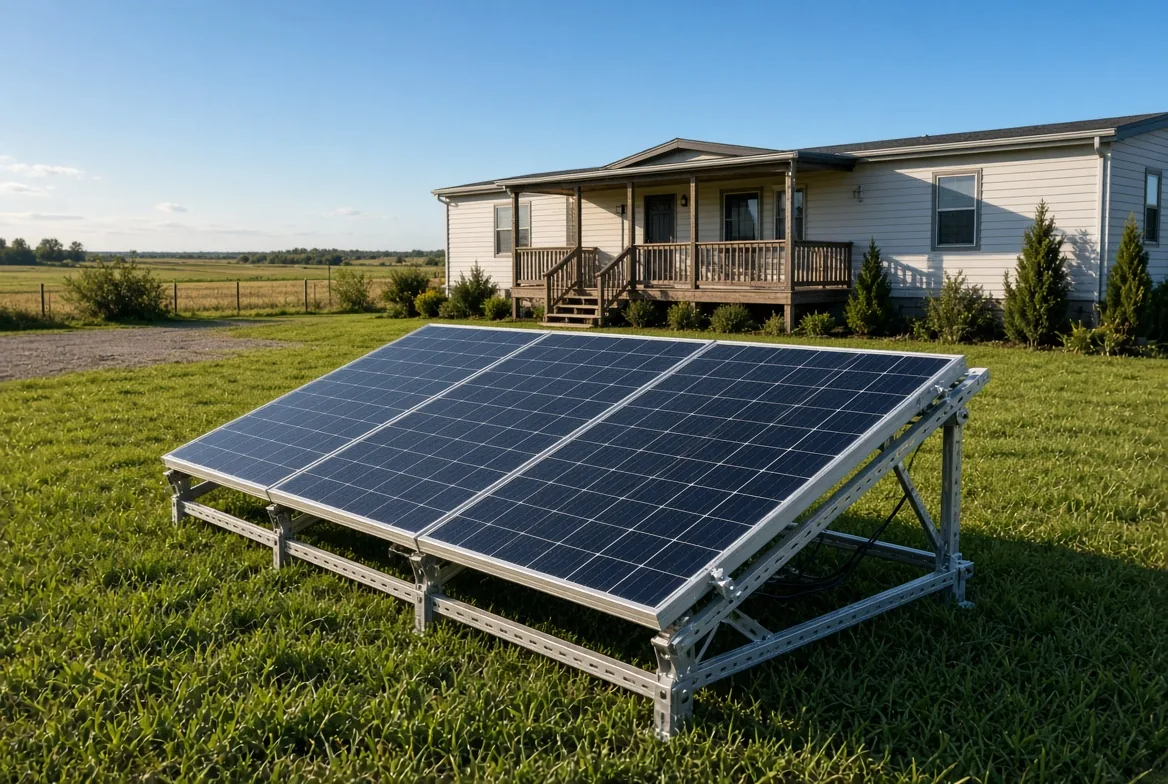
What a "solar panel 600 W" actually is
Search for solar panel 600 w and you will find two completely different products: a genuine 600-watt N-type TOPCon module built for commercial rooftops, and a featherweight "600W" flexible panel the size of a doormat that cannot possibly make 600 watts. On a mobile or manufactured home the difference is not academic. The real thing is roughly 90 inches long, weighs about 70 lb, and spreads its weight over just 27.8 ft² — which works out to about 2.5 lb per square foot of roof that a HUD-code home was never designed to spare.
This guide covers what today's 600W class really delivers, what it costs in the US in 2026, how many panels a mobile home needs, and how to spot the fakes.
The specs behind the number
A genuine 600W module in 2026 is an N-type TOPCon (occasionally HJT) panel: half-cut cells, dual-glass bifacial construction, 16BB multi-busbar. Two mechanical formats dominate:
- 144 half-cells on a 182 mm-class wafer, 2278 × 1134 mm (≈89.7 × 44.6 in) — for example the Canadian Solar TOPBiHiKu6 CS6W-600TB-AG and the Rich Solar MEGA 600. About 27.8 ft², 58–71 lb.
- 132 cells on a rectangular 210R wafer, 2382 × 1134 mm (≈93.8 × 44.6 in) — for example the Trina Vertex N TSM-NEG19RC.20 and LONGi Hi-MO 7/8. A little longer, similar width.
Electrical specs (STC) for real 600W models
| Model | Vmp | Imp | Voc | Isc | Efficiency | |---|---|---|---|---|---| | Canadian Solar CS6W-600TB-AG | 43.9 V | 13.68 A | 53.0 V | ~14.1 A | 23.2% | | Rich Solar MEGA 600 Bifacial | 44.2 V | 13.5 A | 52.9 V | 14.3 A | ~23.2% | | LONGi LR-72HTH-600M (Hi-MO 6) | 44.66 V | 13.44 A | 52.81 V | 14.46 A | 22.9% |
Look at the Voc column: about 53 V. A conventional 400W residential panel is only ~37 V. That gap is what decides how many panels you can put in a series string, and it is where most DIY mobile-home installs go wrong.
600W vs 400W vs 700W
The 600W class is really a utility-scale format repurposed for homes. It is 30% longer than a 400W panel and about 2 ft² per panel more productive, but it crams 70 lb onto 27.8 ft². Going from 400W to 600W adds roughly 2 ft of length and 24 lb per panel and pushes Voc from ~37 V to ~53 V — great for a ground mount, sobering for a lightweight roof.
What a 600W panel costs in the US in 2026
Prices for the 600W class are wildly uneven, and the spread is about 3–4×. Tier-1 pallet pricing starts near $0.27–$0.32 per watt; consumer-brand retail runs $0.66–$1.06 per watt. A single panel from a distributor can be $185–$299, while the same panel split out of a 26–36 panel pallet lands at $174–$191.
A few concrete 2026 listings:
- LONGi Hi-MO X6 600W — $161.29 per panel ($0.27/W) at Portlandia Electric Supply.
- Trina Vertex N 600W — $6,886.99 for a pallet of 36, i.e. $191.30 per panel ($0.32/W) at US Solar Supplier. The same panel bought singly runs $299.
- Canadian Solar CS6W-600TB-AG — $278.40 single ($0.46/W), or $7,199 for a 26-panel pallet at ShopSolar.
- Renogy 590W N-type bifacial — $989.99 for a 2-pack, dropping to $0.66/W in a 10-panel bundle at Renogy.
- Rich Solar MEGA 600 — $550 per panel ($0.92/W) direct, $440 ($0.73/W) at My Generator Plus, and $634.63 ($1.06/W) elsewhere.
Do not forget freight. A pallet of 36 large-format panels weighs about 2,700 lb, ships LTL, and cannot be delivered with a liftgate. Budget $200–$700 per pallet for delivery, plus $99 or so for liftgate service where a retailer offers it.
How much power one 600W panel actually makes
Rated watts are not delivered watts. A 600W panel produces its nameplate only at 25 °C cell temperature and 1,000 W/m² — conditions that almost never occur together on a real roof. Using a standard 80% derate for temperature, soiling, wiring, inverter and mismatch losses:
That is 1.92 kWh per day at 4 peak sun hours, 2.40 kWh at 5, and 2.88 kWh at 6 — roughly 58, 73 and 88 kWh per month. A hot inland site with less than ideal tilt might see the 75% derate figures instead: 657, 821 and 986 kWh per year. Bifacial gain on a ground mount with a light-coloured surface can add several percent back on top.
How many 600W panels does a mobile home need?
Start with the load, not the panel. The EIA's Residential Energy Consumption Survey puts the average mobile home at 12,456 kWh per year — about 18% more than the 10,566 kWh average for all US homes, mostly because older manufactured housing is smaller, less insulated and more likely to heat with electricity.
At 876 kWh per panel per year (5 peak sun hours, 80% derate), covering that average load takes about 15 panels, or 9 kW. Homes that use less do fine with fewer:
- Small single-wide (≈6,800 kWh/yr): 8 panels at 5 PSH, 10 at 4 PSH.
- Large single-wide / small double-wide (≈9,400 kWh/yr): 11 at 5 PSH, 14 at 4 PSH.
- Average mobile home (12,456 kWh/yr): 15 at 5 PSH, 18 at 4 PSH.
Two 600W panels on a single MPPT input is a comfortable starting point for a shed or a well pump; a whole-home system is a 12–18 panel job.
Wiring a 600W array: go 48V
The Voc of these panels makes system voltage the first decision.
| System voltage | Max practical array | Current for 7.2 kW (12 panels) | |---|---|---| | 12 V | ~1 kW | 600 A — unsuitable | | 24 V | ~2–3 kW | 300 A — small cabins only | | 48 V | 5–15+ kW | 150 A — recommended |
At 48 V, a 7.2 kW array needs about 150 A of MPPT capacity (two 100 A controllers, or a hybrid inverter with multiple MPPT inputs). The same array at 12 V would demand 600 A — pointless, oversized cables, and a Vmp of 44 V wasted on a 12 V battery.
Then check the cold-weather string limit. Using a −0.25%/°C Voc coefficient, a 52.9 V panel reaches about 58.9 V at −20 °C. On a 150 V charge controller that means two panels in series maximum; three in series would hit ~177–181 V and destroy the controller. A 250 V MPPT takes four in series, and a 450–500 V hybrid inverter input takes eight.
Can a 600W panel go on a mobile-home roof?
Sometimes — but the structure is the binding constraint, not the panel count.
HUD's construction standard sets design roof live loads at 40 psf in the North zone, 30 psf in the Middle zone and 20 psf in the South. A 600W array with racking adds about 3–4 psf of dead load. That is 15–20% of a South-zone home's entire design allowance, and wind uplift on Zone II eaves is already −51 psf — so panels become additional uplift area, not just extra weight.
Manufactured-home roofs are typically lightweight 2×4 trusses at 16–24 in on centre. A single-wide is only 14–18 ft wide, giving roughly 7–9 ft of horizontal run per side of a centre ridge — enough for two panel rows in landscape only if fire setbacks and walkways allow. Add a low-slope roof (3:12 or flatter) costing a few percent of annual yield, and rooftop starts to look like the expensive option.
Ground mount is usually the better answer
For most mobile-home owners with any yard at all, a ground rack or pole mount sidesteps the HUD structural question entirely. It also lets you set the ideal tilt, keeps the array cooler, and captures bifacial gain from grass or gravel. Check park rules, the lease, and homeowner's insurance before trenching, but expect fewer permits and no structural letter.
How to spot a fake "600 W" panel
Physics caps output at roughly area (m²) × 1,000 W/m² × efficiency. A real 600W panel at 23% needs about 2.6 m² of cell area. Run three checks before you buy:
- Area × efficiency: length × width in metres × 1,000 × efficiency must be ≥ the rated watts. A "600W" panel measuring 100 × 67 cm (0.67 m²) would need 90% efficiency — impossible.
- Vmp × Imp: multiply the two figures on the label. Rich Solar's 44.2 V × 13.5 A = 597 W. If the maths lands short of the nameplate, walk away.
- Weight sanity check: a genuine 600W rigid module weighs 58–72 lb. Anything under about 40 lb claiming 600W of rigid output is not what it says it is.
Also watch kit listings: many Amazon "600W" products are 2 × 300W or 3 × 200W bundles, which is fine but is not one 600W panel. Ask for the manufacturer datasheet and a UL 61730 certificate, and confirm the serial against the maker.
Bottom line
A real 600W solar panel is a commercial-grade module: ~90 × 45 in, ~70 lb, 22–23% efficient, with a ~53 V Voc that wants a 48 V system and short series strings. In 2026 you can land genuine Tier-1 panels for $0.27–$0.35 per watt by pallet, or pay $0.66–$1.06 per watt for the convenience of a retail 8-pack. Each panel returns 701–1,051 kWh a year depending on your sun hours, so an average mobile home needs roughly 15 of them.
Buy the panels that fit your structure first, then your budget. For most mobile homes that means a ground mount, a 48 V hybrid system, and a string design that survives a cold morning.