
Guide
Solar Panel Cleaning Near Me: What It Really Costs on a Mobile Home in 2026
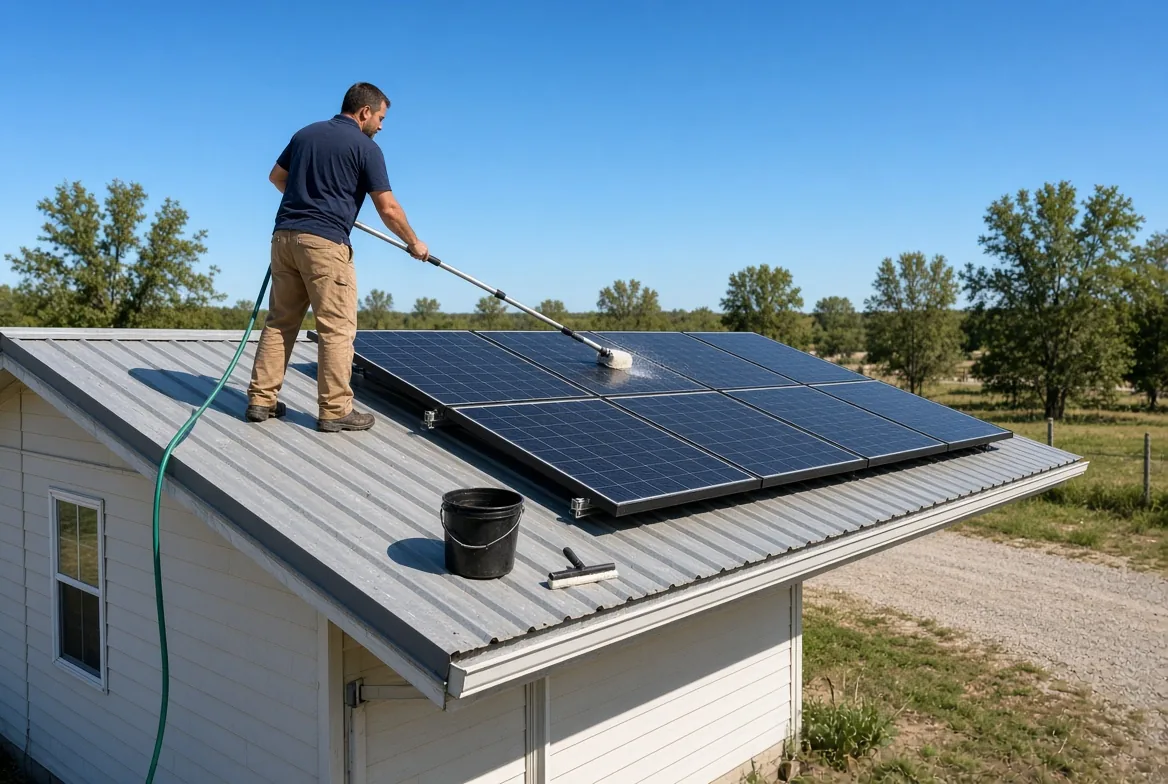
Why "solar panel cleaning near me" is a different question on a manufactured home
If you live in a single-wide, double-wide, park model or RV, the search "solar panel cleaning near me" pulls up the same window-cleaning and solar-maintenance companies that serve site-built houses — but almost none of their published pricing was written for a ten-panel roof. National cost guides price solar cleaning per panel or per visit, and your array is small: a 14–16 ft wide single-wide roof usually holds only eight to sixteen modules. That means the minimum charge, not the per-panel rate, is what you actually pay.
This guide breaks down what local cleaners charge in 2026, what the measured soiling research says about whether you need the service at all, and the roof-safety rules that make manufactured homes a genuine special case.
What professional solar panel cleaning costs in 2026
Across the national cost guides, residential solar panel cleaning runs $150–$500 per visit, with per-panel rates of $10–$20. Angi's solar panel repair and cleaning cost data lists $15–$35 per panel and $150–$350 for a whole system, while Thumbtack's solar panel cleaning cost page shows $5–$10 per panel in low-cost markets and flat tiers such as $129–$149 for up to 32 panels, then $2.50 per panel after that.
- Per panel: $10–$20 in most guides, $15–$35 on Angi, $5–$10 in low-cost markets on Thumbtack
- Per visit: $150–$500, with most single-story homes landing at $250–$350
- Minimum or trip fee: $75–$150 — the number that decides your invoice
- Annual plan (two cleanings plus inspection): $390–$720
- Post-wildfire ash cleaning: $200–$400, treated as its own service category
Why your quote is almost always the minimum fee
Twelve panels at $10–$20 per panel is $120–$240, but the trip fee floors it. Small arrays do not get cheaper than the minimum, so a $95 quote and a $175 quote for the same roof often differ only in how far the crew drives. Angi notes that rural homeowners "could face travel surcharges," and urban markets tend to sit at the low end of the per-panel range.
How manufactured home arrays compare with a site-built roof
- Array size: small. Eight to sixteen panels means the minimum fee drives the price.
- Height: single-story with low eaves — the cheapest access category in the guides. Steep or two-story roofs typically add 20–40%, and you are not paying that.
- Roof type: low-slope metal, rolled roofing or coated roof-overs are easy to reach and easy to dent.
- Ground mounts: simpler to clean than roof mounts, though some crews price them higher because of cable management and mowing risk around the array.
- RV and park-model roofs: many window and solar cleaners will not take these jobs at all. Ask before you book.
How much production you actually lose while you wait
Soiling is real, but slower than the sales pitch. The UC San Diego study of 186 California residential and commercial sites (Mejia and Kleissl, published in Solar Energy in 2013) measured an average loss of 0.051% per day, with 26% of sites losing more than 0.1% per day. Panels that went 145 days without rain lost just 7.4% of efficiency, and the value of a mid-summer wash on a 5 kW home worked out to about $20 — before paying anyone to do it. UCSD's Jacobs School summary is worth reading in full.
NREL's soiling-station data puts most US sites at 0.03–0.15% per day, while desert sites can reach roughly 0.5% per day. Convert that into money rather than percentages: at the California average, a month without rain costs about 1.5% of output, and a full dry season costs around 5%.
How often to clean, by climate
- Dusty Southwest (AZ, NV, inland CA, west TX): the highest-risk region, with long dry seasons, haboobs and farm dust. Desert dust alone can cost up to 15% of output that rain will not wash off. Two to four cleanings a year if the array is tilted under 5°.
- Humid Southeast (NC, GA, FL, SC): frequent rain does not keep panels clean. NREL and Solar Unsoiled found that utility plants in North Carolina accumulated soiling rain failed to remove, and tree pollen sticks hard. Inspect after spring pollen and again after hurricane season.
- Pollen-heavy Midwest: no strong regional dataset exists, so treat this as a gap. If your array is low-tilt and tree-shaded in May, a rinse is cheap insurance.
- Wildfire-smoke West: separate smoke in the air from ash on the glass. Work led by Colorado State researchers (Corwin et al., Nature Communications, 2024) shows widespread smoke dims production through haze, while ash deposits cause the persistent losses. Clean after a deposition event, not after every smoke advisory.
- Tilt matters as much as climate. Panels tilted under 5° lose more to soiling, and REC's module manual says the lower the angle, the more often cleaning is needed.
What a legitimate cleaning includes — and what voids your warranty
Manufacturer rules are stricter than most customers expect. REC's solar module cleaning guide requires deionized water free of grit and physical contaminants, a soft non-abrasive brush on an extension pole, and ambient-temperature water. Pressure washers, steam cleaners and high-pressure hoses "will invalidate" the module warranty, and the same applies to acid or alkaline detergents. Qcells' manuals agree on brushing rather than stepping.
A professional visit should also mean:
- Wash-water rules. Local stormwater ordinances, not federal ones, govern runoff. San Diego, Orange County, Contra Costa County and Phoenix all restrict discharging polluted wash water into storm drains — ask what the crew does with it.
- Fall protection. OSHA's construction standard (29 CFR 1926.501) requires protection at six feet; general industry starts at four. The rule binds the employer, but it tells you what a compliant crew looks like.
- Insurance. Request a certificate of insurance naming you, showing general liability and, if they have employees, workers' compensation.
The do-not-walk rule for manufactured home roofs
HUD-code roofs are engineered for uniform live or snow loads of 20 psf (South zone), 30 psf (Middle) or 40 psf (North) under 24 CFR 3280.305 — and most of that allowance is already spent on snow, wind uplift and the array itself. Foremost, a major mobile-home insurer, advises owners to put weight on the trusses and never between them. Older near-flat aluminum or coated metal roofs dent; shingled roofs shed granules and slip shingles.
Panel makers add their own rule: never step, lean or rest on the modules. Microcracks from being walked on are invisible and permanent. The good news is that a single-story manufactured home is the ideal candidate for a 20–24 ft water-fed pole worked from the ground. Nobody has to be on your roof.
DIY versus hiring: the numbers
- Basic DIY kit (soft brush, squeegee, DI filter, extension pole): $30–$250
- Professional-grade water-fed pole, DI resin and tank setup: $2,000–$8,000 — that is a cleaning business, not a homeowner purchase
- Water use: 3–5 gallons per panel, so 40–100 gallons for a 12–20 panel array
- Resin cost: roughly $3–$8 of DI resin per 25-panel job
- Hard-water risk: spotting comes from dissolved minerals in the rinse water. At 400 ppm source water, resin capacity falls to 500–700 gallons per cubic foot, which is why unfiltered hose water leaves a haze you cannot buff out
For a typical manufactured-home array, a $30–$250 kit plus an afternoon is the honest comparison against a $150–$400 visit. The constraint is water quality and safety, not effort.
How to find and vet a local cleaner
- Ask three companies for a per-visit price for your exact panel count, and ask whether the minimum fee is waived on a return visit.
- Confirm deionized water, a soft brush and ground-level pole work — and no pressure washing.
- Request a certificate of insurance naming you.
- Check your state's minor-work threshold. California's exemption rose to $1,000 in 2025 and Florida's covers jobs under $2,500. Anyone touching wiring, racking or critter guards may need a contractor or electrical license.
- Treat "NABCEP certified cleaner" as a red flag. NABCEP certifies installation and design professionals — it does not certify cleaners.
- Ask what happens to the wash water.
- Get the cleaning method written on the invoice and keep it with your warranty records.
The 60-second payback test
Take your array's monthly production in kWh, multiply by the share of output you think you are losing — use 1.5% for a month without rain, or 5% after a dust or ash event — then multiply by your local rate. A 5 kW manufactured-home array producing 600 kWh a month at 1.5% soiling loses about 9 kWh, roughly $1.50–$2.00 at typical US rates. That does not justify a $200 visit on its own.
Cleaning pays when one of three things is true: your panels sit under 5° of tilt with heavy dust or ash, you have bird droppings or lichen that rain will not remove, or you need documented maintenance for a warranty claim. Otherwise, wait for rain and spend the money on a critter guard.
Bottom line
For mobile and manufactured home owners, "solar panel cleaning near me" is mostly a minimum-fee question. Expect $150–$500 per visit with a $75–$150 floor, insist on deionized water and a soft brush, never let anyone walk the roof, and run the payback test before you book. For most small, tilted, rain-exposed arrays, cleaning is a maintenance habit rather than an investment.