
Guide
Solar Panel Cleaning Service Cost for Mobile Homes (2026)
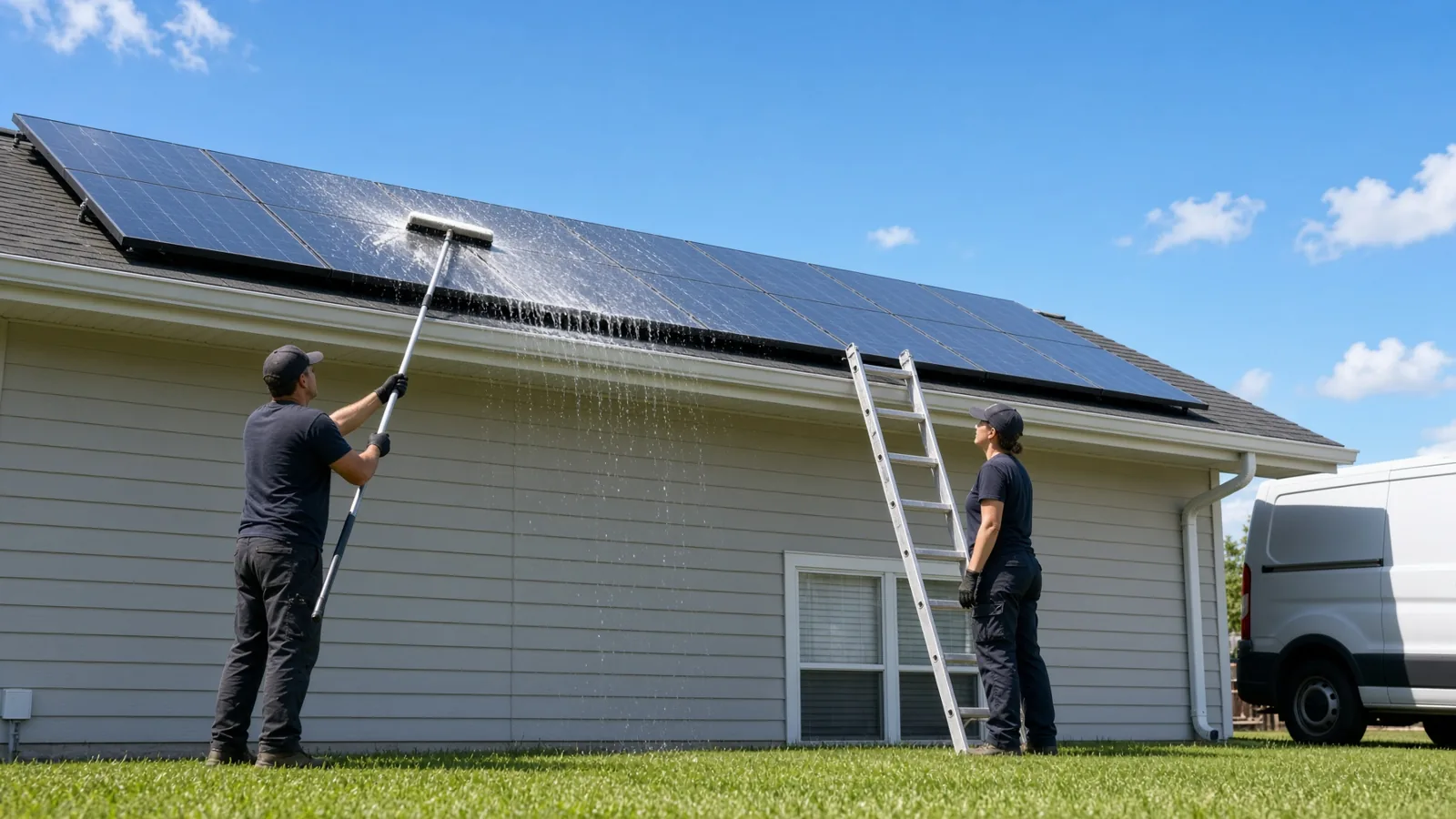
A solar panel cleaning service typically charges $9 to $15 per panel, or $200 to $350 for the 20- to 30-panel array common on a manufactured home, with most companies enforcing a $125 to $150 minimum call-out. On the low-slope, lightweight roofs of mobile and manufactured homes the best crews never get on the roof at all: they clean from the ground with deionized water fed up a carbon-fiber pole. That distinction matters, because untreated tap water and abrasive brushes can permanently damage anti-reflective coatings, and a mobile home roof deck was never built to carry a person plus a brush.
What a professional solar panel cleaning service visit includes
A properly run visit follows a fixed sequence, and you can use it to judge any quote you receive.
- Pre-clean inspection. The technician checks the array for cracked glass, corroded frames, chafed wiring, burnt junction boxes, degraded seals and heavy bird waste.
- Pure-water pre-rinse. Low-pressure deionized water goes on first to cool the glass and lift loose grit. Removing grit before a brush touches the surface is what prevents scratching.
- Soft-brush agitation. Flocked or dual-trim solar brushes on a telescoping pole loosen pollen, salt crust and baked-on dust. Never a stiff bristle, scouring pad or wire brush.
- Final purified rinse. Water at under 10 ppm total dissolved solids (TDS) is flushed across the glass. Carrying no dissolved minerals, it dries streak-free.
- Post-clean verification. Good crews check glass clarity and, where you have monitoring, compare production before and after.
What a visit does not include: electrical repairs, roof sealing, critter-guard mesh (usually billed separately), and glass or panel replacement. A cracked module cannot be cleaned back to health; it has to be replaced, at roughly $200 to $550 per panel plus labor.
Solar panel cleaning service cost in 2026
Pricing in this trade is built from three numbers: a per-panel rate, an array flat fee, and a minimum call-out. Nationally, per-panel rates run about $3.50 to $5 for easily reached arrays, $9 to $15 for a standard single-story roof, and $25 to $35 where multi-storey access or steep pitch demands fall-arrest rigging.
For whole-array work, HomeAdvisor's 2026 maintenance cost data puts a typical 20-panel cleaning at $200 to $300, with low-density or promotional visits at $100 to $160 and difficult installs at $350 to $500. A 30-panel array runs roughly $270 to $360 in the typical case.
Then there is the minimum call-out, the number that surprises most homeowners: $125 to $150 is typical, while metropolitan contractors often set a $200 to $275 floor to cover travel, water purification mobilization and safety setup. A residential flat-rate package usually settles between $149 and $299.
Two things move the price more than panel count. The first is access: on a mobile or manufactured home, a single-story low-slope roof is among the easiest access profiles in the trade, so you should be paying at the bottom of the per-panel band rather than the top. The second is water quality. A crew that brings a reverse-osmosis/deionization cart has real equipment cost behind it, and that is not the line item to negotiate.
The case for and against hiring a cleaning service
Where a service wins
- Accountability. An insured contractor carries the fall and electrical risk instead of you, and a documented maintenance record supports warranty claims.
- Water quality. A contractor's RO/DI cart produces sub-10 ppm water on site, which a garden hose cannot.
- Reach. Carbon-fiber poles work 30 to 50 feet from the ground, which is exactly how a low-slope manufactured-home roof should be cleaned.
- Speed. Two technicians with the right kit finish faster than a homeowner on a ladder ever will.
Where it loses
- Price. You are paying $150 to $350 for something that costs $12 to $30 in consumables once you own the equipment.
- Availability. Some rural markets have no solar-specific cleaner within a reasonable radius, and a general window cleaner with a pressure washer is worse than no service.
- Over-servicing. In high-rainfall regions an annual clean is often enough, making a monthly contract money spent on nothing.
When cleaning pays for itself
The economics are simple once you know your soiling rate. Work published by the IEA PVPS programme and NREL puts average global energy yield loss from soiling at 4% to 7% a year, with United States losses ranging from under 1% in wet temperate regions to around 7% under baseline conditions. In arid, polluted or agricultural settings, uncleaned systems lose 15% to 30% of annual yield.
Run that on a mobile home array. A 20-panel, 8 kW system generating 10,000 kWh a year at $0.40/kWh loses $400 of production at a 10% soiling rate. Two professional visits at $180 each cost $360, so the decision is roughly break-even at that level and turns clearly positive as soiling worsens.
Where it does not pay: a coastal Pacific Northwest array with regular rain and a soiling rate under 2%. There, a single late-spring clean after pollen is the whole programme.
Cleaning methods: pure water, poles and what to avoid
- Deionized water from a water-fed pole. The industry standard. Water is pushed up a carbon-fiber pole to a soft brush head, and the rinse is the same pure water. No detergents, no ladder, no roof traffic.
- RO/DI cart systems. Tap water passes a carbon pre-filter, then a reverse-osmosis membrane that removes 90% to 95% of dissolved solids, then a deionization resin vessel that polishes the output to under 10 ppm, ideally 0 ppm.
- Water-fed brush on a garden hose. A halfway house that works only if the supply is already low-TDS. Otherwise you trade dust for mineral spots.
- Soap and a mop, or a pressure washer. Both are wrong. Surfactant residue attracts dust, manufacturers' manuals void warranties over chemical cleaners, and high pressure drives water past the seals and can crack modules.
Water use is modest: a 20- to 30-panel residential array typically takes 10 to 30 gallons per session, depending on flow rate and how much grime has built up.
Equipment specs that protect your warranty
If you are comparing quotes, ask about these directly:
- Water quality: a calibrated TDS meter reading at or below 10 ppm, taken at the brush head rather than at the tap.
- Pole: high-modulus carbon fiber, 30 feet or more for residential work, non-conductive and isolated from the water path.
- Brush: soft nylon, flocked or dual-trim, made for solar glass.
- Safety: full-body harness, shock-absorbing lanyard and rated roof anchors for anyone who does go up, plus a wiring inspection before water is introduced.
- Insurance: general liability of $1M to $2M and active workers' compensation cover. Ask for the certificate, not a verbal assurance.
Panel glass reaches 130F to 160F on a sunny day. Spraying water below 60F onto glass that hot induces thermal shock, which can crack a module outright and voids the warranty. That is why competent crews schedule early mornings, late afternoons or overcast days, and never clean hot glass.
DIY vs professional: the real cost comparison
The upfront capital is the honest part of the DIY case. A ground-based entry kit with a 12- to 20-foot pole, soft brush and a small inline deionization cartridge costs $200 to $400. A mid-range homeowner setup with a 24- to 27-foot carbon hybrid pole, hose reel and an 8- to 12.5-liter resin vessel runs $587 to $997. A commercial rig with an RO/DI filtration cart and 30- to 50-foot poles starts around $1,500 and passes $4,000.
Once the kit exists the ongoing cost is small. Resin replenishment runs $30 to $100 a bag, and a portable vessel processes 100 to 300 gallons before exhaustion, working out at about $10 to $25 of resin per cleaning plus $2 to $5 of water. That puts a DIY clean at roughly $12 to $30 per visit against $150 to $350 for a contractor.
The comparison only holds if you never go on the roof. Walking a low-slope manufactured-home roof loads lightweight decking and thin TPO or rubber membrane that was never specified for point loads, and stepping on a module flexes the glass and fractures silicon cells into microcracks you cannot see. Those cracks widen through daily heat cycling, sever the internal grid fingers, and become hot spots that degrade the encapsulant and can start a fire. Most module warranties exclude exactly this.
Frequently asked questions
How much does it cost to have solar panels cleaned? Most homeowners pay $150 to $350 for 20 to 30 panels, or $9 to $15 per panel, plus a $125 to $150 minimum call-out on smaller jobs.
Is it worth getting your solar panels cleaned? Yes where soiling is heavy. Above roughly 10% annual production loss the arithmetic turns positive, and in dusty, agricultural or wildfire-exposed regions that threshold is reached within a season. In high-rainfall areas with under 2% soiling it often is not.
How much does a solar panel cleaning system cost? $200 to $400 entry level, $587 to $997 for a mid-range carbon-pole and deionization-vessel setup, and $1,500 to $4,000 or more for commercial RO/DI rigs.
How do you clean solar panels? With pure deionized water and a soft brush, applied from the ground on a water-fed pole, working early or late so the glass is cool. Pre-rinse to lift grit, agitate, rinse again to sub-10 ppm water, then let it air-dry.
How often should solar panels be cleaned? Arid regions need two to four cleanings a year, agricultural corridors about two, forested and suburban areas one to two after pollen, coastal locations two pure-water rinses. Wildfire fallout calls for an immediate clean.
Troubleshooting: panels that still look dull after a clean
- White spots or a chalky haze. Mineral spotting from tap water: the crew skipped the RO/DI cart, and repeated cycles will calcify onto the anti-reflective coating.
- Vertical streaks. Almost always an exhausted resin vessel - the water was pure at the start of the job and was not at the end. Ask for the TDS reading at the brush.
- A dull film that returns within weeks. Detergent residue attracting dust. It is a warranty problem as much as a cosmetic one.
- One panel that stays visibly dirty. Bird waste, usually the module nearest a roofline or vent. Remove it promptly: with cells wired in series, the shading cost of one fouled module is disproportionate.
- Output that does not recover after cleaning. Not a cleaning issue. Soiling loss is reversible; cracked cells, failed bypass diodes and hot spots are not.
Who should hire a solar panel cleaning service
Hire a service if your array sits in a dusty, agricultural, coastal or wildfire-prone area; if the array is on a low-slope manufactured-home roof you should not be walking on; if you run a monitoring app and want the production audit a professional visit includes; or if you cannot safely manage a 30-foot pole and your own water supply.
Do it yourself if you are in a high-rainfall region with low soiling, you already own a proper water-fed kit, and your array is ground-mounted or reachable without roof access.
What to check before you sign: NABCEP certification or an equivalent solar maintenance qualification, $1M to $2M general liability and active workers' compensation, an RO/DI cart with a TDS meter, carbon-fiber poles, a written scope and a before/after production reading. Walk away from anyone quoting a pressure washer, dish soap or a stiff brush - those three things are how warranties get voided.
Why soiling matters more than most owners think
Soiling is not evenly spread dirt. It accumulates in a pattern set by your local climate, and the loss compounds with the seasons.
- Desert dust. Accumulates close to linearly at 0.5% to 1% of efficiency per week through a dry season, which is how arid regions reach 8% to 15% losses before a clean.
- Spring tree pollen. A sticky organic film light rain does not shift; concentrated pollen coats can depress peak power output by up to 15%, and the resins bond to glass.
- Wildfire ash. Fine carbon and mineral particulates that scatter incoming light and can etch glass coatings under humid conditions if left unwashed. Post-fire losses of 10% to 25% are common.
- Bird droppings. Localized but severe. Because cells are series-connected, opaque coverage over a single cell restricts the whole string and forces that cell to dissipate heat as a hot spot - one of the documented mechanisms of soiling loss.
- Coastal salt. A crystalline crust that hazes the glass by 3% to 8% and attracts further dust. It needs pure-water agitation to dissolve, not a dry brush.
A field study at UC San Diego followed arrays through 145 days without rain and measured an average power decline of 7.4%, with wet cleaning restoring 5% to 11% of output. That is the mechanism behind every quote you will be given, and why a professional clean is a maintenance decision rather than a cosmetic one. Roof access is the part the general guides skip: OSHA's fall-protection standard requires protection at six feet in construction and four feet under general-industry rules, and ground-based poles sidestep the question entirely. With roughly six million American solar installations now in place and about 97% of them residential, that maintenance question is only getting bigger.