
Guide
Solar Panel Cleaning for Mobile Homes: How Often, DIY Methods & Costs
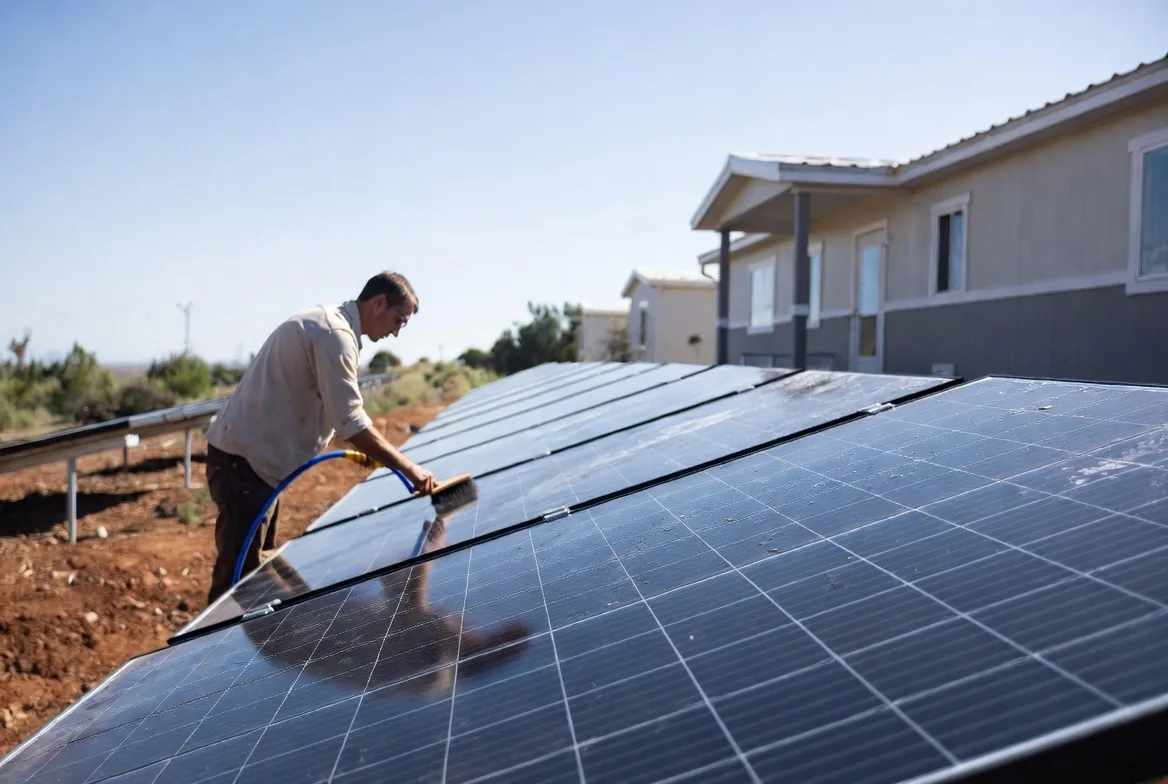
Why solar panel cleaning matters more for mobile and manufactured homes
If your solar array sits on a single-wide or double-wide rooftop, or on a ground mount next to a manufactured home, you're probably dealing with more dust than the average suburban homeowner realizes. Mobile home parks, rural properties, and manufactured-housing communities are disproportionately located along gravel roads, near farmland, or in dry, semi-arid regions — all prime conditions for dust, pollen, and airborne debris to settle on your panels.
Rain washes away some loose dirt, but it rarely removes stubborn grime like bird droppings, tree sap, agricultural dust, or wildfire ash. Because solar cells within a panel are electrically connected, even a small shaded or soiled patch can drag down the output of an entire module — not just the dirty section.
The numbers back this up. The International Energy Agency estimates solar systems lose an average of 3–5% of annual production to soiling worldwide, and a widely cited review of soiling studies found panels can lose roughly 6.5% efficiency after just two months without cleaning. In severe desert conditions, documented losses have hit as high as 42%. For mobile home owners in dusty rural settings, the lower end of that range (a steady 5–15% loss) is a realistic everyday concern.
How often should you clean solar panels on a mobile home?
There's no single rule that fits every property, but industry guidance generally breaks down like this:
- Average residential area: every 6–12 months
- Heavy pollen or bird activity: 2–3 times per year
- Dry, rural, or agricultural settings (common for mobile home parks): every 3–6 months
- Rainy climates with little dust: every 18–24 months
- After dust storms or wildfire ash: clean as soon as it's safe to do so
Because manufactured homes are so often sited in exactly the dusty, low-rainfall environments that accelerate soiling, most owners should lean toward the more frequent end of that range — 2–4 cleanings a year — rather than waiting a full year between cleanings.
Rather than sticking to a rigid calendar, keep an eye on your system's production data if you have a monitoring app. A noticeable, unexplained dip in output — especially after a dry stretch — is usually your cue that it's time to clean.
DIY cleaning: the safest method for mobile home solar setups
One advantage manufactured homes often have is that rooftops sit lower than a typical two-story house, and a large share of mobile home solar systems are ground-mounted rather than roof-mounted — which makes DIY cleaning both safer and more practical.
A basic, manufacturer-friendly cleaning routine looks like this:
- Pick the right time. Clean early morning, late afternoon, or on an overcast day. Cold water on sun-heated glass can cause thermal stress, and cleaning solution evaporates too fast in direct midday heat, leaving mineral spots behind.
- Rinse loose dirt first with a garden hose or a low-pressure spray nozzle. Skip the pressure washer — high-pressure water can damage seals, wiring, and frame joints.
- Wash with soft tools only: a microfiber cloth, soft sponge, soft extension brush, or a squeegee with a microfiber head. Plain water is usually enough; add a little mild soap for stubborn grime. Never use steel wool, abrasive pads, bleach, ammonia, or metal scrapers — they can scratch the anti-reflective coating.
- Soak bird droppings before wiping rather than scraping them off dry.
- Rinse thoroughly, ideally with distilled or filtered water to avoid hard-water spotting.
A basic DIY toolkit — microfiber cloths, a soft telescoping brush, a squeegee, a hose nozzle, and a bucket — typically runs $30–80 total, and most of it is reusable for years.
Ground-mounted arrays can usually be cleaned in under 30 minutes with no ladder required, which is a real safety advantage. If your panels are on the roof, standard precautions apply: never work on a wet roof, use a stable ladder, avoid high winds, keep clear of exposed wiring, and never walk directly on the panels themselves — it can crack cells or void your warranty.
When to call in a professional
Professional solar panel cleaning in the US typically runs $150–500 per visit, or roughly $10–20 per panel, depending on system size, roof accessibility, and how much buildup has accumulated. Steep rooflines, heavy bird-dropping coverage, and hard-to-reach panels all push costs toward the higher end.
For most homeowners, a reasonable rhythm is DIY cleaning every 3–6 months paired with a professional cleaning and inspection once a year — especially useful if you want a technician to double-check wiring and mounting hardware while they're up there. If your system is easy to reach and lightly soiled, DIY alone may be all you need.
Does cleaning actually pay for itself?
For an 8 kW residential system producing around 11,000 kWh a year at $0.18/kWh, here's roughly what regaining lost production is worth annually:
- 3% soiling loss recovered: about $59/year
- 8% soiling loss recovered: about $158/year — close to the cost of one professional visit
- 12% soiling loss recovered: about $238/year
- 20% soiling loss recovered (heavy soiling): about $396/year
DIY cleaning, which costs next to nothing after the initial toolkit purchase, tends to pay for itself almost immediately in dusty environments. Professional cleaning becomes most cost-effective once soiling losses climb into the 8–12%+ range, which is more common in agricultural or desert-adjacent mobile home communities than in rainy suburban neighborhoods.
Bottom line for mobile and manufactured home owners
Dust, pollen, and bird droppings hit rural and manufactured-housing properties harder than most residential neighborhoods, which makes solar panel cleaning a more meaningful maintenance task than it might seem. A simple routine — rinse, soft-wash, rinse again, every 3–6 months — keeps most systems performing close to their rated output, and calling in a professional once a year covers the harder-to-reach spots and gives you an extra set of eyes on your hardware.
Sources: EnergySage solar panel maintenance guide, Angi average solar panel cleaning costs, Fixr solar panel cleaning cost guide, ScienceDirect review of photovoltaic soiling research, and IEA PVPS.