
Guide
Solar Panel Cost for Mobile Homes: What You Pay in 2026
Solar panel cost for mobile homes: the short answer
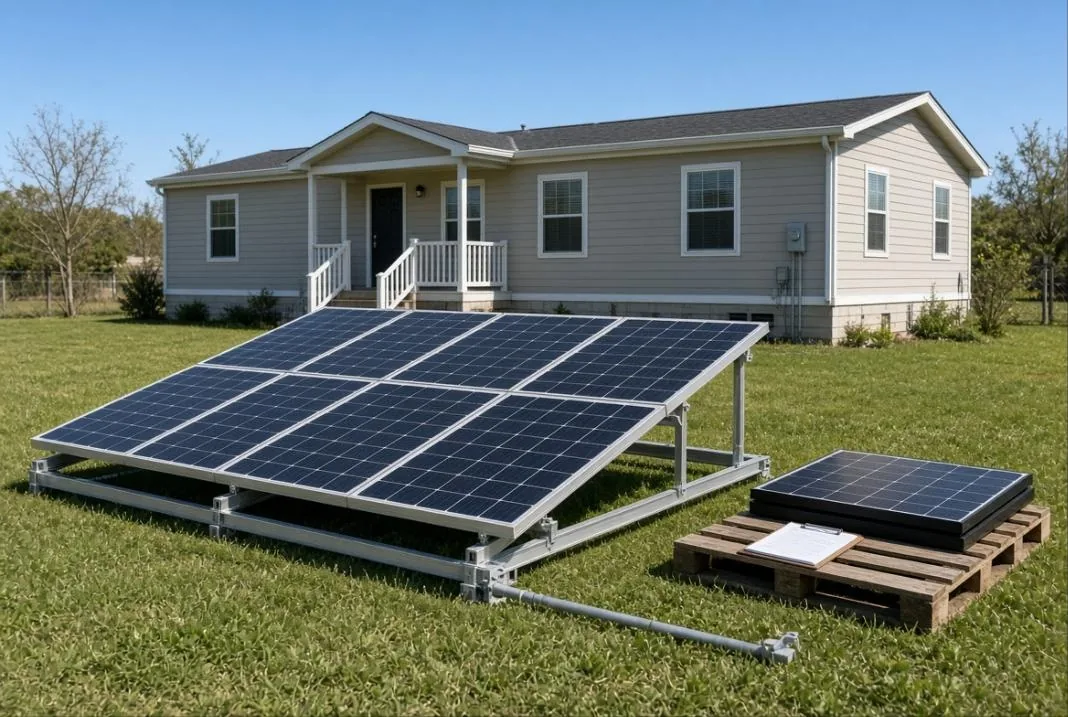
If you own a manufactured or mobile home, the number to remember is $2.80 to $4.00 per watt installed. The bottom of that range is a reinforced roof mount. The top is a ground-mounted array, which is what a lot of mobile home owners end up with once a contractor inspects the roof. On a 6 kW system - the size that fits a typical double-wide looking for a full bill offset - that is $16,080 to $24,000 before incentives, and roughly $11,250 to $16,800 after the 30% federal tax credit.
Here is where those numbers come from, and how to tell which one is yours.
Why solar costs more on a manufactured home
The roof sets the first hard limit
Manufactured homes are built to the federal HUD Code, and that code is strict about weight. Roof trusses are typically engineered for a small additional dead load - often just 2 to 5 pounds per square foot - and the roof membrane is part of the factory-sealed envelope. Standard residential panels, rails and ballast blow past that allowance, and drilling through the membrane can void the structural warranty. Roof mounting is possible, but it usually means a structural assessment, lightweight racking or added blocking, and a roofer's warranty conversation.
So most mobile home arrays go on the ground
A ground mount is a small civil engineering project: grading, concrete pier footings or ground screws, steel racking rated for boundary-layer wind loads, and underground trenching with heavy-gauge conduit back to the home's main panel. Trenching alone typically runs $1,000 to $3,000. Independent comparisons put ground-mounted systems 20% to 36% higher per watt than roof-mounted ones (PVRack), which is exactly how the manufactured-home range stretches to $3.20-$4.00/W.
Smaller systems carry more fixed cost
A mobile home uses less electricity than a 2,500 sq ft site-built house, so installs land between 3 kW and 6 kW. Permits, interconnection paperwork, design and the truck roll do not shrink with system size, so the cost per watt goes up as the array gets smaller. This is the single most under-appreciated reason a mobile home quote looks expensive next to a neighbor's 8 kW rooftop job.
A 6 kW system, priced four ways
Those are pre-incentive gross costs, with the 30% credit shown as its own line:
- 6 kW PV only, roof mount (reinforced): $16,080 gross ($2.68/W), $4,824 credit, $11,256 net
- 6 kW PV only, ground mount: $19,800 gross ($3.30/W), $5,940 credit, $13,860 net
- 6 kW PV + 10 kWh battery, roof mount: $26,580 gross, $7,974 credit, $18,606 net
- 6 kW PV + 10 kWh battery, ground mount: $30,300 gross, $9,090 credit, $21,210 net
Battery storage adds a median $651 to $1,037 per kWh of usable capacity installed, so a 10 kWh battery is a $6,500-$10,400 line item inside those totals. Whether you want it depends on your utility: under time-of-use rates or stingy export tariffs the battery is what keeps your evening consumption off the grid; where net metering is still generous, it is optional.
What the 30% federal tax credit actually does
The Residential Clean Energy Credit (Section 25D) covers 30% of the installed cost of solar and battery storage. Mobile home owners qualify on the same terms as anyone else: the home must be a primary or secondary residence, and you do not need to own the land. A manufactured home on a leased lot in a park still qualifies as long as you own the equipment, though your park will usually want to approve a ground mount or any roof attachment (IRS Form 5695 instructions, ENERGY STAR).
Two details people get wrong. First, it is a credit, not a deduction: on the $16,080 roof-mounted system above it takes $4,824 straight off your federal tax bill. Second, it is capped by your liability in the year you install - anything unused carries forward, so it is not money you lose, but it is money you may have to wait for.
Where the money actually goes
On that $16,080 roof-mounted 6 kW system, the invoice breaks down like this:
- solar panels: 12% ($1,930)
- inverter: 10% ($1,608)
- wiring and balance-of-system hardware: 9% ($1,447)
- permitting and interconnection: 8% ($1,286)
- installation labor: 7% ($1,126)
- racking: 3% ($482)
Hardware is only about a third of what you pay; soft costs - design, sales, permitting, overhead and profit - are the other two thirds. That is why two quotes for an identical array can differ by thousands of dollars. Ground mounting shifts the mix again: racking climbs from 3% to roughly 8-10% ($1,800-$2,200) and trenching adds $1,500-$3,000 on top. Net of the tax credit, choosing a ground mount costs about $2,604 more and pushes payback out by 1.5 to 2 years.
How solar panel cost has changed since 2010
The national median installed cash price fell from $8.89 per watt in 2010 to $3.50 per watt in 2024, while module prices alone collapsed from $2.29/W to $0.35/W. The interesting part is 2016: system prices stopped falling in lockstep with hardware, because by then hardware was already a minority of the bill. Today, competitive marketplaces quote $2.49-$2.75/W for site-built rooftop solar (EnergySage, Sunhub); the broader cash-purchase median sits nearer $3.34-$3.50/W. That gap is your negotiating room - and it is also why a mobile home quote that lands above $3/W is not automatically a bad deal.
DIY and plug-and-play kits
If the quote you got is unacceptable, the DIY path is real for manufactured homes, and it is friendlier than it is for a two-story house: everything happens at ground level. Self-installed arrays start around $1,200 for an entry-level setup, and battery-integrated kits in the 6 kW to 18 kW range run $6,500 to $12,500 - avoiding up to $8,000 in soft costs and labor. The catch is that you own the design, the permits, the inspection and the roof or ground attachment details, and a ground mount still needs footings and trenching done properly. Owners who keep the paperwork straight still claim the same 30% credit.
Payback in sunny states
In high-sunlight markets - California, Arizona, Florida, Texas - a mobile home system typically shows a simple payback of about 7 to 11 years, with monthly bill savings of $90 to $240 depending on your rate and net-metering rules. Retail electricity prices have been climbing about 2.89% per year nationally, and 4-6% per year in fast-growing Sun Belt markets, which shortens the effective payback by another 1.5 to 2.5 years against a static model. If your park buys power in bulk and sub-meters it to you, check whether local rules let you connect solar to offset that sub-metered tariff - it changes the math more than any hardware choice.
The bottom line
For a mobile home in 2026, budget $2.80-$4.00 per watt and expect to land near $11,000-$17,000 net for a 6 kW system after the 30% federal credit. Get at least three quotes, ask each installer to state whether they are quoting a reinforced roof mount or a ground mount, and ask for the trenching line separately - it is the single easiest place for a bid to hide a few thousand dollars. Sizing guidance for this specific housing type is worth reading before you sign anything (Sungo Energy).