
Guide
Solar Panel Installation for Mobile & Manufactured Homes: The Complete 2026 Process Guide
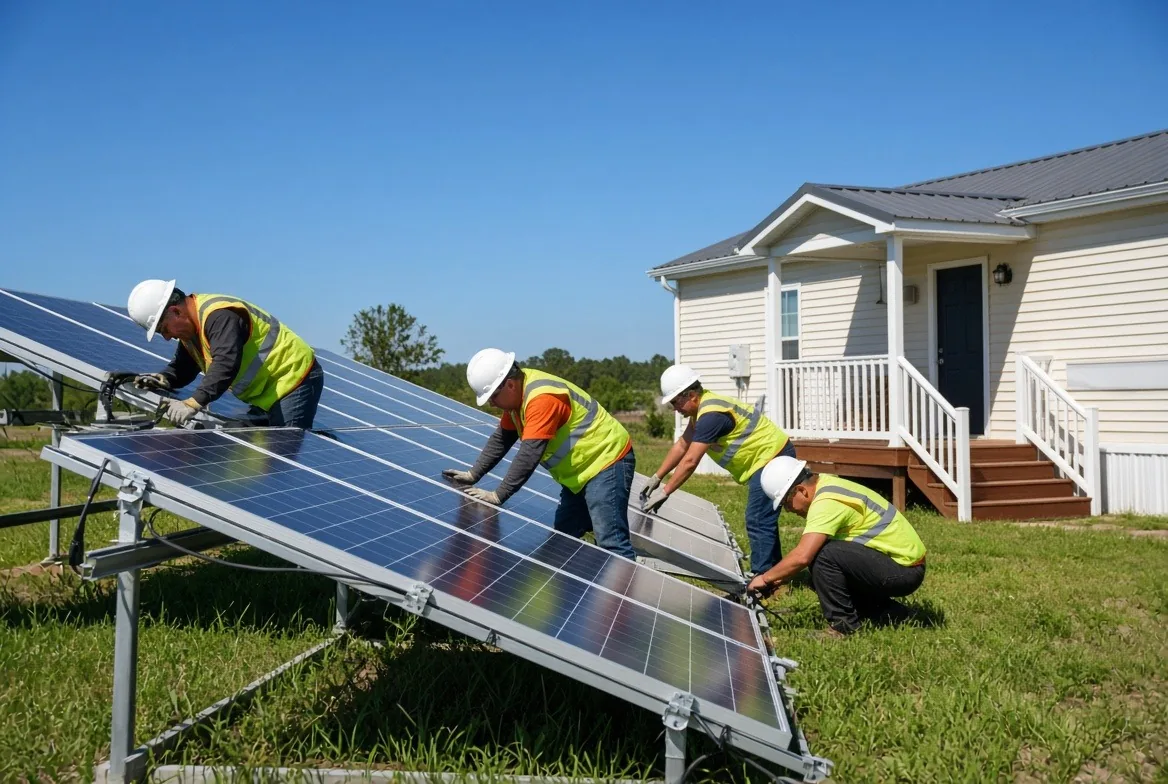
Searching "solar panel installation" usually turns up guides written for site-built houses with standard asphalt-shingle roofs. If you live in a mobile or manufactured home, that advice can be misleading — and in some cases unsafe. Manufactured home roofs are built to a different structural standard (the HUD Code, 24 CFR Part 3280), and that changes almost every step of the installation process, from mounting to permitting to insurance.
This guide walks through how solar panel installation actually works for mobile and manufactured homes, what it costs in 2026, and where the process diverges from a typical rooftop install.
Why manufactured homes need a different installation approach
Under HUD Code construction standards, manufactured home roofs are generally engineered with only a slim margin of extra dead-load capacity above the roofing materials themselves — commonly cited in the range of 3 to 5 lbs per square foot. A standard rooftop solar array, including panels, racking, and hardware, typically weighs 3 to 4 lbs per square foot on its own. That leaves little to no safety margin once you factor in snow load, wind uplift, and maintenance foot traffic.
Installing directly on an unreinforced manufactured home roof risks structural stress, water intrusion at mounting penetrations, and — critically — can void both the manufacturer's home warranty and your homeowners insurance policy. For this reason, installers who specialize in manufactured and mobile homes usually steer customers toward one of three alternatives:
- Ground-mounted racking systems anchored in a concrete or helical-pile foundation near the home
- Solar carports or freestanding canopy structures, which double as covered parking
- Lightweight flexible (thin-film) panels, in cases where roof-mounting is unavoidable and a structural engineer signs off
Each of these sidesteps the roof load problem entirely, which is why ground-mount systems have become the default recommendation for HUD Code homes rather than the exception.
The installation process, step by step
Whether you're on a manufactured home or a conventional house, professional solar installation follows the same broad sequence — the manufactured-home version just adds an extra structural review step.
- Site assessment and engineering design (roughly 1–2 weeks). An installer evaluates sun exposure, shading, your electrical panel's capacity, and — for manufactured homes — whether roof-mount is even viable or a ground-mount/carport layout makes more sense. This is also when a structural engineer may be brought in to review dead-load capacity.
- Permitting and utility interconnection application (roughly 2–6 weeks). This is usually the longest phase of the entire project. Your installer files for a local building permit and submits an interconnection application to your utility. Manufactured home installations sometimes require additional state-level forms (for example, HCD paperwork in California) confirming the home's HUD Code compliance.
- Equipment procurement. Panels, inverter(s), racking, and balance-of-system components are ordered once permits are approved.
- Physical mounting and wiring (roughly 1–3 days). This is the fastest part of the process. Crews install the racking (ground-mount, carport, or roof, depending on the design), mount the panels, run DC wiring to the inverter, and complete AC wiring into your electrical panel, including a rapid-shutdown system as required by NEC 690.12.
- Inspection. A local electrical/building inspector verifies the installation meets code before it can be energized.
- Utility Permission to Operate, or PTO (roughly 1–4 weeks after inspection). Your utility performs a final review and formally authorizes the system to connect to the grid. You cannot legally turn the system on until PTO is granted.
Added together, the full process typically spans 4 to 12 weeks from signed contract to a fully operational system — even though the physical mounting itself takes only a few days. Permitting and utility interconnection, not the installation labor, are what determine your timeline.
What it costs in 2026
Professional installation pricing in the US currently runs $2.50 to $3.50 per watt before incentives, with a national average closer to $3.20–$3.50/W. More price-competitive online marketplaces and bulk-purchase platforms can bring that down toward $2.50–$3.00/W. Ground-mount and carport systems for manufactured homes often land at the higher end of that range because they require additional foundation work and racking compared to a straightforward roof mount.
Within that total price, roughly:
- 30% (range 22–33%) goes to hardware — the panels and inverter(s)
- 50% (range 45–55%) goes to "soft costs" — permitting, design, customer acquisition, and overhead
- 20% (range 15–20%) goes to direct installation labor
That soft-cost share is worth noting: it's a large part of why manufactured-home installations, which require extra engineering review and sometimes ground-mount construction, tend to cost more per watt than an equivalent system on a conventional roof.
DIY vs. professional installation
Off-grid and DIY solar kits can bring the equipment-only cost down to roughly $1.20–$1.60 per watt — meaningfully cheaper than a professional turnkey install. For a small, battery-based off-grid setup that never touches utility wiring, that can be a reasonable path.
But for a grid-tied system feeding power back through your home's electrical panel, DIY installation carries real risks that go beyond saved labor cost:
- High-voltage DC work on the array side of the inverter is dangerous without training, and mistakes aren't always obvious until they cause a fire.
- NEC 690.12 rapid-shutdown compliance is mandatory in most jurisdictions and is easy to get wrong without electrical code experience.
- Permits and utility interconnection typically require a licensed electrician's sign-off regardless of who does the physical installation — DIY doesn't eliminate this step.
- Equipment warranties on panels and inverters are frequently voided if installed by an unlicensed party.
- Homeowners insurance may decline claims tied to a self-installed electrical system, particularly on a manufactured home where the roof-load question is already a sensitivity point.
For manufactured and mobile homeowners specifically, the safest and most warranty-preserving path is a professional installer experienced with HUD Code homes, even if it costs more upfront than a generic DIY kit.
Key takeaways
Solar panel installation for a mobile or manufactured home isn't simply "the same process as a regular house, on a smaller roof." The HUD Code's roof load limits push most manufactured-home installations toward ground-mount or carport designs, and permitting/utility interconnection — not the physical mounting — is what stretches the timeline out to 4–12 weeks. Budgeting $2.50–$3.50 per watt for professional installation, and treating any DIY grid-tied wiring with real caution, will keep both your warranty and your insurance coverage intact.
Sources: