
Guide
DIY Solar Panel Kits for Mobile & Manufactured Homes: 2026 Sizing, Pricing & Installation Guide
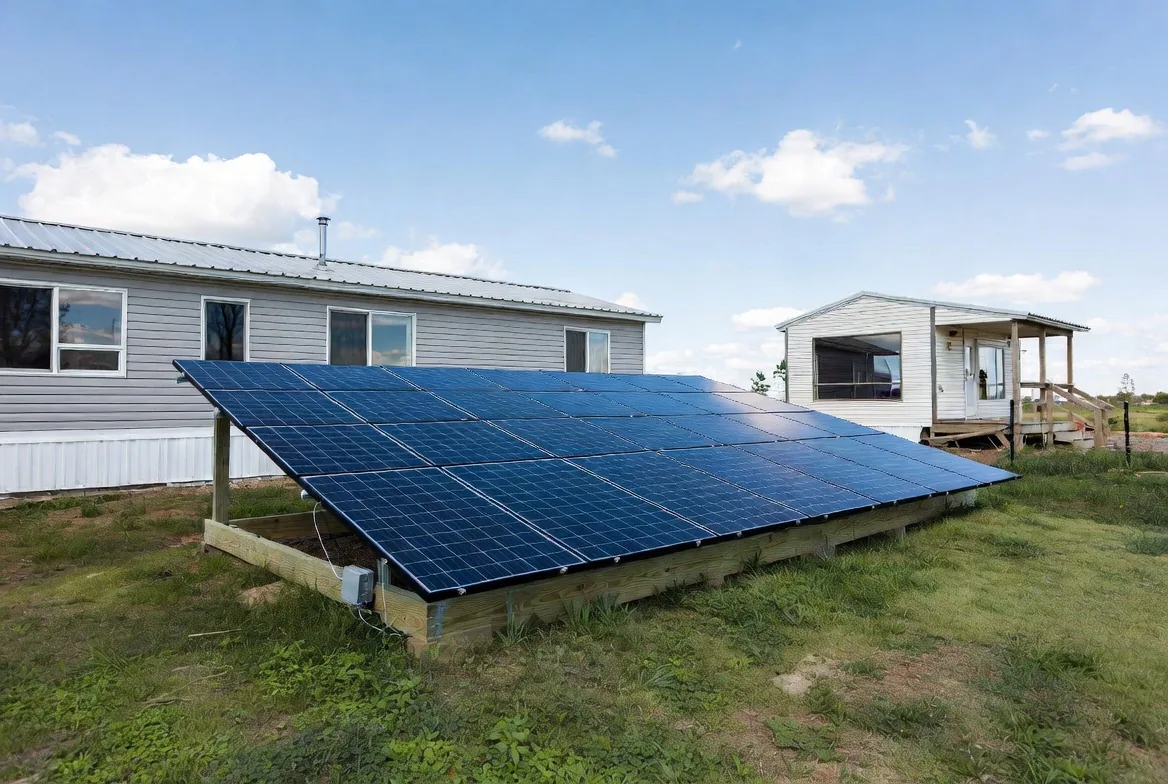
Choosing a solar panel kit is one of the few home-energy decisions where owning a mobile or manufactured home actually simplifies things a little — and complicates others a lot. You skip HOA fights and roof re-shingling, but you inherit a lighter roof structure, a smaller footprint, and a completely rewritten federal tax incentive picture for 2026. Here's what a kit actually contains, what it costs, how to size one to your real usage, and where manufactured-home roofs run into trouble.
What's actually inside a DIY solar panel kit
A complete kit bundles five things: the photovoltaic panels themselves, a charge controller, an inverter, a battery bank, and mounting hardware.
Monocrystalline panels dominate the 2026 DIY market, with efficiency ratings routinely between 21% and 25%. Many current kits also use bifacial panels, which capture reflected light on their back surface and can boost total yield by 15–30% depending on how reflective the ground beneath them is — a real advantage for the ground-mounted racks common on manufactured-home lots.
The charge controller is where MPPT (Maximum Power Point Tracking) units earn their higher price over basic PWM (Pulse Width Modulation) controllers: MPPT tracks the panel array's optimal voltage in real time, converting 30–40% more usable energy than PWM in variable weather, with tracking efficiency up to 99.5%.
For storage, LiFePO4 (lithium iron phosphate) batteries have mostly replaced lead-acid in complete kits. They deliver 3,500–7,000 charge cycles at 80% depth of discharge, need no maintenance, and include a battery management system that guards against over-voltage and thermal issues — worth the premium if the kit includes one.
What kits actually cost in 2026
Real current pricing across the major DIY brands (Renogy, ECO-WORTHY, Rich Solar, Grape Solar, HQST, Jackery, Bluetti):
- 100–200W panel-only kits: roughly $49–$350
- 400W starter kits (panels + basic MPPT controller, no battery): about $374–$592
- 400W complete kits with inverter and lithium battery: $1,300–$1,600
- 1,000W cabin-scale kits from Rich Solar or ECO-WORTHY: $1,200–$2,000
- All-in-one portable stations (Jackery, Bluetti): from around $599 for roughly 1 kWh of storage up to $4,800+ for whole-home backup capacity
Component-based kits (Renogy, ECO-WORTHY) are cheaper per watt and more repairable long-term; all-in-one generators trade that for plug-and-play simplicity, which matters if you're not planning to do your own electrical troubleshooting later.
Sizing a kit to your actual usage
The standard sizing formula uses a national average of 4.5 peak sun hours per day and a 75% system efficiency factor to account for cabling and inverter losses:
Required watts ≈ (daily kWh × 1,000) ÷ (4.5 × 0.75)A mobile home running lights, a fridge, and basic electronics at roughly 10 kWh/day needs about a 3,000W system — call it eight 400W panels. A larger manufactured home running central air conditioning at 40 kWh/day needs closer to 12,000W, or around thirty 400W panels — well beyond what most manufactured-home roofs can structurally support, which is exactly why ground mounting matters here.
Why manufactured-home roofs are the real constraint
This is the part general solar guides skip. The HUD code divides the country into three roof-load zones — South (20 psf), Middle (30 psf), and North (40 psf) — but those numbers are rated for temporary live loads like snow and foot traffic, not the permanent dead load a bolted-down solar array adds (typically 2–3 psf for panels alone, more with racking).
Manufactured-home roofs are built lighter than site-built homes by design, and federal standards (24 CFR 3280) generally require a signed structural engineer's report before any permanent roof-mounted addition — skipping it risks voiding your manufacturer's warranty or failing a resale inspection. For a deeper look at what installers check before signing off, How to Look at a House is a genuinely useful read before you buy anything.
Ground-mounted kits sidestep the entire problem. They're heavier to install (concrete footings or ground screws, more cable run back to the house), but they carry zero roof-load risk and are the practical default for most manufactured-home DIY installs — which is also why ground mounts show up disproportionately in kit reviews aimed at this exact housing type.
DIY vs. professional installation
DIY installation saves the labor line item — often 30–50% of a professional quote — and component kits are genuinely designed for a competent DIYer with basic electrical knowledge. But professional installation still wins when: the array is roof-mounted (structural sign-off and code inspection are non-negotiable), the system needs grid interconnection, or local permitting requires a licensed electrician's stamp regardless of who does the physical mounting. Ground-mount, off-grid, battery-only systems are the sweet spot for DIY.
The 2026 tax credit reality check
This is the single biggest change from what older solar guides still say. The 30% federal Residential Clean Energy Credit (IRS Section 25D) that DIY buyers relied on for over a decade was eliminated by the One Big Beautiful Bill Act, signed in July 2025 — with no transition period — for any system placed in service after December 31, 2025. If you buy and self-install a solar kit outright in 2026, you get $0 in direct federal tax credit on that purchase. The IRS's own Residential Clean Energy Credit page and SolarReviews' 2026 breakdown both confirm the cutoff.
A narrower commercial credit (Section 48E) survives through 2027, but it only applies to third-party-owned systems under lease or PPA arrangements — not a kit you buy and bolt down yourself. Some states still run their own rebate or tax programs independent of the federal credit, so it's worth checking your state revenue department before assuming a kit purchase gets zero help.
The bottom line
For most mobile and manufactured homes, the practical path in 2026 is a mid-size component kit (400–1,000W) with an MPPT controller and LiFePO4 battery, ground-mounted rather than roof-mounted, sized against your actual daily kWh rather than a generic "starter kit" wattage — and budgeted without a federal tax credit cushion that no longer exists.