
Guide
Solar Panel Mounting Brackets & Hooks for Balconies: Mobile Home Guide
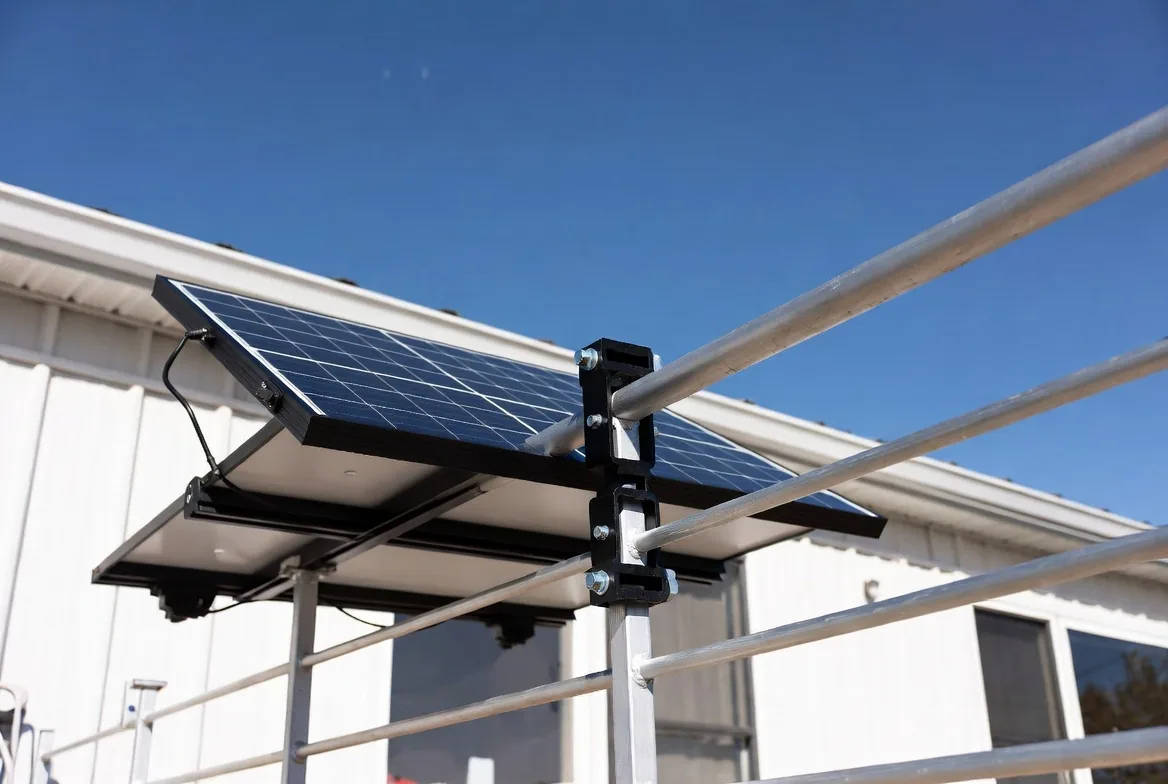
Solar panel mounting brackets, hooks, and clamps: which one fits your home?
If you live in a mobile or manufactured home, you probably don't have the option of a full roof-mounted solar array — and that's actually fine, because a huge chunk of the "balcony solar" hardware boom happening right now was built for exactly your situation: small spaces, no drilling, and a structure that wasn't engineered to carry a heavy ballasted rack.
Solar panel mounting brackets and hooks for balconies come in six basic families. Picking the right one comes down to what you're attaching to (a railing, a deck floor, a metal roof, a carport post, or bare ground) and how much wind load your structure can safely take. This guide breaks each type down, walks through the weight and wind-load numbers you actually need to check, and covers the legal side of plugging a panel straight into a wall outlet.
The 6 types of solar mounting brackets and hooks
Railing clamp kits. These are adjustable clamps with a screw or jaw mechanism that grip round tube, square tube, or flat-bar railing without any drilling. They're the standard hardware bundled with most portable balcony kits (EcoFlow, Anker SOLIX, Renogy, and similar brands all ship a version of this). Because they don't penetrate anything, they're the safest starting point for a manufactured home's porch or deck railing — you're not putting a hole in framing you can't easily inspect.
Hook-and-rail systems. Popularized by Germany's "Balkonkraftwerk" (balcony power plant) movement, these use S- or J-hooks to hang the panel directly over a railing top rail, sometimes with a spacer bar that adds a slight tilt. They're the cheapest and fastest option, but they leave the panel close to vertical, which costs you energy production compared to an angled mount.
Adjustable tilt brackets. Foldable A-frame or triangle arms that sit on a flat surface — a deck floor, a flat carport roof, or a patio slab — and let you dial in a tilt angle, typically anywhere from 15° to 65°. These are a strong match for manufactured-home decks and porches where you have floor space and want better year-round output than a vertical hook mount gives you.
Rail-free / metal-roof seam clamps. Instead of running a continuous rail, these clamp straight onto the panel frame and onto standing-seam or corrugated metal roofing without a single screw penetrating the roof deck. Since a lot of manufactured homes have thin metal roofing that wasn't designed for heavy penetrating hardware, seam clamps are usually the safer route if you're mounting to the roof at all.
Ground mounts. Freestanding A-frame or pole racks set up beside the home. If you've got yard space, this sidesteps every roof and railing weight question entirely, and it lets you optimize tilt and orientation for the best possible output.
U-bolt and C-clamp universal brackets. The generic, inexpensive option — U-bolts wrap around round posts (carport supports, fence rails, awning frames) and C-clamps grip flat bar or a channel lip. These are common on manufactured-home lots that have carports or awning structures to attach to.
Which mount fits your setup?
Match the hardware to what you're attaching to: round tube railing calls for a standard adjustable clamp or U-bolt; square tube needs a square-jaw clamp; flat bar or a channel lip works best with a C-clamp; and glass balustrades typically need a dedicated clamp-on adapter rather than a generic kit. If you're not mounting to a railing at all — say, a deck floor, patio, or yard — an adjustable tilt bracket or ground mount will get you a better angle than any railing-hung hardware can.
Special considerations for mobile and manufactured homes
HUD-code manufactured homes are built differently than site-built houses: lighter roof trusses (often spaced 24 inches on center), thinner metal or membrane roofing, and a steel chassis instead of a conventional foundation. That combination means the heavier, ballasted roof-rack systems designed for stick-built roofs are frequently a poor — or unsafe — fit. For most manufactured-home situations, the better choices are non-penetrating railing clamps on a deck or porch, a freestanding tilt or ground mount, or seam clamps if you do need to attach to a metal roof.
Weight, wind, and load limits you actually need to check
A single 100–200 W portable panel is light — commonly in the 14–30 lb range — so the static weight is rarely the limiting factor. The real constraint is wind. Residential guardrails are generally required to resist a 200 lb concentrated load applied at the top rail, and residential decks and balconies are typically designed for around 40 psf of live load, per the International Residential Code. A flat panel mounted near-vertical on a railing acts like a sail in high wind, and that's where you can approach or exceed a railing's rated capacity — not from the panel's weight alone.
Manufactured homes add another layer: HUD's construction and safety standard (24 CFR Part 3280) assigns every home a Wind Zone — Zone I at roughly 70 mph, Zone II at roughly 100 mph, and Zone III at roughly 110 mph design wind speed — with Zones II and III concentrated along the Gulf Coast and southern Atlantic coast. If your home is in a higher wind zone, favor removable or low-tilt mounting, and consider bringing panels in or laying them flat ahead of a storm rather than leaving them hanging on a railing.
Best tilt angle for a balcony panel
The general rule of thumb for solar tilt is to set the angle close to your site's latitude for the best average annual output; tilting flatter (latitude minus 10–15°) favors summer production, while tilting steeper (latitude plus 10–15°) favors winter. A panel hung near-vertical on a railing — which is how most hook-and-rail systems mount — gives up a meaningful chunk of annual energy compared to an optimally tilted panel on the same south-facing wall, which is one of the better arguments for spending a little more on an adjustable tilt bracket if you have the deck space for one.
Is plug-in balcony solar legal where you live?
This is the part that trips people up, because the US and Europe have gone in very different directions. Germany simplified balcony solar significantly under its 2024 Solarpaket I reform, raising the inverter cap from 600 W to 800 W and reducing the registration requirement to a single entry in the Marktstammdatenregister. In the US, there's historically been no dedicated framework for plug-in solar — until Utah passed HB 340 in 2024, exempting plug-in solar devices up to 1,200 W from standard interconnection requirements and becoming the first state to explicitly legalize the "just plug it into an outlet" approach.
Outside of a state law like Utah's, any permanently wired system still needs to meet NEC 690.12 rapid shutdown rules — conductors inside the array boundary must drop to 80 V or less, and those outside the boundary to 30 V or less, within 30 seconds of shutdown — along with inverter certification to UL 1741 SB. Manufactured homes are also subject to HUD's 24 CFR Part 3280 construction standard, so it's worth checking your specific wind zone and any state or local plug-in solar rules before you buy hardware, since the legal landscape is changing quickly and more states are expected to follow Utah's lead.
The bottom line
For most mobile and manufactured homes, skip the heavy roof-rack thinking that applies to stick-built houses. A non-penetrating railing clamp or an adjustable tilt bracket on a deck will get a panel up safely without touching your home's structure, a seam clamp is the safer call if you do need the roof, and a ground mount is worth considering if you have the yard space and want the best possible angle. Whatever you choose, size it to your home's HUD wind zone, respect the 200 lb railing and 40 psf deck load limits as sanity checks rather than hard targets, and confirm your state's plug-in solar rules before you wire anything permanently.
FAQ
Can I hang a solar panel on my mobile home's balcony railing without drilling? Yes — adjustable railing clamp kits and hook-and-rail systems are both designed to grip round or square tube railing without any fasteners into the structure.
Do I need a permit for a plug-in balcony solar panel? It depends on your state. Utah's HB 340 created an explicit legal pathway for plug-in devices up to 1,200 W without standard interconnection paperwork; most other states don't yet have an equivalent law, so check your local utility's interconnection rules.
What wind zone is my manufactured home rated for? Check your home's HUD data plate or contact the manufacturer — homes are assigned Wind Zone I, II, or III under 24 CFR Part 3280 based on where they were sited.