
Guide
Solar Panel Repair on Mobile and Manufactured Homes: What Fails and What It Costs
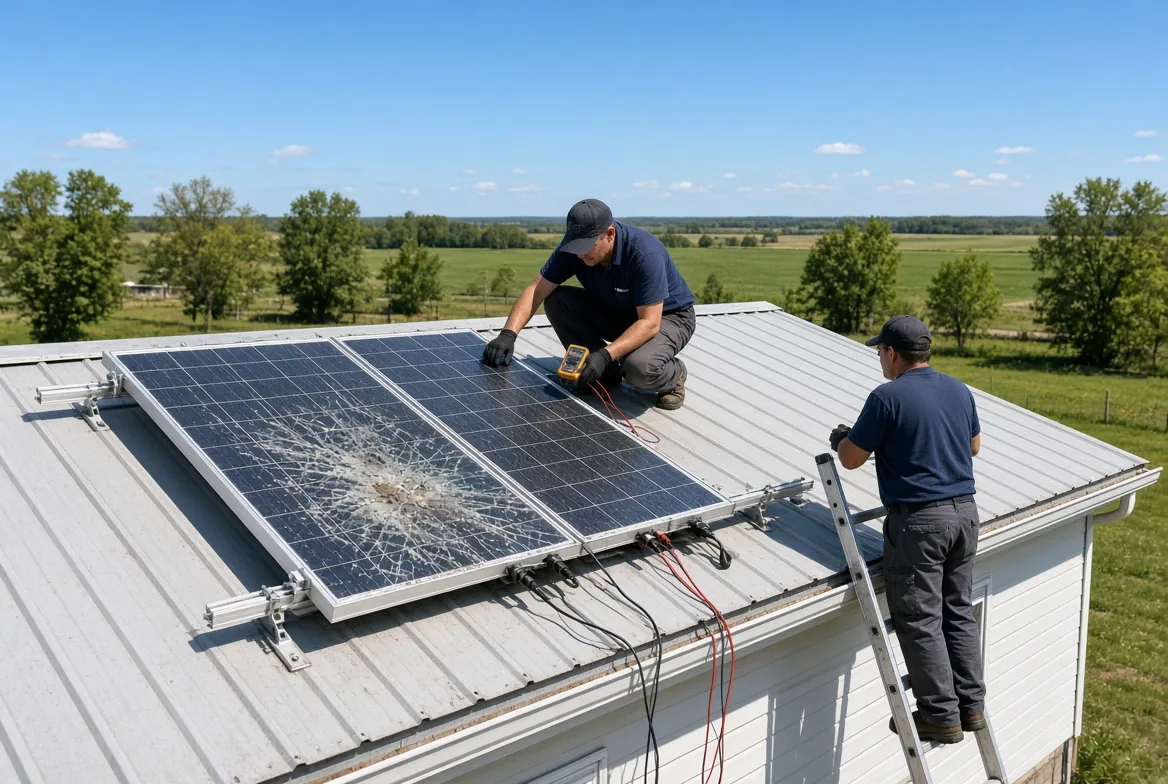
The short answer
If your mobile or manufactured home has a solar array, the part most likely to break is not the panels — it is the electronics. In one NREL solar reliability study, inverter failures accounted for 36% of all lost energy production while module failures accounted for only 5% (NREL inverter reliability). A separate Sandia/NREL failure compilation puts the annual module replacement rate at 5 in 10,000 (OSTI).
That is the good news. Most repairs on a residential-scale array run from a couple of hundred dollars to a few thousand. The complication is specific to mobile homes: your roof, not your panels, usually decides whether repairing is worth doing.
What actually fails, in rough order of likelihood
1. Inverters, monitoring gear and software
In a 2025 survey of installers, the five most common solar repairs started with monitoring and software faults, ahead of every hardware item (SolarReviews). On an older string system the inverter is the most expensive component you are likely to replace. On a microinverter system the electronics are usually covered for 25 years — but the service visit is what you pay for.
2. Junction boxes, bypass diodes and connectors
Kiwa PVEL's 2025 Module Reliability Scorecard found that 11% of manufacturers had junction-box covers fall off during testing and 8% had loose or failing connectors (PVEL Scorecard). These are accelerated lab results rather than field failure rates, but they mark the weak points — the same junction boxes and MC4 connectors that sit on your roof.
3. Roof penetrations and flashing
Leaks at the mounting points rank third in the same installer survey. On a manufactured home — often a low-slope metal roof with a seal at every bracket — a slow leak is the failure that does the most damage per dollar spent.
4. Weather
kWh Analytics' 2025 Solar Risk Assessment found that hail alone accounts for 73% of solar losses measured in dollars (kWh Analytics). Hail is an insurance claim, not a warranty claim; product warranties explicitly exclude weather damage.
5. The panels themselves
Modules fail outright about 5 times per 10,000 per year. When they do, it is usually physical damage: hail, a falling limb, something thrown. Microcracks, snail trails and delamination are more common and show up as gradual output loss rather than a dead panel.
Degradation: what is normal, and what speeds it up
The benchmark study — Jordan and Kurtz's review of roughly 2,000 measured degradation rates — found a median of 0.5% per year and a mean of 0.8% per year (OSTI). More recent data is worse: a 2025 meta-analysis of 80 studies and 610 observations found a median of 0.94% per year (ScienceDirect).
Three things push you to the fast end of that range — heat (NREL's fleet data shows hot climates losing output about 1.8 times faster than cool ones), humidity, and physical defects nobody caught. Practically, 0.9% per year means an array that made 100% in year one is making roughly 89% in year 12. That is normal and it is not a warranty claim. A 5% drop in a single year is not normal.
What a repair actually costs
The numbers behind the chart:
- One panel replaced — the panel itself runs $200 to $550, plus about $100 per hour labour with a $100–$150 minimum service fee (HomeAdvisor).
- An average repair job — Angi puts the national average at $861, with a typical range of $238 to $1,487 (Angi).
- A service visit at all — a truck roll is $200 to $300, then $150 or more per hour, and wiring repairs start around $1,000 (SolarReviews).
- MC4 connectors — $200 to $400 for a handful of connectors, with minor connector fixes as low as $120.
- String inverter — $350 to $3,500 installed, of which roughly $200 to $500 is labour.
- Microinverter — an IQ8-series unit is about $166 to $242; the visit is the real cost.
- Lifting the array off and putting it back for a re-roof — $1,500 to $6,000, or $200 to $300 per panel (EnergySage).
For comparison, a brand-new system runs about $3.15 per watt modelled market price — roughly $23,000 for a 7.4 kW system before incentives (NREL).
Warranty reality
Panel product warranties are typically 25 years, with a performance guarantee around 86% of original output at year 25 on premium lines. Enphase microinverters carry 25 years from activation and the IQ Gateway carries five (Enphase warranty).
Then come the conditions, which matter more on a home that can be moved:
- Registration is required within 45 days of installation.
- Claims must be made within 90 days of discovering the defect.
- Labour to uninstall and reinstall is excluded — Enphase's labour programme pays $200 per service visit plus $25 for labour (Enphase).
- Cover is void for equipment that was improperly installed, tampered with, or moved away from its original location.
That last bullet is the one to read twice. Under the plain wording, relocating a manufactured home can end coverage. If there is any chance the home moves, get written confirmation from the manufacturer before you pay for anything.
When NOT to repair
Under the HUD Code, manufactured-home roofs are rated for a live load of 20 psf in the South Zone, 30 in the Middle Zone and 40 in the North Zone (24 CFR 3280.305). A flush-mounted residential array adds roughly 3 to 5 psf including racking (SurgePV). Load is not the whole story, though — the roof also has to outlive a 25-year array.
Do not repair in place if:
- The roof has less life left than the array. Removing and reinstalling costs $1,500 to $6,000 now, and again when the roof actually goes.
- There are active leaks at the mounts, sagging, or soft decking.
- The home was never engineered for the array: no permit, no engineering letter.
- You plan to move the home.
- The panels are old, low wattage and out of warranty; modern modules make more power per square foot.
Repair or replace: the 25% rule
A useful rule of thumb is to repair when the fix costs less than about 25% of replacing the array, and when roof, structure and warranty are all sound. On a $23,000 system that is a $5,750 ceiling, which covers a new inverter, a new panel and a service visit with room to spare. It does not cover lifting the array for a re-roof plus replacing an ageing inverter on a roof with five years left.
Also check who is still trading. SunPower filed for Chapter 11 in August 2024, and a workmanship warranty dies with the installer that issued it. Enphase's own benchmark puts ongoing operations and maintenance at $27 to $30 per kW-year for residential systems — about $220 a year for a 7.4 kW array (NREL ATB).
What you can safely check yourself
- Read the monitoring app first. On a microinverter system, one panel reading zero while its neighbours produce normally points at that unit or its connector.
- Panel or inverter? Inverter error codes, ground faults and isolation faults point at the inverter. A single underperforming panel points at the panel or its wiring.
- Visual signs worth reporting: brown or burn marks near junction boxes, melted connectors, bubbles or delamination, heavy soiling along the bottom edge.
- Never step on panels, never disconnect an MC4 connector under load, and trip rapid shutdown (NEC 690.12) before anyone works on the array.
- Anything that involves opening the DC circuit, swapping an inverter, or touching an energised rooftop array belongs to a licensed electrician.
The bottom line
Panels are the most reliable part of a solar system and inverters, connectors and flashing are the least. Repair is nearly always cheaper than replacement — until the roof or the warranty gets in the way. For a manufactured home, check three things before you sign anything: the roof load zone on your HUD data plate, the age of the roof, and whether you might ever move the home.