
Guide
Solar Panel Wire Guide: Choosing the Right Gauge for Mobile & Manufactured Home Solar Kits
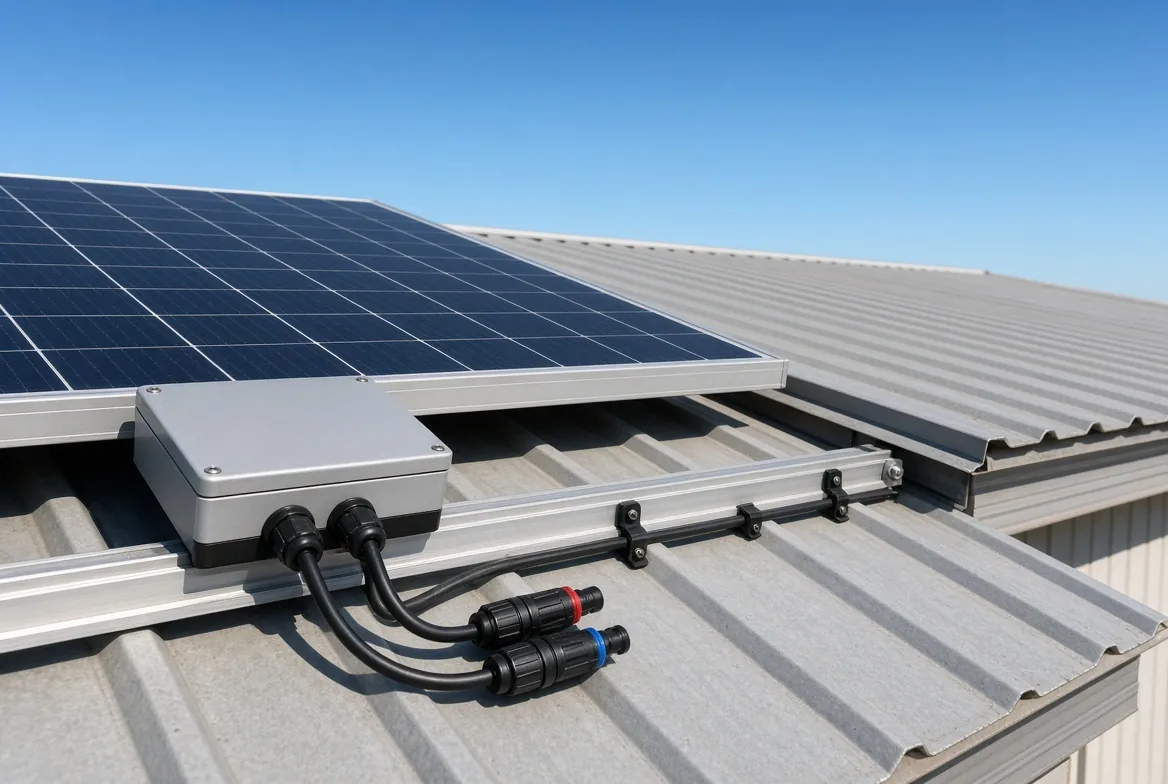
Getting the solar panels themselves right is only half the job on a mobile or manufactured home DIY solar kit. The wire connecting those panels to your charge controller, battery bank, or inverter determines how much of that power actually reaches your appliances — and whether the installation is safe. Undersized or wrong wire wastes energy as heat, trips your charge controller, and in the worst case starts a fire. Here's exactly what solar panel wire to buy, what gauge to run, and how to wire it safely.
PV Wire vs. USE-2: what's actually different
Almost every solar kit ships with red and black cable already terminated in MC4 connectors. That cable is either PV Wire (UL 4703) or USE-2 (UL 854), and the difference matters more than most DIYers realize.
PV Wire uses a double-layer, cross-linked XLPO or XLPE jacket (60–75 mils on 10 AWG), is rated up to 2000V DC, tolerates 90–150°C depending on the dry-location rating, and passes the UL VW-1 vertical flame test. Critically, it's approved for both grounded and ungrounded (transformerless) arrays — which covers the vast majority of modern inverters and charge controllers used on mobile homes.
USE-2 is the older, single-layer alternative. It maxes out at 600V DC, isn't VW-1 flame-rated, and under NEC 690.31 it's restricted to grounded arrays only. If your system uses a transformerless inverter (most compact/portable and many string inverters do), USE-2 on the exposed rooftop run is a code violation and a real fire risk. USE-2 is fine for a buried feeder run from a ground-mounted array back to the house, but for anything exposed on the roof of a mobile or manufactured home, use PV Wire.
Both types use fine-stranded, tinned copper conductors almost universally. Tinning stops the individual strands from corroding over a 25–30 year outdoor lifespan. Aluminum wire is cheaper up front but conducts about 61% as well as copper, needs two gauge sizes larger to match performance, and is prone to thermal creep at connections — skip it for panel and battery wiring.
MC4 connectors: don't mix brands
The quick-connect plugs on your panel leads are MC4-style connectors built to UL 6703 / IEC 62852. Genuine matched-brand pairs use a ribbed "MULTILAM" spring contact that keeps resistance under 0.5 milliohms and seals to IP67/IP68. The catch: connectors from different manufacturers often look compatible and will physically click together, but small dimensional differences create a loose, high-resistance joint that can reach 100–150°C under load — enough to melt the housing and ignite nearby roofing material. Always mate connectors from the same brand as your panel leads, and use a proper ratcheting crimp tool (not pliers) for any field-terminated ends.
Choosing wire gauge: it's about amps and distance, not just "what came in the kit"
Wire resistance causes voltage drop, and the longer and thinner the run, the more power you lose as heat before it ever reaches your battery or inverter. The goal is to keep total voltage drop under roughly 2–3%.
That chart shows the real cost of undersizing: at 10 amps over a 50-foot one-way run (100 feet round-trip) on a 12V system, 14 AWG wire loses over a quarter of your power to resistance. Even the 10 AWG wire that ships with a lot of kits loses over 10% at that distance. Stepping up to 8 AWG or 6 AWG for longer runs makes a real difference.
The other lever, often overlooked, is system voltage. Doubling your nominal voltage — say wiring panels in series for a 24V or 48V string instead of 12V — cuts percentage voltage drop in half or better for the same current and wire size, because you're pushing the same power at lower amperage. For a 50-foot 10 AWG run at 10A, drop is 10.33% at 12V but only 2.58% at 48V. If your combiner box or charge controller is far from your panels, raising array voltage is often cheaper than buying thicker copper.
Rough 2026 pricing per foot
Bulk-spool pricing (per foot, red or black) runs approximately:
- 10 AWG PV Wire: $0.55–$0.70/ft bulk, $0.80–$1.25/ft cut-to-length
- 8 AWG PV Wire: $0.75–$0.95/ft bulk, $1.10–$1.55/ft cut-to-length
- 6 AWG PV Wire: $1.38–$1.80/ft bulk, $2.20–$3.50/ft cut-to-length
- 4 AWG PV Wire: $2.50–$3.20/ft bulk, $3.50–$4.80/ft cut-to-length
USE-2 runs roughly 15–30% cheaper per foot at every gauge, but remember the grounded-array restriction above. For small kits under 100 feet of total run, cut-to-length is usually still the practical choice despite the per-foot premium.
NEC rules that actually apply to a mobile home install
A few code requirements trip up DIY installers specifically on manufactured homes:
Overcurrent sizing (NEC 690.8): Your fuse or breaker, and your minimum conductor ampacity, must be sized to 1.5625 times the array's total short-circuit current (a 1.25x factor for irradiance spikes, times another 1.25x for continuous-load duty). A 4-panel array with 9.5A short-circuit current per panel needs conductors and a fuse rated for at least 59A — that pushes you to 6 AWG copper, not 10 AWG, on the homerun.
Indoor routing (NEC 690.31(C)): Exposed PV Wire is for outdoor array wiring only. The moment DC conductors cross into the living space of the home, they must transition inside a weatherproof junction box to THHN/THWN-2 wire inside grounded metal conduit (EMT, rigid metal conduit, or MC cable) — no exposed PV Wire indoors.
Rapid shutdown (NEC 690.12): Conductors outside 1 foot of the array must drop to 30V or less within 30 seconds of shutdown; inside that 1-foot boundary, 80V or less. Module-level rapid shutdown devices or microinverters satisfy this automatically.
Chassis grounding (NEC 550 / HUD 24 CFR 3280.809): Bond the array racking with grounding washers, run a 6 AWG bare or green copper equipment grounding conductor back to your main solar ground bus, and bond that bus directly to the manufactured home's structural steel chassis — never to the neutral.
Common mistakes to avoid
Beyond mismatched connectors, the most frequent failures inspectors see are: pulling thick-jacketed PV Wire through conduit sized for regular THHN (it jams and tears the jacket — recalculate fill using the actual PV Wire outer diameter), using USE-2 on a transformerless/ungrounded inverter setup, and sticking with a 12V system over a long cable run instead of wiring panels in series for higher voltage. All of these are avoidable at the design stage, before you've bought any wire.
Bottom line
For a mobile or manufactured home DIY kit: buy UL 4703 PV Wire (not USE-2) unless your array is grounded, size the gauge for your actual amperage and run length rather than whatever ships in the box, match MC4 connector brands, and respect the NEC 690 rules on conduit, rapid shutdown, and chassis grounding. Get the wire right and the rest of the system runs cooler, safer, and more efficiently for the next 25 years.
Sources: PV Wire vs. USE-2 Cable: The Critical NEC Compliance Guide, Solar Cable Types: PV Wire vs USE-2 vs THHN vs THWN, NEC Article 690 Explained: Solar PV Code Guide, MC4 Connector Meaning, Definition, Benefits & FAQs.