
Guide
Getting "Solar Panelled": What It Really Costs on a Mobile or Manufactured Home in 2026
What "getting solar panelled" actually means
"Solar panelled" is just a shorthand way of asking: what does it take to add solar panels to a home? For a standard site-built house, that almost always means panels bolted to the roof. For a mobile or manufactured home, it's a more layered question — because the roof itself, not roof space, is usually the limiting factor.
Manufactured homes built after June 15, 1976 fall under the federal HUD Code, which sets specific structural and wind-load requirements for the roof and chassis (24 CFR §3280.305). Homes built before that date generally can't be made HUD-compliant and, in practice, no reputable installer will roof-mount panels on them — a ground-mounted array is the only realistic path. For HUD-code homes, going "solar panelled" comes down to one question your installer should answer before anything else: can this roof carry the extra load, and can it survive the wind uplift a flush-mounted array creates?
Roof-mount vs. ground-mount: the load and wind math
Most manufactured-home roofs are rated for roughly 15–20 pounds per square foot (psf) of dead load. A typical rooftop solar array adds about 2.5–4 psf directly, which sounds trivial — but the bigger issue is wind uplift, not weight. HUD's Basic Wind Zone Map splits the country into three zones: Zone I (70 mph, "fastest-mile" basis), Zone II (100 mph), and Zone III (110 mph). Under 24 CFR §3280.305, a Zone I home's roof must handle 15 psf of horizontal wind load and 9 psf of net uplift that "must not be reduced by the dead load of the roof structure." In higher wind zones, code requires steel strapping at 24 inches on-center (Zone II) or 16 inches on-center (Zone III) to keep the roof from peeling off in a storm — and a solar array sitting inches proud of the roof surface can make that uplift worse.
That's why a licensed structural engineer's stamped assessment (a "wet stamp") is standard practice before permitting a roof-mount system on a manufactured home, typically running $200–$500 for the review alone, with another $500–$1,500 if reinforcement is needed. States take this seriously: California's HCD explicitly requires a permit (HCD Form MH 120) for any solar system installed on a manufactured home and warns that because these roofs "are not accessible," damage from poor installation "is hidden until it leaks."
Roof material matters too. Metal standing-seam roofs allow non-penetrating clamp-on mounting hardware (like S-5 clips), which is the cleanest option. Rubber-membrane or flat roofs typically need ballasted or mechanically attached racking, and improper penetration or flashing can quietly void a roof warranty.
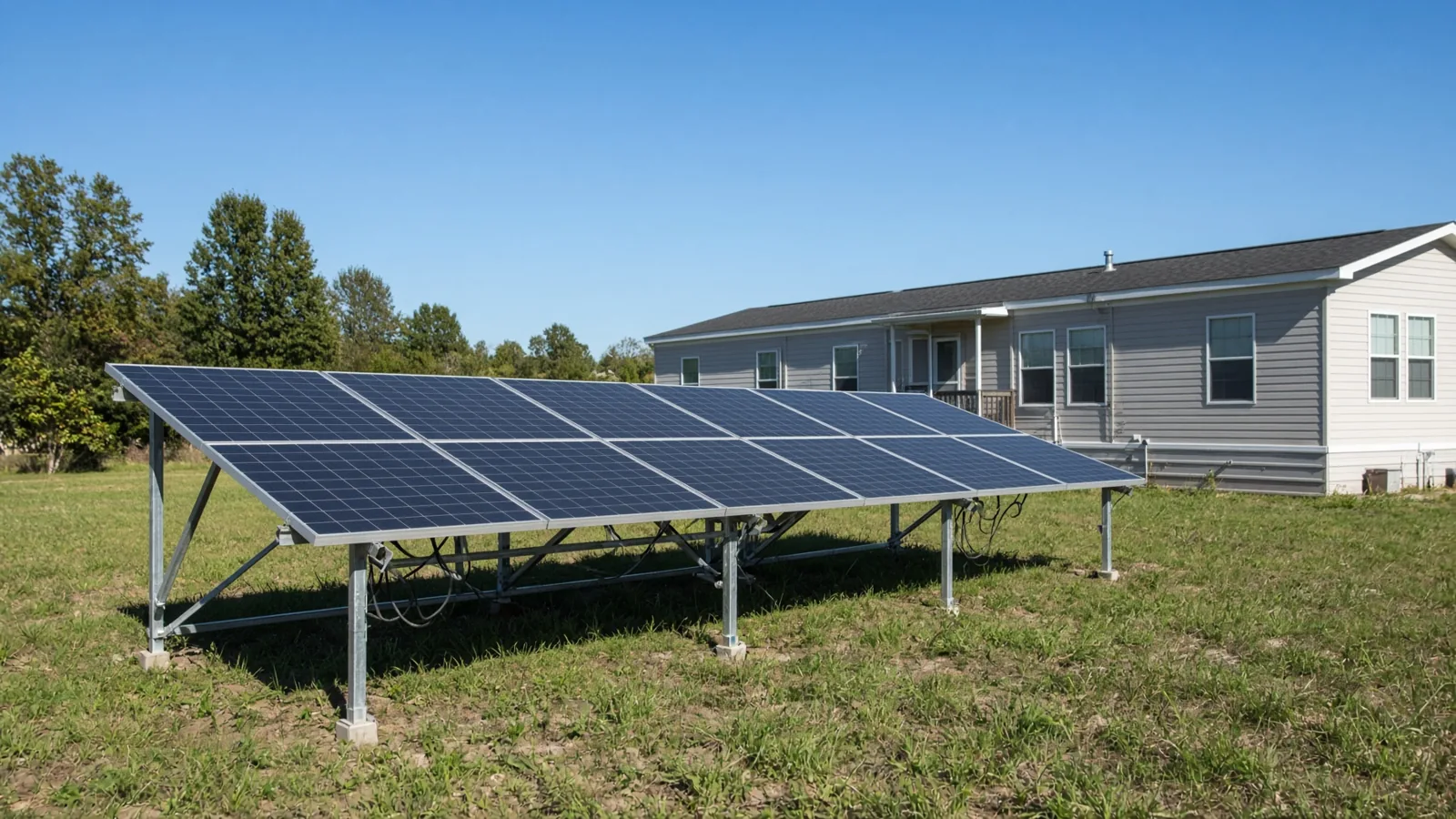
Given all that, ground-mount systems are frequently the more practical answer for mobile and manufactured homes — they sidestep roof-load and uplift questions entirely, at a modest cost premium of roughly $0.30–$0.50 per watt plus $1,000–$2,000 in mounting hardware. The tradeoff: they need usable, owned yard space, which is exactly where things get complicated in a mobile home park, where the lot is often leased rather than owned and park or HOA rules may restrict installations. According to the Kansas Legislative Research Department, 29 states have adopted laws limiting an HOA's ability to restrict or prohibit solar devices — but 22 of those still allow "reasonable restrictions," and leased-land or common-area situations in parks aren't necessarily covered at all.
2026 costs by system size
Nationally, getting a home solar panelled in 2026 runs roughly $2.50–$3.50 per watt installed before incentives, with EnergySage's auto-updated national data (as of September 2026) pegging the average closer to $2.60/W and SolarReviews citing $3.03/W. Mobile and manufactured homes tend to land at the higher end of that range once engineering review and ground-mount premiums are factored in — but because these homes are smaller, a modest system often covers close to 100% of usage. Here's what the common system sizes cost before any incentives:
Because fixed costs like permitting, design, and mobilization spread across more panels, the price per watt actually falls as systems get larger — a 10 kW system costs roughly $25,800 up front, but delivers nearly enough output to fully offset a higher-usage household. For most single- or double-wide mobile homes, a 5–7 kW system is the sweet spot: enough to approach full offset without oversizing into weak net-metering export rates.
It's worth noting why mobile-home energy use skews the math: per the Environmental and Energy Study Institute (citing DOE's Residential Energy Consumption Survey), manufactured homes built before 1980 consume an average of 84,316 BTUs per square foot — 53% more than other home types. That inefficiency is exactly why even a modest solar array can meaningfully cut a mobile home's typically $100–$200 monthly electric bill (single-wides commonly run $80–$120, double-wides $120–$180).
Incentives changed for 2026 — know before you buy
This is the single biggest shift homeowners need to understand this year: the 30% federal Residential Clean Energy Credit (Section 25D) was repealed by the One Big Beautiful Bill Act (P.L. 119-21, signed July 4, 2025) for any expenditures made after December 31, 2025. Per IRS guidance (FS-2025-05), "this credit will not be allowed for any expenditures made after December 31, 2025," and an expenditure is treated as made when installation is completed — meaning homeowners who buy and own a system outright in 2026 get no federal credit at all.
The commercial Section 48E credit does still exist through the end of 2027, but it only applies to third-party-owned systems — meaning a solar lease or power purchase agreement (PPA) can still indirectly capture that value, even though a direct purchase can't.
With the federal credit gone, state and utility programs are doing more of the heavy lifting. Depending on where you live, that can include state tax credits (New York offers 25% up to $5,000; South Carolina 25% with no cap; Hawaii 35% up to $1,000; Massachusetts 15% up to $1,000; Iowa 15% up to $5,000), property and sales tax exemptions, net metering, and Solar Renewable Energy Certificate (SREC) programs in states like New Jersey, Massachusetts, Illinois, and Maryland — which pay out over 10–15 years rather than as an upfront rebate. It's worth checking the DSIRE database for what's currently available in your state before budgeting a project.
Payback period and savings
With the federal credit gone, the national average payback period for a 2026 solar purchase runs roughly 8–12 years — about 2–3 years longer than before the credit expired. Where you land in that range depends heavily on your local electricity rate. The average U.S. residential rate is 18.34¢/kWh as of June 2026, but that ranges from 13.11¢ in Nevada up to 52.72¢ in Hawaii. In high-rate states like Hawaii, Massachusetts, and Connecticut, payback can drop to 5–6 years; in low-rate states like Louisiana and North Dakota, it can stretch past 18–20 years.
Installation timeline
From first call to system online, expect roughly 8–14 weeks:
- Site assessment (roof condition, shading, electrical panel, usage) — a few days.
- Structural/engineering assessment — critical for manufactured homes; $200–$1,500, and the stamped report is often required before permitting.
- System design and proposal.
- Permitting — 2–8 weeks, though jurisdictions using SolarAPP+ automated permitting can cut this to minutes or days.
- Physical installation — typically 1–3 days for a residential system.
- Inspection by the local Authority Having Jurisdiction, followed by utility interconnection.
Homeowners on chattel loans (common for mobile homes on leased land, where the home is financed as personal property rather than real estate) should confirm solar eligibility with their lender early — chattel financing can complicate adding solar and typically carries higher rates and shorter terms than a mortgage. The Urban Institute found that switching from a chattel loan to a mortgage could save a family roughly $2,600 a year on an $80,000, 20-year loan. A service panel upgrade, if needed, adds around $2,000 to the project.
The bottom line
Going solar panelled on a mobile or manufactured home in 2026 is entirely doable, but it's not identical to a standard rooftop install. Start by pulling your HUD data plate to confirm your build date and Wind Zone — a pre-1976 home should plan on ground-mount from day one. Get a structural engineering review before signing any roof-mount contract, get quotes for both roof- and ground-mount, and size the system to your actual usage rather than maxing out your roof. And because the federal tax credit is gone for 2026 purchases, lean on state incentives and, if a straight purchase doesn't pencil out, look seriously at a lease or PPA to still capture some of that value.