
Guide
Solar Panels and the Roof: Mobile Home Mounting Guide
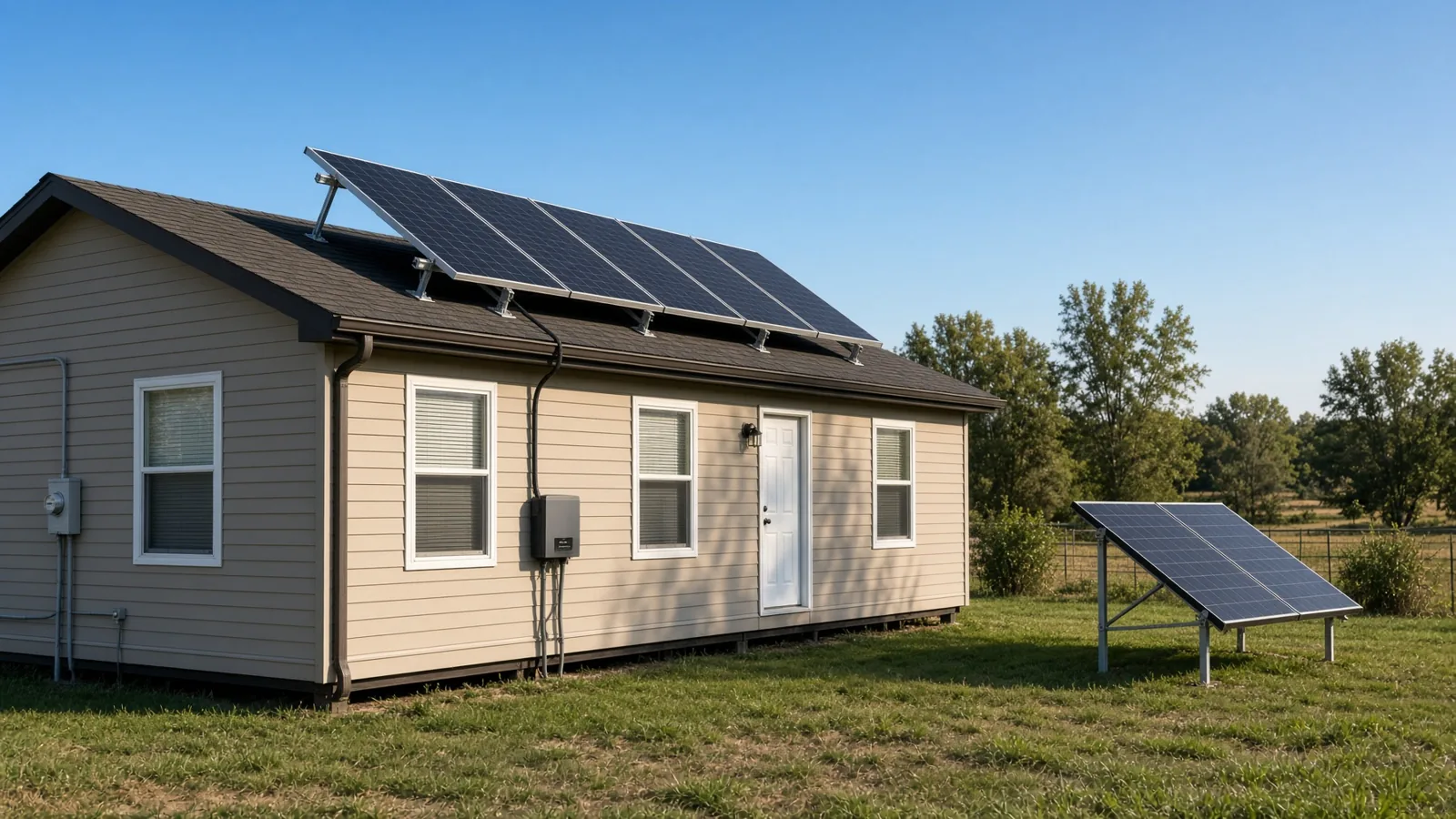
Most manufactured homes can carry solar panels. The weight almost never rules it out: a flush-mounted array adds roughly 3 pounds per square foot, and HUD-code roofs are built for 20, 30 or 40 psf depending on snow zone. What decides a roof mount is everything around that number — truss framing, wind-zone uplift, attic access, the age of the shingles, and whether any installer in your area will work on a factory-built home at all.
How to check your roof before you buy panels
Six checks separate a roof that can take an array from one that cannot. Do them in this order, because any single one can end the conversation.
Find the data plate. Every home built to the HUD code after June 15, 1976 carries a data plate, usually inside a kitchen cabinet or beside the electrical panel. It lists the roof load the home was designed for, the wind zone and the snow load — the three numbers an installer needs before quoting anything.
Date the shingles. Three-tab asphalt lasts 15 to 20 years and architectural shingles 25 to 30. Published installer cutoffs for mounting on an existing roof range from under 5 years of remaining life to under 15, so the same roof can be a yes at one company and a no at the next.
Confirm the wind zone. Zone II and Zone III homes are engineered for 100 mph and 110 mph design winds, with roof-truss uplift loads of −39 psf and −47 psf. Uplift of that size is a far bigger structural demand than the weight of the modules will ever be.
Look at the trusses from underneath. If the ceiling is finished with no access hatch, nobody can add blocking or verify framing, and plenty of installers will decline rather than guess.
Buy a structural opinion when the numbers are close. An engineer's letter costs a fraction of a failed inspection, and some jurisdictions ask for one on a factory-built roof regardless.
Get the penetration warranty in writing. Terms run from five years to ten, and the fine print outlasts any sales pitch.
Mounting options for a manufactured home
Five approaches cover nearly every home, and the roof structure chooses between them more than budget does.
- Rail-and-foot on shingles. Aluminum rails sit on L-feet lag-bolted into trusses, with flashing at every hole. It is the cheapest method and the most common one, and every penetration is a future leak if the flashing is rushed.
- Standing-seam clamps. If the home has a metal roof with raised seams, clamps such as the S-5! line grip the seam without drilling. Rail-less clamp systems cut material, freight and labour, and a single clamp lists around $6.
- Tile hooks. On tile roofs a hook replaces a tile and hangs from the batten underneath, at a premium of roughly $0.25 to $0.40 per watt, or $0.50 to $0.75 per watt when the field has to be lifted and reset.
- Ballasted trays. Concrete or steel weights replace fasteners, but ballast brings the assembly to 4–15 psf and needs a roof with reserve. On a low-slope manufactured-home roof with minimal spare capacity, that is usually the wrong trade.
- Off-roof mounts. Ground, pole, carport and porch mounts take the roof out of the equation entirely, and on these homes they are frequently the only option an installer will quote.
Roof mount pros and cons on a mobile home
The case for the roof is mostly economic. At $2.60 per watt installed, a rooftop array is the cheapest way to buy solar, it uses structure the home already has, it keeps equipment out of reach of lawnmowers and thieves, and the modules shade the shingles beneath them from sun and hail.
The case against is specific to factory-built homes. Penetrations land in trusses that were optimised to a minimum rather than built with reserve. Wind Zone II and III homes carry uplift demands that a mounting foot has to be engineered around. Roof-leak warranties run five to ten years while the modules are warranted for 25, so the waterproofing expires long before the equipment does. And the day the shingles fail, the array has to come off first.
What a roof job plus solar costs in 2026
Three numbers decide the budget: the array, the roof, and the cost of taking the array off again.
On installed cost, EnergySage's first-half-2026 marketplace averages put rooftop solar at $2.60 per watt, ground mounts at $2.96 and carports at $3.62. Ground systems look 14% dearer per watt and 41% dearer in total, because the average ground-mount project is larger: $43,571 at 14.7 kW against $31,042 at 12 kW. Berkeley Lab's October 2025 data update puts the 2024 national median at $3.5 per watt cash and $4.7 per watt financed.
On roofing, 2026 pricing runs about $350–$550 per square for three-tab, $450–$750 for architectural shingle and $1,200–$1,800 for standing-seam metal. A typical full replacement lands near $10,000, and EnergySage's asphalt average is $9,500.
On removal and reinstall, the market rate is $200–$300 per panel, or $1,500–$6,000 for a whole system, with large arrays past $7,000. Run that against a single-wide: roughly 10 to 11 squares of architectural shingle is $4,500–$8,250, and detaching and resetting a 12-panel array adds $2,400–$3,600 on top — a 40% to 80% increase on the roofing bill for work the roof would have needed anyway.
Roof mount vs ground mount vs carport
The three options differ less on sticker price than on what happens in year fifteen.
- Roof mount — $2.60/W. Cheapest per watt, no land used, no separate foundation, but every future roof repair starts with a crane-free but expensive detach.
- Ground mount — $2.96/W, with installer quotes commonly landing between $3.10 and $3.70/W. Costs more per watt and needs yard space plus trenching, but it can be tilted, cleared of snow by hand, serviced standing up, and it never touches the roof.
- Carport or porch mount — $3.62/W. The priciest per watt and the most useful on a home with no spare ground: the structure does double duty as shade, and the array is at working height.
Frequently asked questions
Can you put solar panels on a mobile home roof?
Yes, and weight is rarely the obstacle. A flush array adds about 3 psf against a design load of 20 to 40 psf. The practical obstacles are truss access, wind-zone uplift and finding an installer who will quote the job.
How much weight can a mobile home roof hold?
The HUD code sets roof live and snow loads at 20 psf in the South zone, 30 psf in the Middle zone and 40 psf in the North zone, with deflection limited to L/180. Trusses are tested to dead load plus 1.75 times the design live load, so there is reserve — but not much of it on a home built to the minimum.
Do solar panels damage a mobile home roof?
Not through weight. Damage comes from bad flashing at penetrations, foot traffic during installation, and debris trapped under the array. A properly flashed, rail-based install is the difference between a dry roof and a claim.
What happens if I need a new roof after the panels go on?
The array comes off, the roof is replaced, and the array goes back. Budget $200–$300 per panel for that round trip, and expect to pay for new mounting hardware if the old feet cannot be reused.
How much does it cost to remove and reinstall solar panels for a reroof?
$1,500–$6,000 for most residential systems, over $7,000 for large ones, or roughly $250–$350 per panel from specialist crews. On a small mobile-home roof that premium is what turns a routine reroof into a 40–80% overspend.
Will solar void my roof warranty?
Shingle manufacturers generally keep the material warranty in force, but they will not pay to remove an array to reach a defect. GAF and Owens Corning both exclude that removal cost, so the labour falls to the homeowner.
Can I mount panels on a metal mobile-home roof?
Standing-seam metal is the best-case roof for solar: clamps grip the seam with no penetration, and the roof usually outlives the array. Corrugated or screw-down panels are harder, because fasteners sit where a mounting foot wants to go.
What if no installer will work on my mobile home?
Ask ground-mount installers instead of roof-mount ones, and ask whether they will quote a carport or porch structure. A detached array avoids the framing question, the uplift question and most of the liability question in one move.
Do panels keep the home cooler?
Yes, measurably. A 2011 UC San Diego study found roughly 38% less heat reaching the roof deck under an array, with ceiling temperatures about 5°F cooler. On a home with a thin roof assembly and modest insulation, that is a real summer load reduction.
Who should roof-mount, and who shouldn't
Roof mounting makes sense on a post-1976 multi-section home in Wind Zone I with a roof replaced in the last decade, truss access from below, and an installer who puts a penetration warranty in writing. It also makes sense when the yard is unusable — a shaded lot, a shared pad, a narrow city lot with no setback room.
It does not make sense on a single-wide with a 20-year-old shingle roof, on any home in Zone II or III without an engineer's letter, or where the only quote on the table comes from a company that has never worked on a factory-built home. In those cases the honest answer is a ground or carport mount, even at $0.36 to $1.02 more per watt.
Why mobile-home roofs are different
Site-built homes and manufactured homes follow different rulebooks. The IRC sets a 20 psf roof live load nationally with snow added on top; the HUD code at 24 CFR 3280.305 sets 20, 30 or 40 psf by snow zone and then layers wind requirements on the same truss. In Zone II and III the roof covering within three feet of a gable end must resist −73 and −89 psf of uplift, and within three feet of a ridge or eave −51 and −62 psf. Those are the numbers that make an installer pause, not the 3 psf of modules.
The housing stock matters too. About 7.9 million manufactured homes make up roughly 5.4% of US housing units, concentrated in Florida at about 824,000 homes and reaching a 15% share in New Mexico. The average new unit sold for $131,500 in late 2025. Homes built before the 1976 HUD code have no comparable load rating at all, and some installers will only touch post-1980 double-wides.
Roof pitch, overhangs and undersized eave framing all push in the same direction. NREL's mapping work found that 82% of small US buildings have at least some suitable roof area, but only 26% of small-building roof area qualifies — roughly one building in five has no usable plane. For a manufactured home with a shallow gable and an obstruction-heavy roof, that ratio is optimistic.
Is it worth it?
A rooftop array on a mobile home is worth it when the roof is young and the home is a keeper. The array will last 25 to 30 years and the modules are warranted for 25, while the shingles under it may have 10 to 15 years left. Sequencing the two — reroof first, solar second — is the single most valuable decision in the project.
When the roof is old, do the arithmetic the other way. A ground mount costs about 14% more per watt today and avoids a $2,400–$3,600 detach-and-reset later, which on a modest array is most of the premium returned. Add the 38% reduction in heat reaching the roof, the ability to clear snow and wash panels standing up, and the fact that a ground array does not care what the trusses were rated for, and the case gets stronger the older the home gets.
The uncomfortable middle is the home with a 12-year-old architectural roof, decent yard and a quote for both. There, the roof mount usually wins on cost and the ground mount wins on everything else. Pick based on how long you intend to stay, then get the penetration warranty in writing either way.