
Guide
Solar Panels for Sale: Buying Guide for Mobile Homes
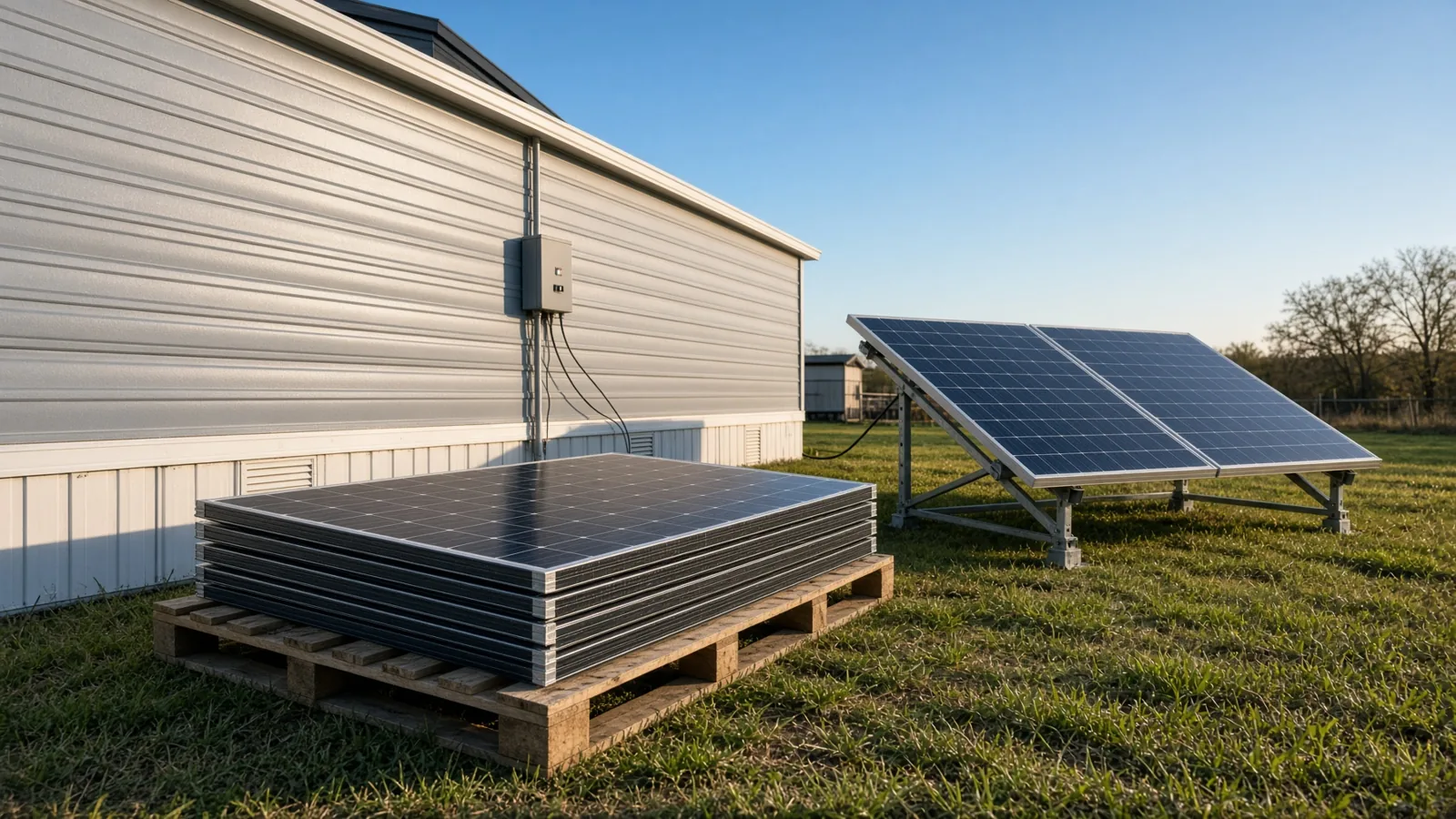
Solar panels are sold through three completely different channels in the United States, and the gap between them is wider than most buyers expect. A single 100-watt panel can work out to more than a dollar a watt, while a 550-watt module pulled off a full pallet runs under thirty cents. For someone heating a single-wide or powering a cabin, that spread is usually the difference between a project that pencils out and one that does not.
This guide is written for buyers who are not financing a turnkey rooftop system: manufactured homes, park models, small off-grid cabins, and the shops and farms that sit beside them. The numbers below come from 2026 distributor pricing, manufacturer datasheets and freight quotes, not from marketing pages.
What "for sale" means at each price tier
Solar panels are not one product with one price. The band you buy in decides almost everything else about the project.
- 100W to 200W singles. A Renogy 100W rigid panel lists at $109.99, or $1.10 per watt; the same panel in a four-pack drops to about $0.77 per watt. A Renogy 200W rigid unit lists at $179.99, or $0.90 per watt. Convenient, returnable, and by far the most expensive way to buy watts.
- 400W class on a pallet. SanTan Solar's Alexus 400W mono panel works out at roughly $137 each when you take the 36-panel pallet at $4,932. That is about $0.34 per watt.
- 550W to 600W class. A Signature Solar HT 550W bifacial panel is about $187 as a single, or $0.34 per watt. On a 36-panel pallet from A1 SolarStore, the SolarSpace 550W lands at $146.52 per panel, or $0.27 per watt.
- 700W and up. US Solar Supplier lists a Canadian Solar 700W module at about $253 on a 31-panel pallet ($7,840.90), which works out to $0.36 per watt.
- Flexible panels. A Renogy 100W flexible panel runs around $1.26 per watt. You are paying for bend, low weight and adhesive mounting, not for efficiency.
Market context matters here. PV Magazine reported US-assembled module prices holding steady around $0.30 per watt in mid-2026, after a first quarter of upward pressure from trade cases and FEOC sourcing rules. Pallet pricing sits close to that line; retail single-panel pricing sits two to three times above it.
Why the price per watt collapses as panels get bigger
A solar module is mostly glass, aluminium frame, junction box and copper ribbon, and those parts do not scale down with wattage. A 100W panel and a 550W panel use the same number of frames, the same junction box and roughly the same amount of packing material. The 550W module simply spreads that fixed cost over five times the watts.
Freight behaves the same way. A pallet of 31 to 36 modules ships as one freight class, one liftgate, one delivery appointment. Ten loose panels ship as ten fragile items with the same appointment overhead. The result is that the cheapest watts per dollar are almost always on a pallet, and the most expensive are single panels bought one at a time.
New, used, or flexible: pick by roof and rulebook
New rigid modules carry the longest paper trail. A tier-one N-type TOPCon 550W module from Jinko's Tiger Neo line comes with a 12-year product warranty and a 30-year linear power warranty settling at 87.4% of rated output in year 30. A Renogy 200W rigid panel carries a 10-year workmanship warranty and a promise of more than 80% output at year 25.
Used and salvaged panels are where a lot of "solar panels for sale" searches actually land. SanTan's used stock typically comes with a one-year seller warranty and no manufacturer warranty at all. The watts are real, the paperwork is thin, and you should assume you are inspecting the product yourself: look for delamination, browned cells, cracked backsheets and evidence of potential-induced degradation before money changes hands.
Flexible panels are the right answer for a curved or weight-limited surface, and the wrong answer for everything else. The Renogy 100W flexible unit carries a five-year materials and workmanship warranty and a five-year output warranty, against 25 to 30 years for rigid glass. You trade lifespan for installability.
For a manufactured home, the deciding factor is usually not the panel but the roof. A low-slope, membrane-covered roof on a single-wide is a poor host for 300 pounds of glass unless the framing was designed for it. Ground mount or a rack over a shed is often the cheaper engineering answer.
The specs that decide whether a panel fits
Two module sizes cover most of the market, and their dimensions are not interchangeable.
- 400W, 108-cell (1722 x 1134 mm): about 67.8 x 44.6 inches, 48.5 lb, 21.0 square feet, Voc 38.32 V, Isc 13.37 A. Jinko's datasheet for this class lists 21.00% efficiency, with top bins reaching 22.77%.
- 550W, 144-cell (2278 x 1134 mm): about 89.7 x 44.7 inches, 70.6 lb in dual-glass form (nearer 60 lb single-glass), 27.8 square feet, Voc 50.27 V, Isc 14.01 A, and roughly 21.3% efficiency.
Those numbers drive three practical decisions. Series strings add voltage, so five 550W panels in series put you near 251 volts before cold-weather correction; NEC 690.7 exists precisely because a 20-degree morning pushes Voc higher than the label. Parallel strings add current, which is what pushes you into thicker wire. And physical size decides how many panels a 14-foot-wide roof can actually carry: two 550W modules side by side already span 89 inches.
How many panels you need to buy
The sizing arithmetic is not complicated, but it is unforgiving if you skip the derate. Take your daily consumption in kilowatt-hours, multiply by 1,000, and divide by peak sun hours times a system derate of about 0.80 for wiring, heat and inverter losses. At 4.5 peak sun hours that is 3.6 usable watts per watt of array.
- 5 kWh per day needs about 1,389 W. In 400W modules that is 4 panels (1,600 W, 84 square feet, 194 lb); in 550W modules it is 3 panels (1,650 W, 83 square feet, 212 lb).
- 10 kWh per day needs about 2,778 W. In 400W modules that is 7 panels (2,800 W, 147 square feet, 340 lb); in 550W modules it is 5 panels (2,750 W, about 1% short) or 6 panels for headroom (3,300 W, up to 167 square feet and 423 lb).
Notice what the second chart implies for a mobile home: the 10 kWh case is a 340 to 423 pound array. That is a ground-mount quantity for most manufactured housing, even when the roof looks big enough.
Where to buy, and what each channel is good for
Pallet distributors are the price leaders: SanTan Solar, A1 SolarStore, Signature Solar, US Solar Supplier and GoGreenSolar all publish per-panel pricing and ship full pallets. Minimums of 31 to 36 panels are normal, and the per-watt figure assumes you take the whole pallet.
Retail and marketplace listings sell singles and small quantities with returns and consumer protection. You pay roughly two to three times the pallet rate, and you get a box on your porch instead of a freight appointment.
Local yards and used-panel dealers let you inspect modules in person and skip freight entirely. Bring a multimeter, check Voc against the label, and look at the junction box for corrosion.
Freight is the line item that surprises people
GoGreenSolar's published policy quotes $150 to $400 for shipping on orders of 1 to 24 panels, plus $40 to $100 for residential delivery and $75 to $150 if a liftgate is needed. Full pallets run $400 to $600 each. WARP's freight guidance for solar panels quotes LTL carriers at $200 to $700 depending on lane, with sample rates of $207 from Los Angeles to Phoenix, $369 to Dallas and $447 to New York.
Put those numbers next to the module prices and the math changes. Four 400W panels at $137 each is $548 of product; add $300 of freight and a $100 residential fee and you have paid $0.59 per watt instead of $0.34. A 36-panel pallet at the same lane cost stays under $0.05 per watt of freight. Freight is the reason pallet pricing exists.
Five checks before you pay
- Datasheet, not listing copy. Confirm Voc, Isc, dimensions and weight from the manufacturer PDF. Retail listings routinely round these.
- Warranty holder and transferability. A 30-year linear warranty is only useful if it transfers to you and the manufacturer is still trading.
- Damage terms in writing. Ask what happens to a module that arrives with cracked glass, and how long you have to file the freight claim.
- Racking and anchoring. Panels do not include mounts. A mobile-home install needs anchors rated for the roof structure, not self-tapping screws into 26-gauge steel.
- Interconnection and permits. A manufactured home on a permanent foundation is treated like a house by most utilities; a park model or RV is not. Ask before you order, not after.
Who should not buy a pallet
If you need three panels for a shed, a pallet is the wrong purchase: you cannot store 31 spare modules, you probably cannot unload 800 pounds without equipment, and the savings evaporate the moment you resell the surplus at retail-minus. The same applies to renters, to roofs that cannot take the point loads, and to anyone who has not yet sized a battery bank. Buy the small quantity, pay the higher per-watt rate, and put the difference into the charge controller.
Is buying used solar panels for sale worth it for a mobile home?
Sometimes. Used modules at pallet pricing can cut the array cost sharply, but the warranty is typically one year from the seller with nothing from the manufacturer. Inspect for delamination, browned cells and cracked backsheets, and verify Voc with a multimeter before paying.
What does a 500W to 550W solar panel cost in 2026?
Roughly $187 as a single panel, or about $146 per panel on a full pallet, which is $0.27 to $0.34 per watt. Freight is quoted separately and can add $0.05 per watt on a pallet or considerably more on small orders.
Can I mount these panels on a manufactured home roof?
Only if the roof structure and covering can take the load and the penetrations can be sealed properly. A 10 kWh-per-day array weighs 340 to 423 pounds before racking. Ground mount or a separate rack is usually the safer and cheaper choice for a single-wide.
Do I need a permit for solar on a mobile home?
In most jurisdictions, yes, and the utility interconnection application is separate again. A manufactured home on a permanent foundation is generally handled like a site-built house; a park model or RV typically is not. Confirm both with the local building department and the utility before ordering modules.