
Guide
Tesla Solar Panels for Mobile and Manufactured Homes: 2026 Costs, Specs, and Alternatives
The short answer
Tesla still builds one of the most price-competitive solar packages in America — but if you live in a manufactured or mobile home, Tesla will not sell it to you. Tesla's published property rules exclude manufactured homes, mobile homes, prefabricated structures without a permanent foundation, and recreational vehicles from direct sales and installation. The hardware is real, the savings are real, and the exclusion is real too. Here is what Tesla sells in 2026, what it costs per watt, the roof-load math that decides whether any panel can go on your roof, and the four routes mobile-home owners actually use to go solar.
What Tesla sells in 2026
Tesla Energy's residential line-up is three products, not a catalogue:
- Tesla Solar Panels — conventional roof-mounted monocrystalline modules, currently the TSP-420 (420 W) with a 25-year product and performance warranty.
- Tesla Solar Roof — a building-integrated roof of active solar glass tiles alternating with inactive structural tiles, at roughly $42 per square foot for the active tiles.
- Tesla Powerwall 3 — a 13.5 kWh LFP battery with an integrated inverter that delivers 11.5 kW of continuous power.
Tesla's financing has swung back and forth. The company killed its month-to-month solar subscription in September 2021 (Electrek), then in October 2025 reintroduced a 25-year solar-plus-storage lease with $0 down, a 3% annual payment escalator and an optional fair-market-value buyout from year six (Electrek). The day-to-day process and property requirements live on Tesla's own support pages.
The TSP-420 spec sheet
If you are comparing a Tesla quote against a ground-mount quote for a manufactured home, these are the numbers that matter:
- Nominal power: 420 W per module (the TSP-415 variant is 415 W)
- Efficiency: 20.5% — 20.3% on the 415 W panel (EnergySage)
- Dimensions: 1,890 x 1,046 x 40 mm, or 22.1 square feet of surface area
- Weight: 49 lbs per module, which works out to 2.22 lbs per square foot of panel
- Temperature coefficient: -0.34% per degree C above 25 degrees C
- Degradation: 2.0% in year one, then 0.45% per year, guaranteed to 87.2% at year 25
- Warranties: 25 years product, 25 years performance
Independent datasheet figures are published on ENF Solar.
Why Tesla will not touch a mobile home
Tesla's exclusion is not marketing language; it is an engineering and permitting position, and three constraints drive it.
1. The roof dead-load budget is nearly spent before you start
Manufactured homes are built in a factory to the federal HUD Code (24 CFR 3280), not to the site-built International Residential Code. HUD structures carry a permanent roof dead-load allowance of only 10 to 15 pounds per square foot (psf) — that allowance already covers trusses, ceiling board and the roof membrane. HUD's design live loads are 20 psf in the South zone, 30 psf in the Middle zone and 40 psf in the North zone (HUD structural design manual).
Once the live reserve is set aside, the net headroom left for an array is roughly 0 to 2 psf in the South zone and 2 to 5 psf in the North. A standard rigid glass-and-aluminium array adds about 3.5 psf, and mounting brackets concentrate that weight into point loads on light-gauge rafters. Flexible thin-film modules add only about 0.7 psf, which is why they are the usual answer on RV and trailer roofs. Independent structural write-ups reach the same conclusion about allowable load in psf for manufactured homes.
2. Remote design and foundation rules
Tesla designs systems remotely from satellite and aerial imagery. Manufactured-home roofs often have non-standard rafter spacing, rolled asphalt membrane or corrugated metal geometry that cannot be verified that way. Utility interconnection rules also expect generation equipment on a structure permanently anchored to an engineered foundation, and mobile homes on piers, chassis or tiedowns are routinely rejected at the permit stage. Where permits are granted, they are granted on paperwork: California, for example, requires HCD Form MH 415 with structural load calculations stamped by a licensed professional engineer.
3. Powerwall 3 needs the grid and a wall it likes
Tesla's Powerwall 3 installation manual requires a continuous utility grid connection and forbids mounting the unit inside habitable living space, which rules out mobile home interiors and motorhomes.
What Tesla does require of the homes it serves
- Fee-simple ownership, or written authorisation from the property owner
- A hard credit check, with roughly 650-plus FICO for prime terms
- Approved roof types: composition shingle, single-ply membrane, rolled asphalt, standing-seam metal, or tile at 6.5 lbs per square foot minimum
- A pitch between 15 and 45 degrees, with at least two panels per roof plane
- A minimum Total Solar Resource Fraction of 25% — in plain terms, no heavy shade
What Tesla costs in 2026, and what a mobile home pays instead
Tesla's direct online ordering cuts customer-acquisition cost, so its installed cash price sits at a baseline median of $2.81 per watt. The national residential average is $2.75 per watt, and the EnergySage marketplace median recorded in late 2025 was $2.49 per watt. The same capacity costs a different amount depending on which benchmark you use:
- 5 kW system: $14,050 at Tesla's $2.81/W baseline, $13,750 at the national average, $12,450 at the EnergySage median
- 8 kW system: $22,480, $22,000 and $19,920 respectively
- 10 kW system: $28,100, $27,500 and $24,900 respectively
- Tesla's wider published range for the same systems: $2.30 to $3.50 per watt
- Tesla Solar Roof, complete project: $35,000 to $70,000-plus
- Powerwall 3: $9,300 to $11,500 for the hardware, $13,500 to $16,800 installed as part of a solar job
- National average payback period: about 8.5 years
None of those numbers apply to a manufactured home, because Tesla will not quote one. The alternatives that do apply are priced like this:
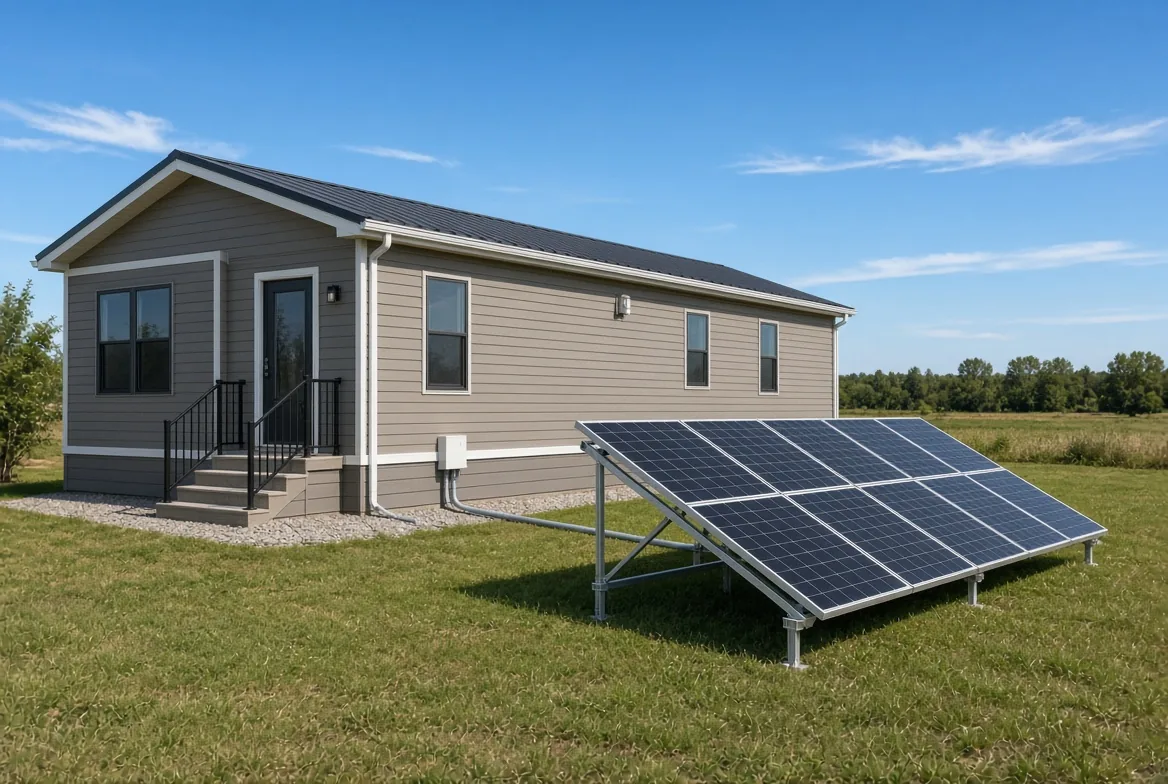
- Ground-mounted array beside the home: $3.00 to $3.80 per watt, plus $1,500 to $3,500 for trenching conduit to the main panel. Zero roof load, and because a ground rack can hold the ideal tilt and azimuth, it yields 10% to 15% more energy per watt than a roof constrained by the home's pitch.
- Array on a detached garage, steel carport or heavy-duty shed built to IRC code: $2.60 to $3.20 per watt.
- Flexible CIGS thin-film bonded to an RV or trailer roof with structural adhesive: $1.50 to $2.50 per watt, at 16% to 18% efficiency and about 0.8 psf, with no roof penetrations.
- Community solar subscription: $0 upfront, no equipment and no permits, typically a guaranteed 5% to 15% reduction on the supply side of the electricity bill.
Who actually installs solar on mobile and manufactured homes
Because the volume players will not, the work goes to contractors set up for custom engineering and PE-stamped permitting. Sunrun reviews manufactured-home projects case by case where permanent foundation standards are met. Freedom Forever installs ground-mount and secondary-structure arrays in its regional markets. Harvest Solar specialises in rural and agricultural ground-mount work. Intermountain Wind and Solar designs engineered ground-mount and reinforced-roof systems across the Intermountain West, and publishes a plain-language explainer on solar power for a mobile home.
Whichever route you take, sequence it the same way: get a structural assessment first, decide roof versus ground on that basis, and only then talk hardware. If a contractor offers to bolt 420 W glass modules onto a 1990s single-wide with no engineering review, the honest answer is no.
The bottom line
Manufactured housing is 6% to 10% of the United States housing stock — 6.8 million occupied homes and about 22 million residents — and it uses more energy per square foot than site-built housing, at 50.5 versus 41.8 thousand Btu per square foot per year (Urban Institute). Tesla's prices are among the lowest in the market, but the federal dead-load limits on a HUD-code roof mean those prices do not reach this segment. Own the land, and ground-mount is the safest engineering and financial answer. Rent the lot, and community solar is the only zero-hardware option that pays from month one.