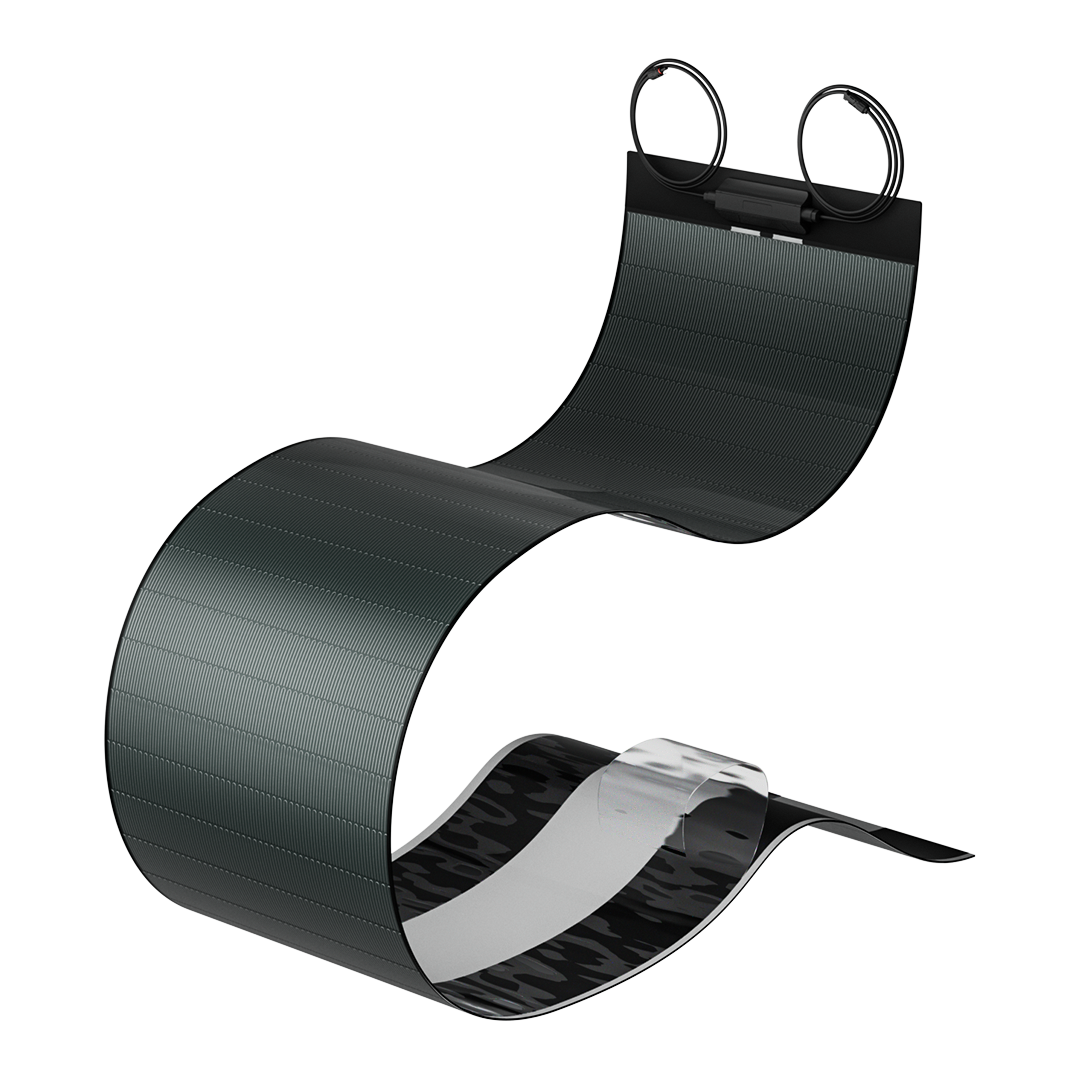
The BougeRV Yuma 100W CIGS Flexible Panel is a 100-watt cigs thin-film option best suited to narrow, curved roof sections. Just 3.75 lbs — wraps tight curves.
At a glance
- Best for
- Narrow, curved roof sections
- Power
- 100W CIGS Thin-Film, 3.75 lbs
- Roof fit
- Flexible / low-profile — suits manufactured-home roofs
- Price
- $287.49 — flat $25 US shipping, 30-day returns
Overview
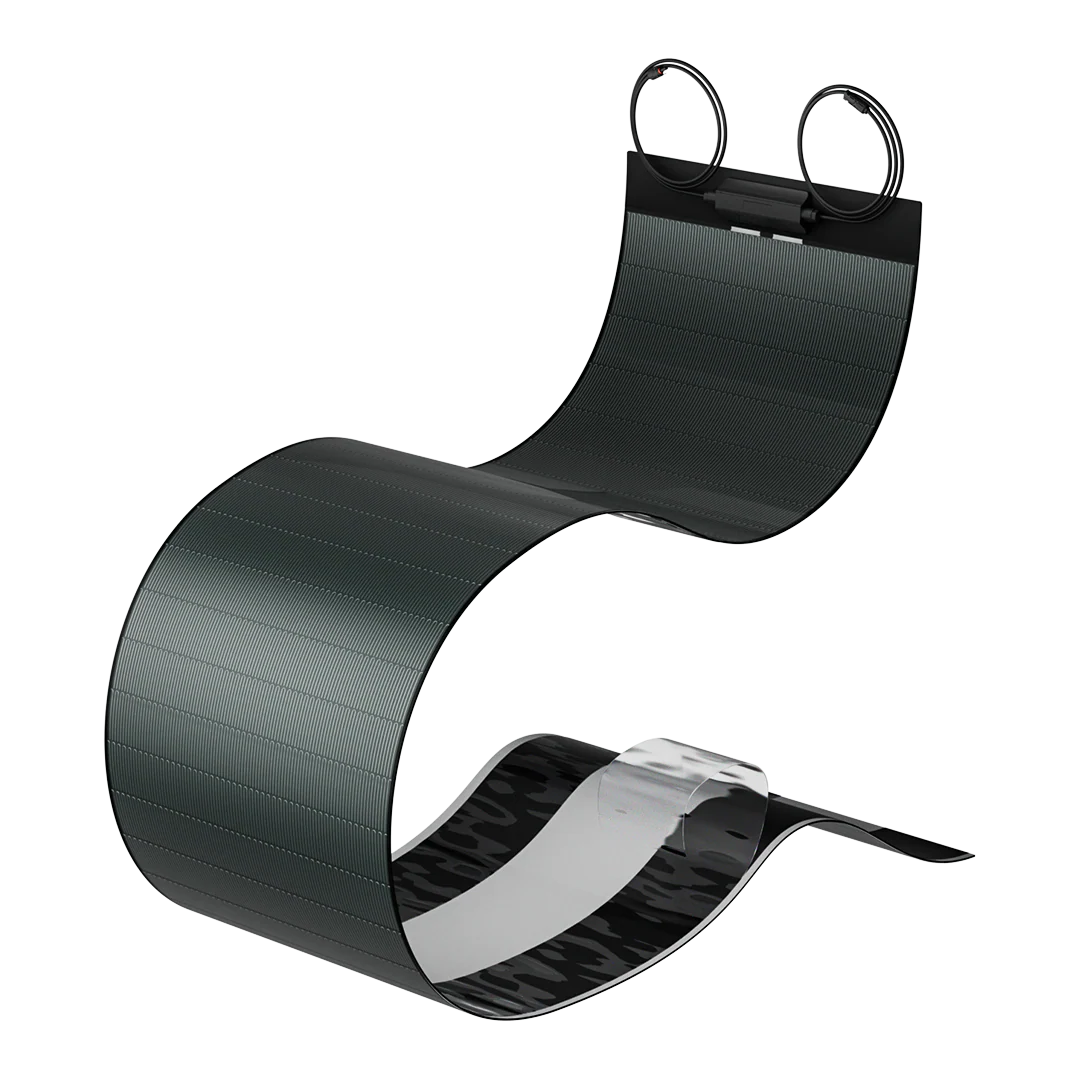
The BougeRV Yuma 100W CIGS is a thin-film flexible panel in a long, narrow format built for rooftops that can't take weight or drilling. CIGS (copper indium gallium selenide) cells sit on an ultra-thin, adhesive-backed sheet that bends to follow curved and uneven surfaces, so it goes onto an RV, van, or manufactured-home roof without a frame or brackets.
Compared with rigid crystalline panels, CIGS trades a little peak efficiency for real-world resilience: it holds output better in heat and partial shade, and its 12 bypass diodes keep a shaded corner from dragging the whole panel down. That matters on a mobile roof, where vents, antennas, and passing shade are unavoidable.
At 4.63 lbs and 0.06 in thick, it adds almost nothing to a roof's dead-load budget — the single biggest constraint on a HUD-code manufactured home. The adhesive backing means no penetrations to seal and no leak paths, and the long rectangular shape fits narrow roof channels a square panel can't.
Highlights
360° flexibility
The CIGS cell stack bends a full 360° and can even be rolled for storage or transport, conforming to curved roofs and irregular surfaces without cracking — the failure mode that ends most rigid and semi-flexible panels.
Ultra-light, ultra-thin
At 4.63 lbs and just 0.06 inches thick, the panel needs no aluminum frame or mounting rail. Less weight and a lower profile mean better aerodynamics on a moving vehicle and a cleaner look on a fixed roof.
Stronger in low light and shade
Multiple bypass diodes and CIGS's higher absorption coefficient reduce power loss under partial shading — BougeRV rates it for meaningfully more output than a comparable monocrystalline panel across an overcast day.
Drill-free adhesive install
A factory-applied adhesive backing bonds the panel directly to the roof. No brackets, no drilling, no penetrations to weatherproof — the safest mounting method for a thin manufactured-home or van roof.
Built to take a knock
The thin-film construction is impact-tolerant and keeps working even if a section is damaged, unlike glass panels that can fail outright from a single crack.
Features & real-world use
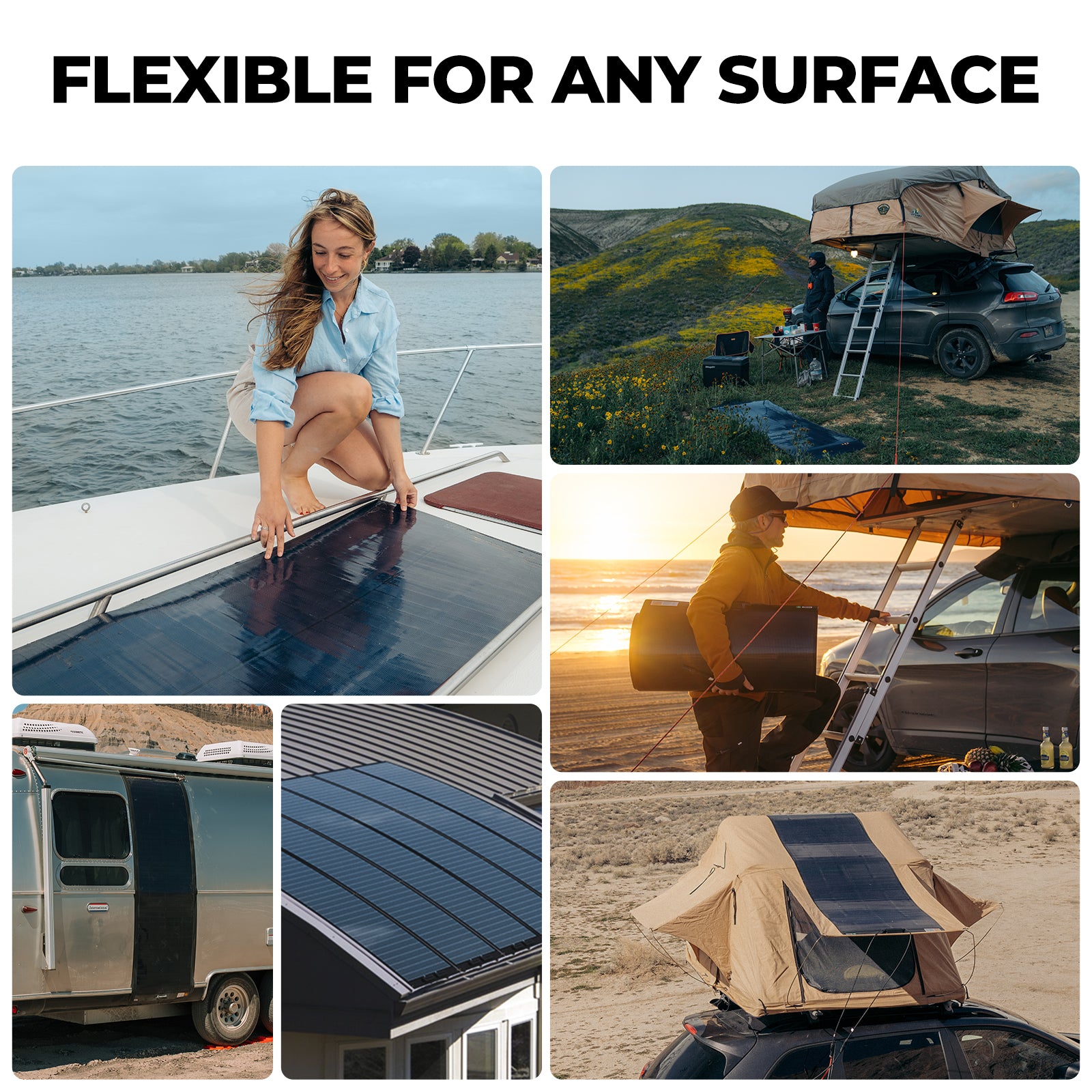
Fits any roof, deck, or vehicle
One panel covers a boat deck, an RV or Airstream roof, a rooftop tent, a camper van, or a manufactured-home roof — anywhere a rigid module can't follow the curve.
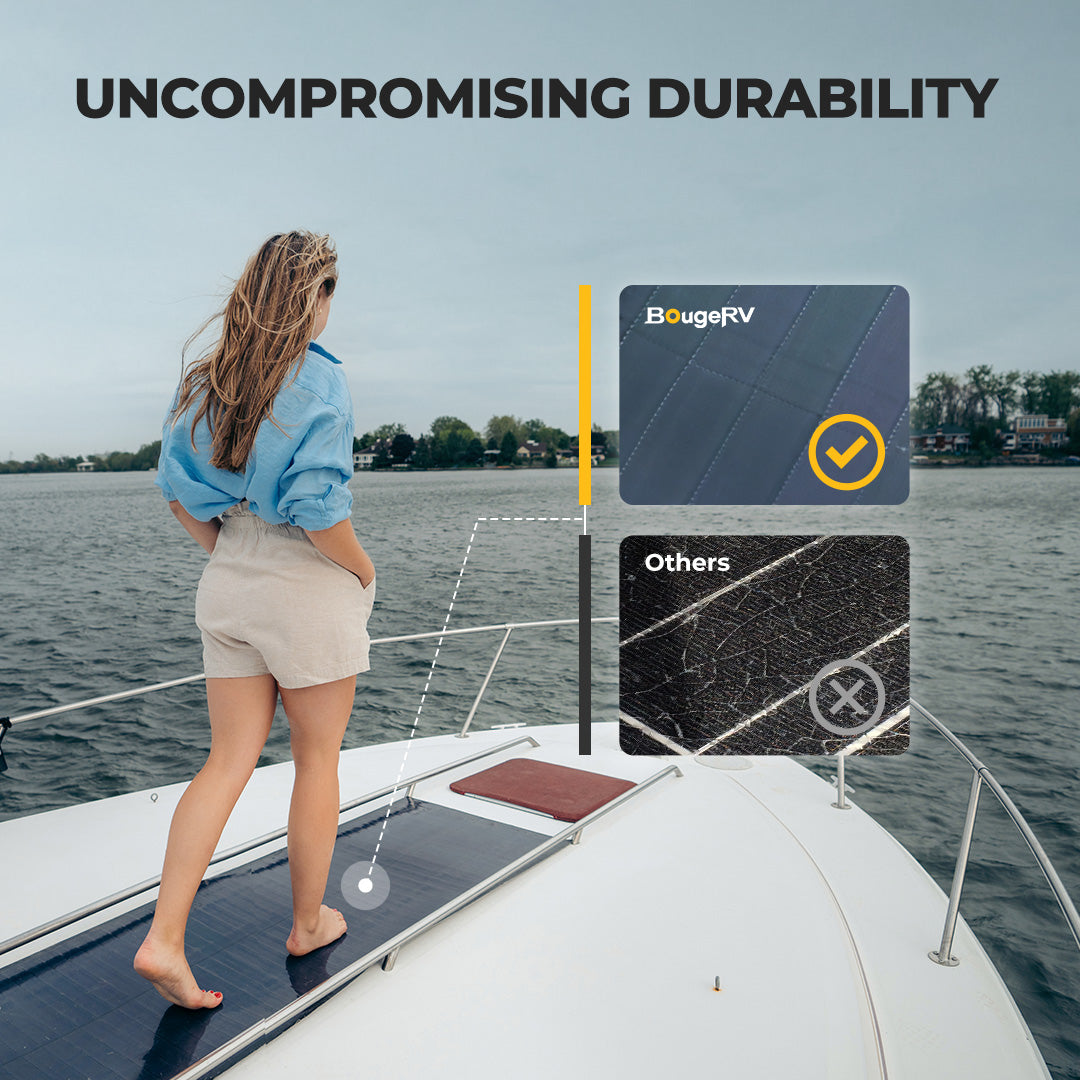
Walkable — it takes foot traffic
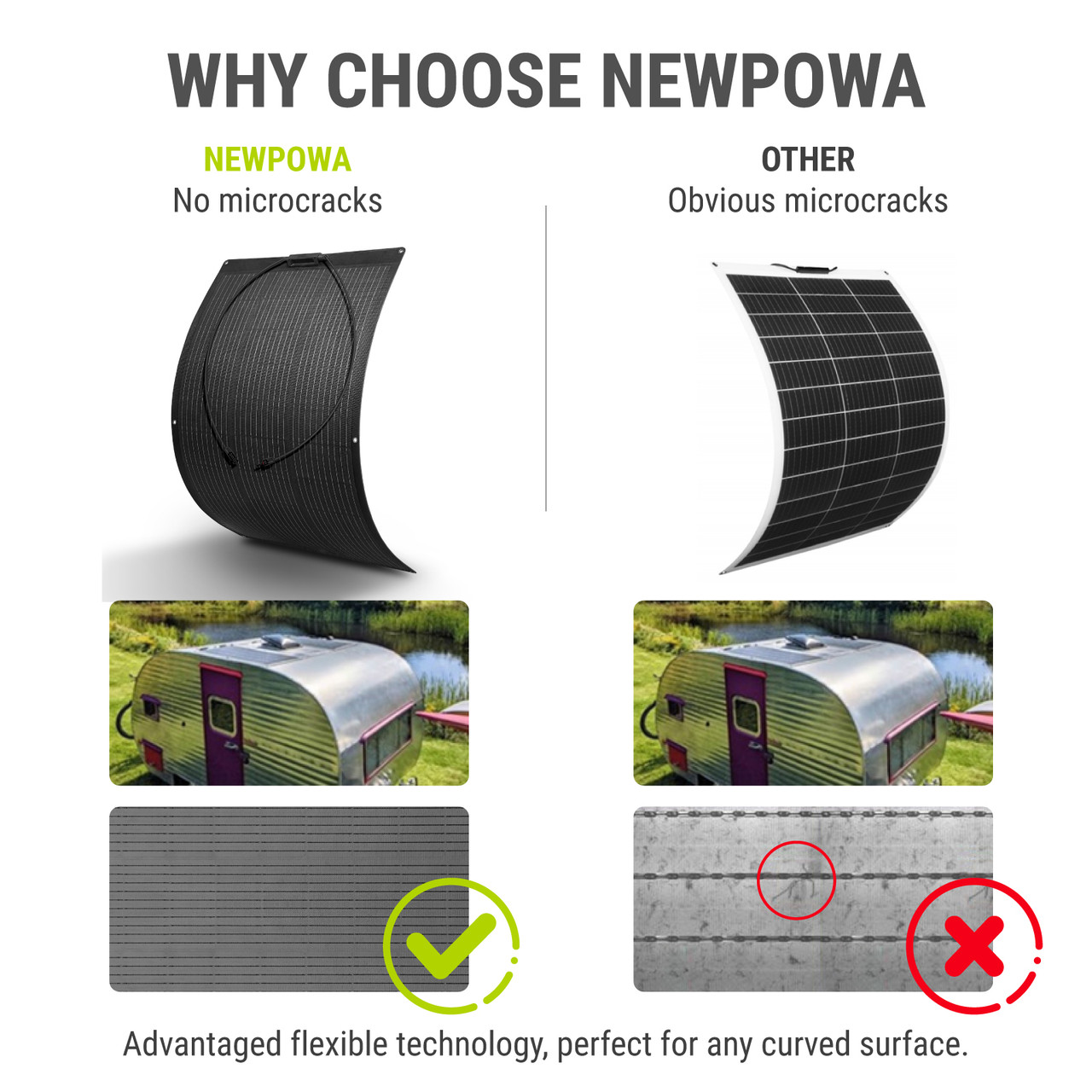
Step on it to wash a deck or reach a hatch. The CIGS cell stack flexes under your weight and springs back, where a rigid 'flexible' mono panel would spider-crack in the same spot.
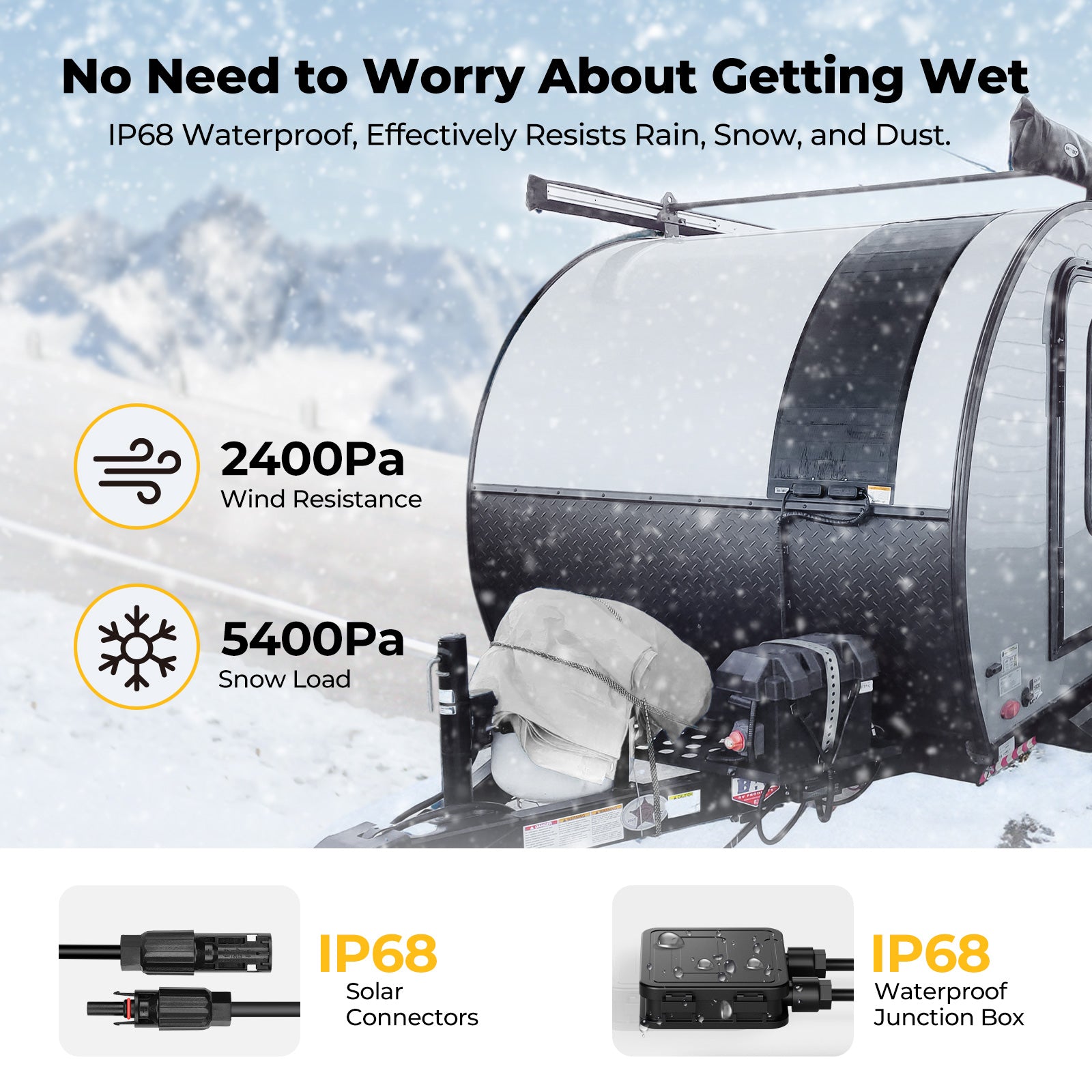
IP68 — no need to worry about getting wet
The panel, its connectors, and its junction box are all sealed to IP68 against rain, snow, and dust, and it's rated to 2400Pa wind and 5400Pa snow load — so a downpour or a winter on the roof doesn't faze it.
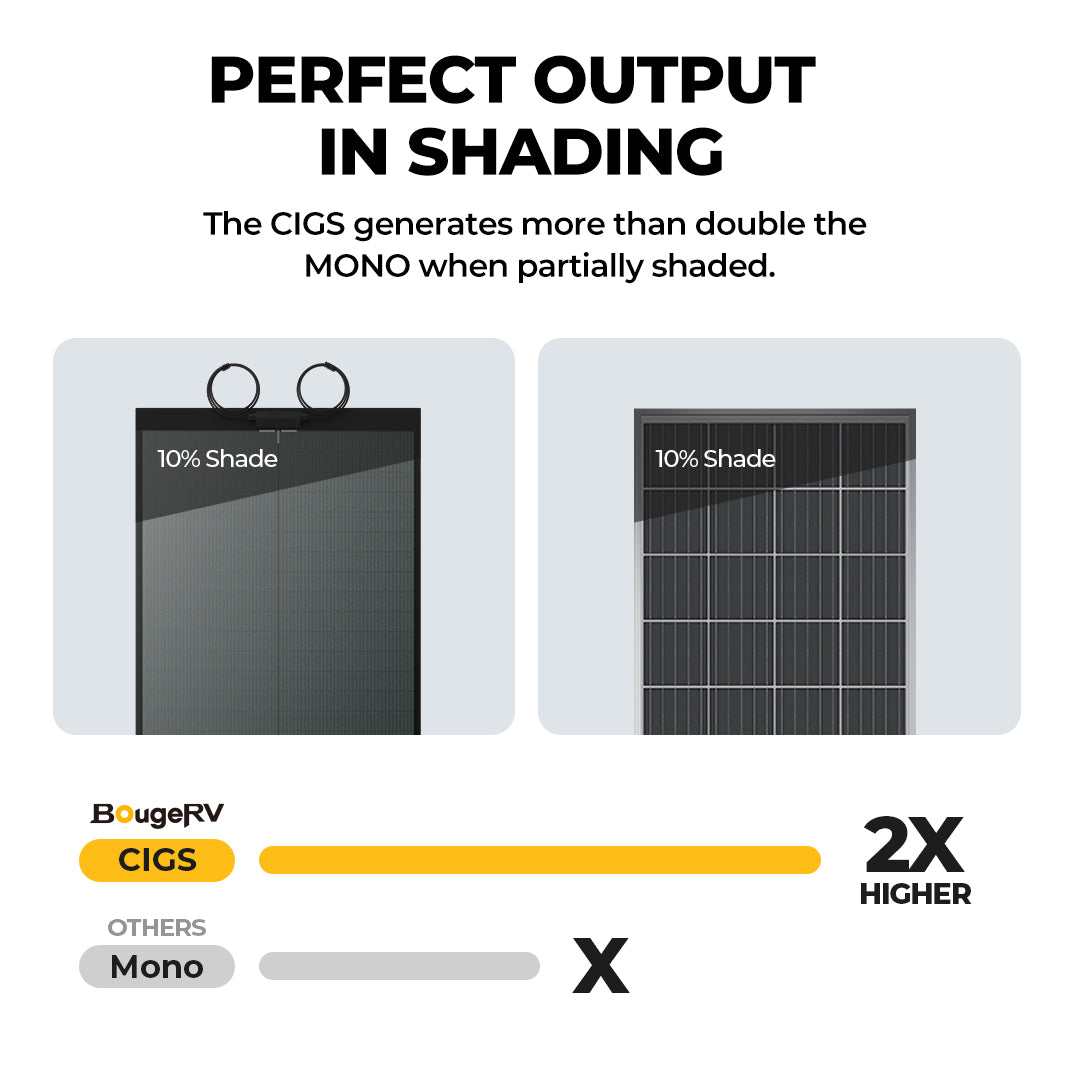
Roughly double the output in shade
With 12 bypass diodes and CIGS's shade tolerance, a lightly shaded panel keeps producing where a comparable monocrystalline panel collapses to a fraction of its rating.
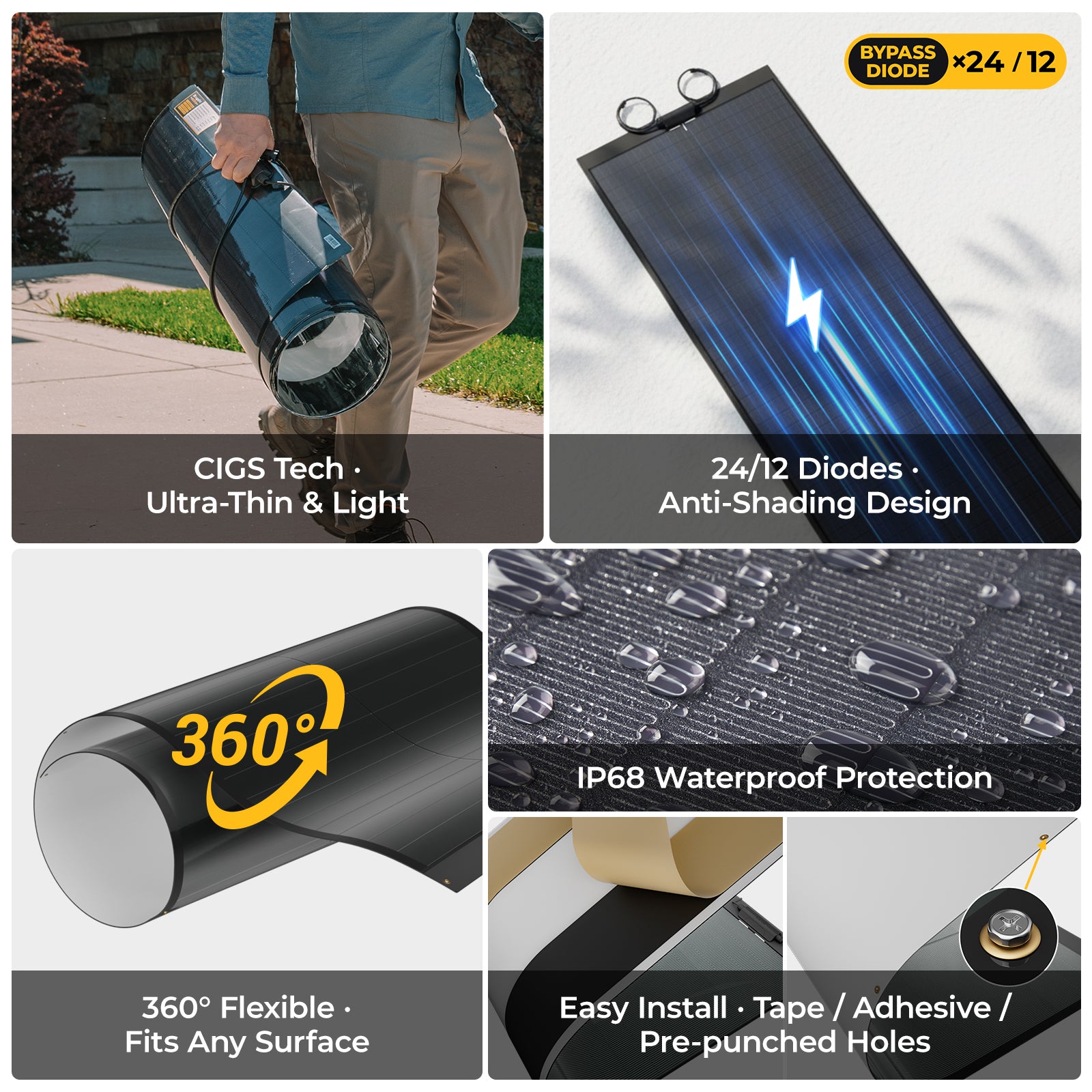
Everything that matters, at a glance
CIGS thin-film, 24/12 anti-shading diodes, 360° flex, IP68 sealing, and a drill-free tape or pre-punched-hole install — the whole design in one view.
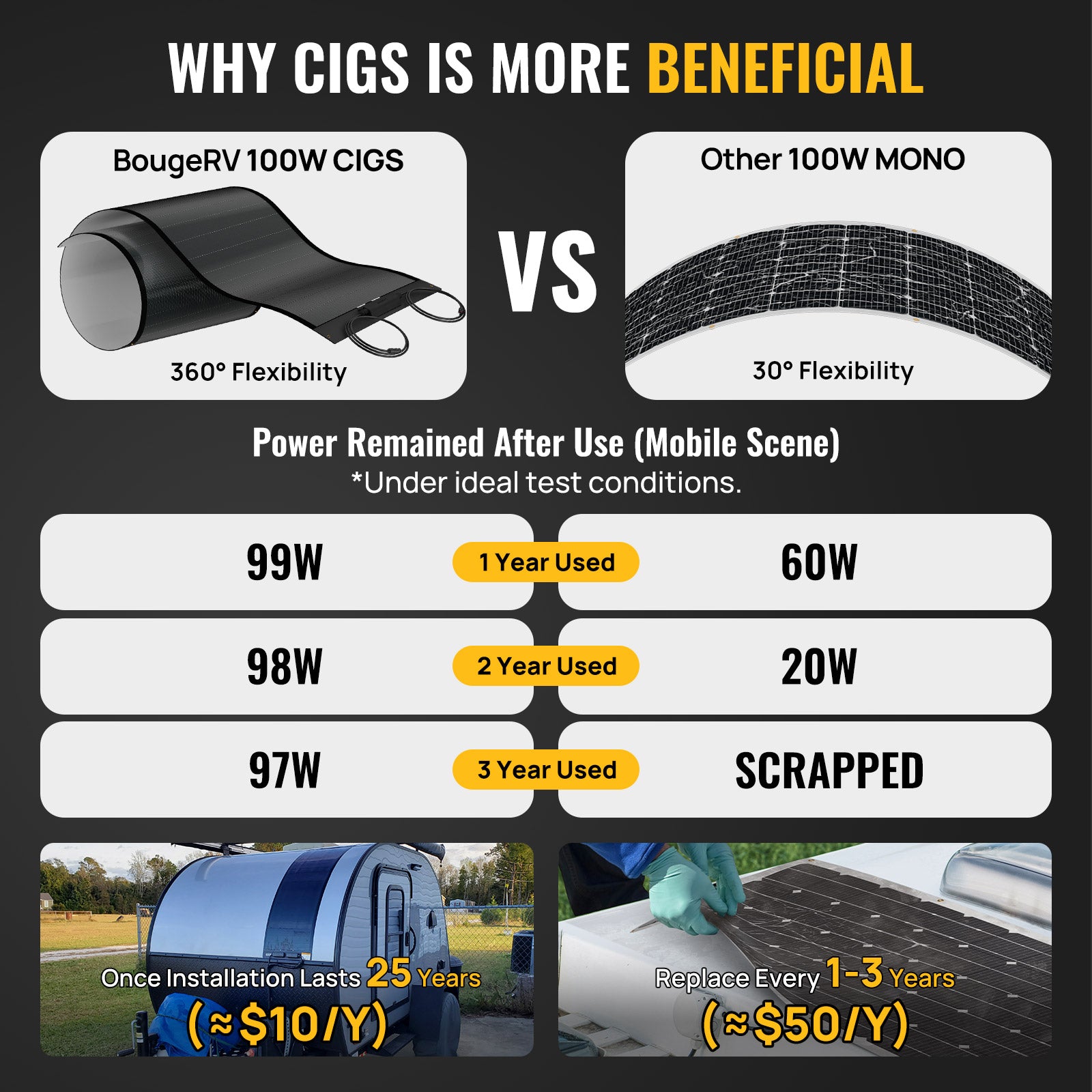
Built to outlast a mono panel
In BougeRV's mobile-use testing it held about 97 of its 100 watts after three years, where thin mono panels degrade hard or get scrapped in 1–3 years — closer to $10 a year than $50 over a 25-year life.
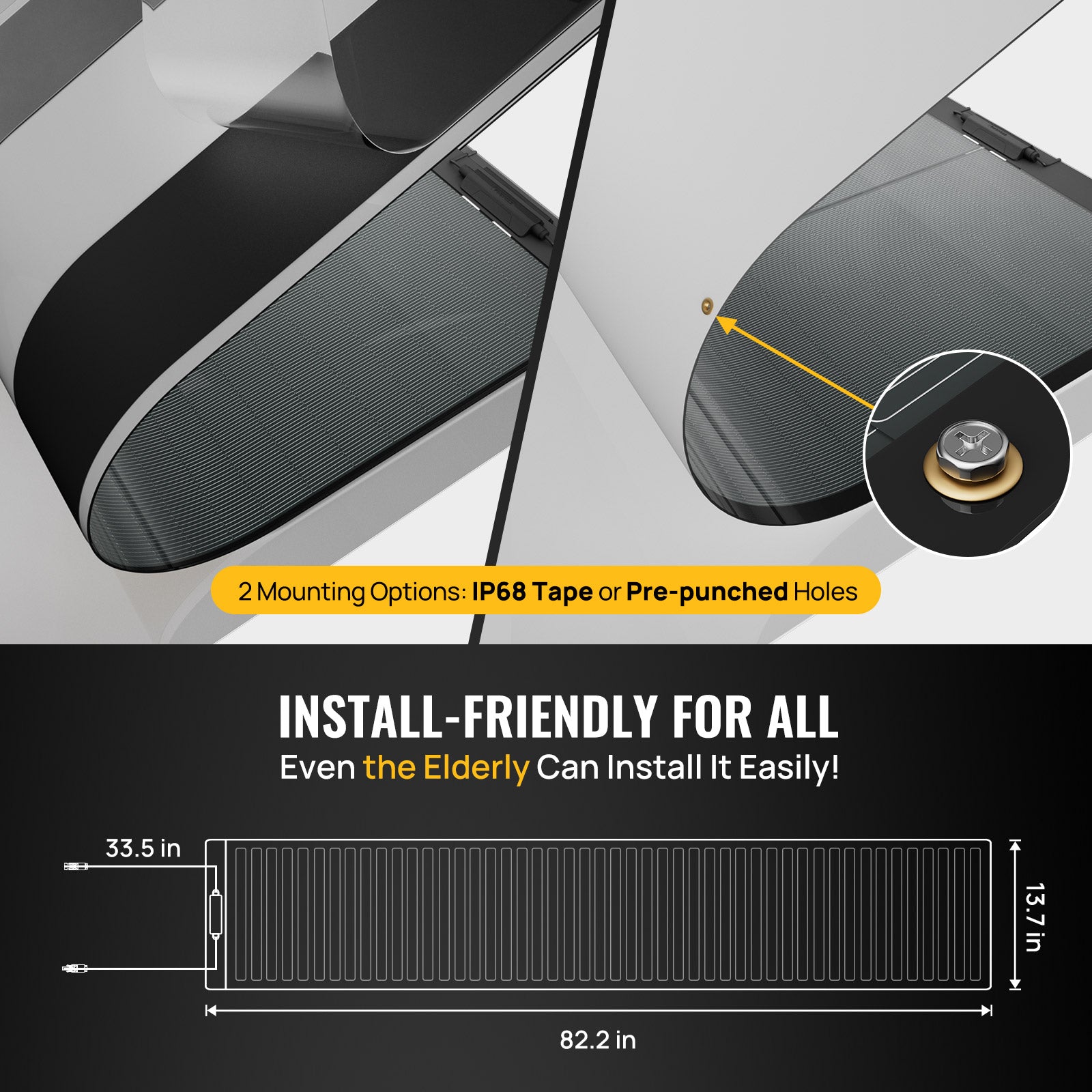
Install-friendly for everyone
Two mounting options — IP68 adhesive tape or pre-punched holes — on a long, narrow 82.2 × 13.7 in panel light enough for one person to place.
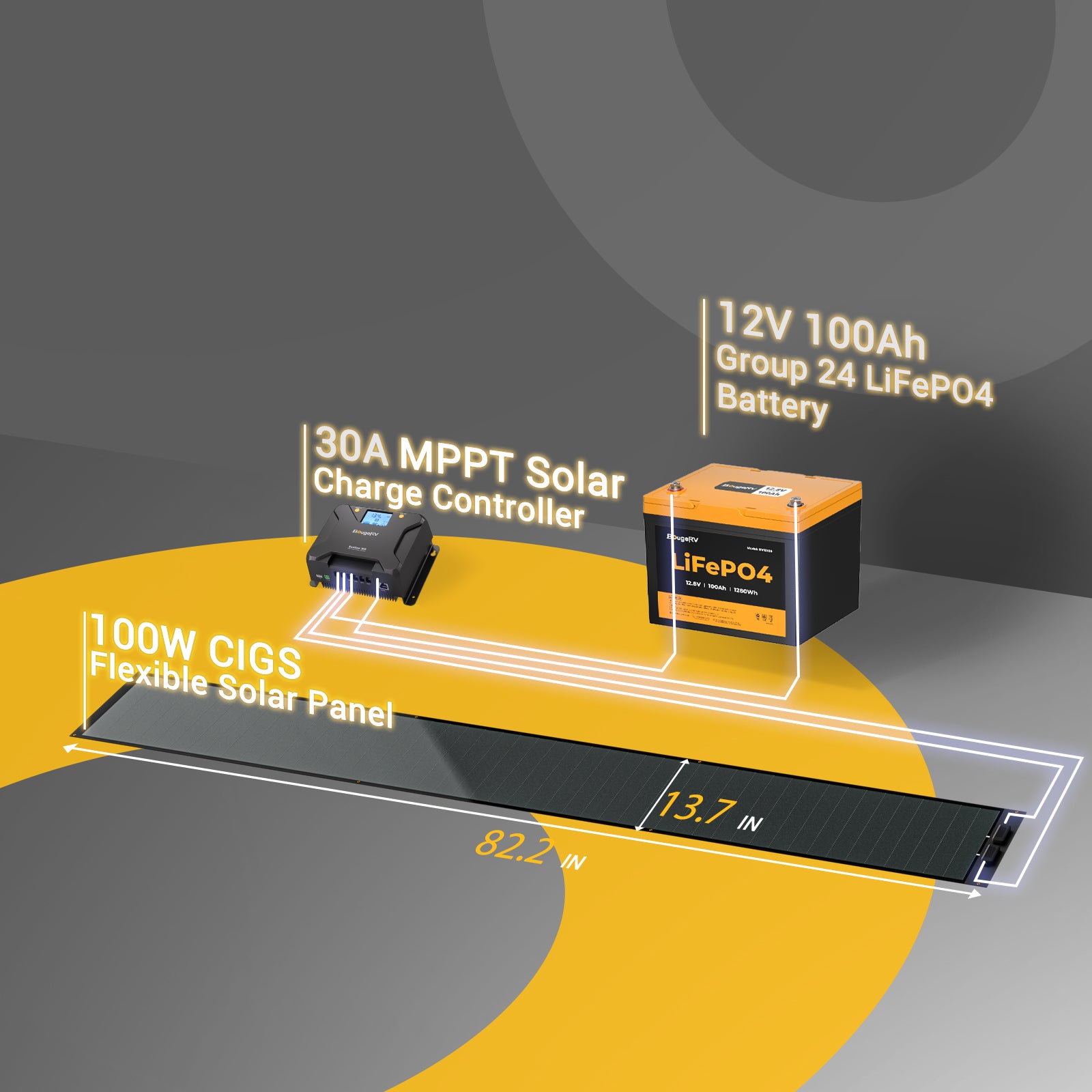
Drops into a simple 12V system
Pair it with a 30A MPPT charge controller and a 12V 100Ah LiFePO4 battery for a compact, self-contained off-grid setup.
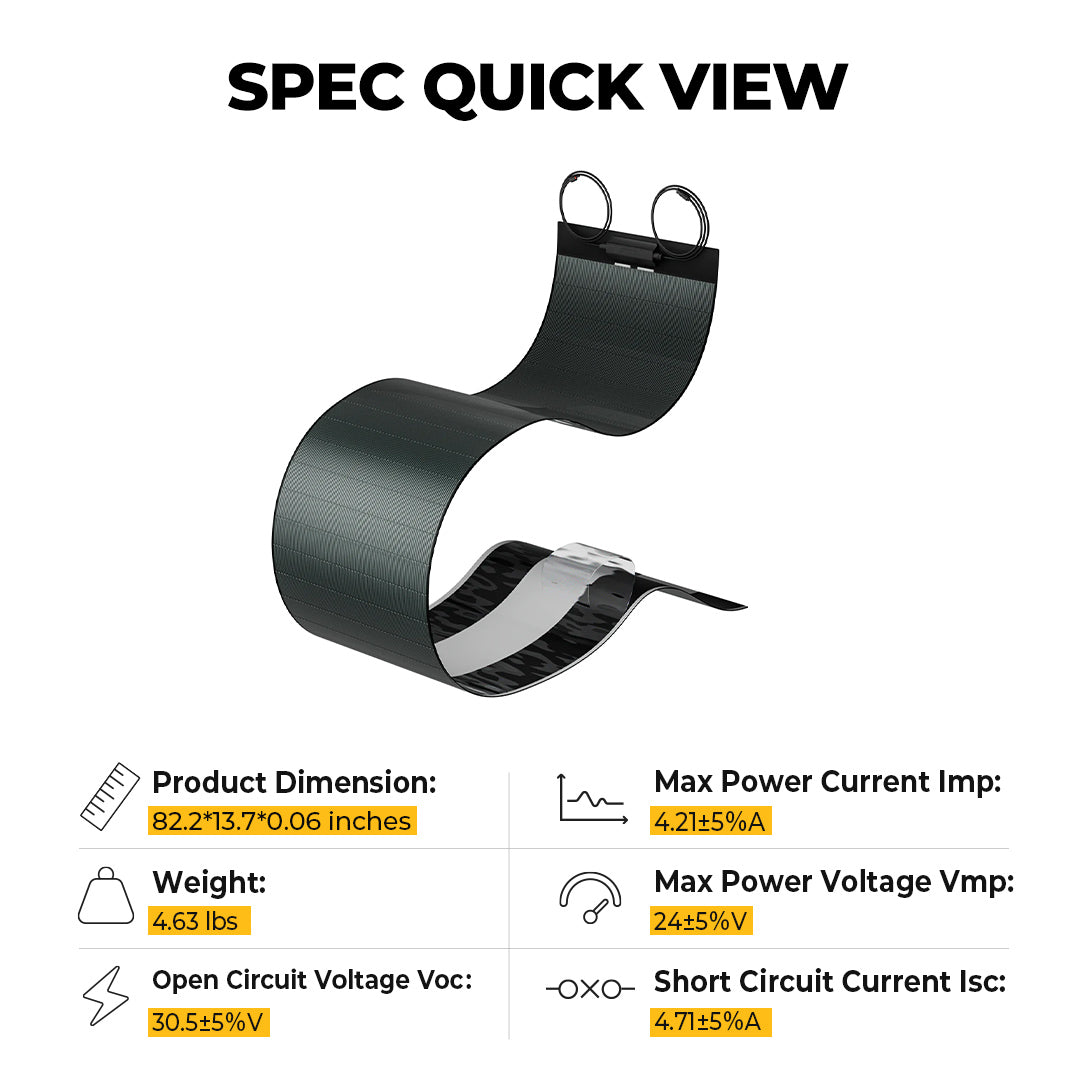
Spec quick view
The key electricals at a glance: 100W, 24V Vmp, 4.21A Imp, 30.5V Voc, and 4.71A Isc.
Built for any roof, deck, or vehicle
The same panel that solves a manufactured-home roof also fits almost anything else that moves or sits off-grid. Because it flexes 360° and bonds without brackets, it goes where a rigid module can't.
RV & trailer roofs
Bonds flush to fiberglass, aluminum, or rubber roofs and follows their crown — no rack, no roof penetrations to seal.
Camper vans & conversions
Low-profile and light enough for a high-top or pop-top van roof, with a narrow shape that slips between vents and fans.
Boats & marine decks
Sealed to IP68 and rated to be walked on, so it survives a wet, foot-traffic deck that would crack a glass panel.
Airstreams & curved rigs
The 360° flex lets it wrap the tight radius of a polished Airstream or teardrop where rigid modules simply won't sit.
Rooftop tents & overland
Sticks to a tent shell or hard case and shrugs off trail vibration, dust, and the odd branch strike.
Mobile & manufactured homes
Adds under 0.5 psf and bonds flat to a thin HUD-code roof deck — safe across South, Middle, and North load zones.
Cabins, sheds & tiny homes
A drill-free way to power an off-grid outbuilding without the weight and framing a rigid array would demand.
Specifications
| Brand | BougeRV |
|---|---|
| Category | Flexible & CIGS Panels |
| Power output | 100 W |
| Cell technology | CIGS Thin-Film |
| Efficiency | 16.0% |
| Weight | 3.75 lbs |
| Price | $229.99 |
| Best for | Narrow, curved roof sections |
| Max power (Pmax) | 100W ±5% |
| Cell efficiency | 17% |
| Max power voltage (Vmp) | 24V ±5% |
| Max power current (Imp) | 4.21A ±5% |
| Open-circuit voltage (Voc) | 30.5V ±5% |
| Short-circuit current (Isc) | 4.71A ±5% |
| Bypass diodes | 12 |
| Max system voltage | 1000V DC |
| Operating temperature | -40°F to +185°F |
| Temp coefficient (Pmax) | -0.38%/°C |
| Dimensions | 82.2 × 13.7 × 0.06 in |
| Weight | 4.63 lbs |
| Flexibility | 360° |
| Performance warranty | 25 years |
| Product warranty | 10 years |
| SKU | ISE137 |
Roof-load fit for manufactured homes
CIGS thin-film adds under 0.5 psf and bonds flat to the deck — no point loads, safe across all HUD roof-load zones (South, Middle, North).
Where this panel's efficiency lands among portable, flexible, and rigid options:
Pros & cons
👍 Pros
- Flexible CIGS thin-film — drill-free, zero point-load on the roof
- Very light at 3.75 lbs — minimal roof dead load
👎 Cons
- Lower peak efficiency than premium rigid mono — needs more area per watt
Is the BougeRV Yuma 100W CIGS Flexible Panel right for your mobile home?
Choose this panel if your priority is narrow, curved roof sections. Because it is a flexible, low-profile panel, it can usually go straight onto a manufactured roof without exceeding the 10–15 psf dead-load limit. For full sizing math, HUD roof-load zones, and permitting requirements, read our guide to the best solar panels for mobile homes.
Frequently asked questions
How is the panel attached to the roof?
It has a factory-applied adhesive backing, so it bonds directly to a clean, dry roof surface — no brackets, no drilling, and no holes to seal. That makes it well suited to thin manufactured-home and van roofs where penetrations risk leaks.
Will the adhesive hold at highway speeds?
The adhesive is designed for permanent mounting on RVs and vans. For sustained highway driving, BougeRV recommends ensuring the roof is thoroughly cleaned and prepped before bonding, and many installers add a bead of compatible sealant or edge trim at the leading edge for extra security against wind lift.
Can it really mount on a curved roof?
Yes. The CIGS panel flexes up to 360°, so it conforms to the curve of an RV or trailer roof and bonds flush along it with the adhesive backing. Rigid and even most semi-flexible panels can't follow that curvature without stress cracks.
What are the exact dimensions and weight?
This long version measures 82.2 × 13.7 × 0.06 inches and weighs 4.63 lbs. The narrow profile is meant to fit roof channels between vents and fixtures where a square panel won't.
How many can I connect together?
You can wire several in series or parallel up to your charge controller's input limits and the panel's 1000V DC maximum system voltage. In practice the controller's rated voltage and current, not the panel, set the ceiling — size the array to the controller you're using.
Is a 100W panel enough for a manufactured home?
A single 100W panel is best for maintaining a battery or running small 12V loads. For meaningful household backup you'd combine several panels or step up to a 200-400W kit — see our buyer's guide for sizing against your roof's load budget.
Reviews
No reviews yet. Bought this panel? Be the first to review it — your experience helps other mobile-home owners choose.